The primeval fire god of Chinese mythology described in the Shan Hai Jing: a divine sovereign with a beast body and human face who commands twin dragons across the southern skies.《山海经》记载的南方上古火神与炎帝辅弼之神,生有猛兽躯体与端严人面,脚踏驾御两条苍龙巡行天宇,司掌南夏火令与万物生发。
Body身形
Beast body, human face生有猛兽躯体人面
獸身人面
Mount坐骑
Rides two dragons乘着两条龙
乘兩龍
Realm方位
God of the south南方之神
南方祝融
Lineage世系
Grandson of Zhuanxu颛顼的孙子
老童生祝融
祝融
祝融降處於江水,生共工
Zhurong descended to dwell by the Jiang River, and begot Gonggong.
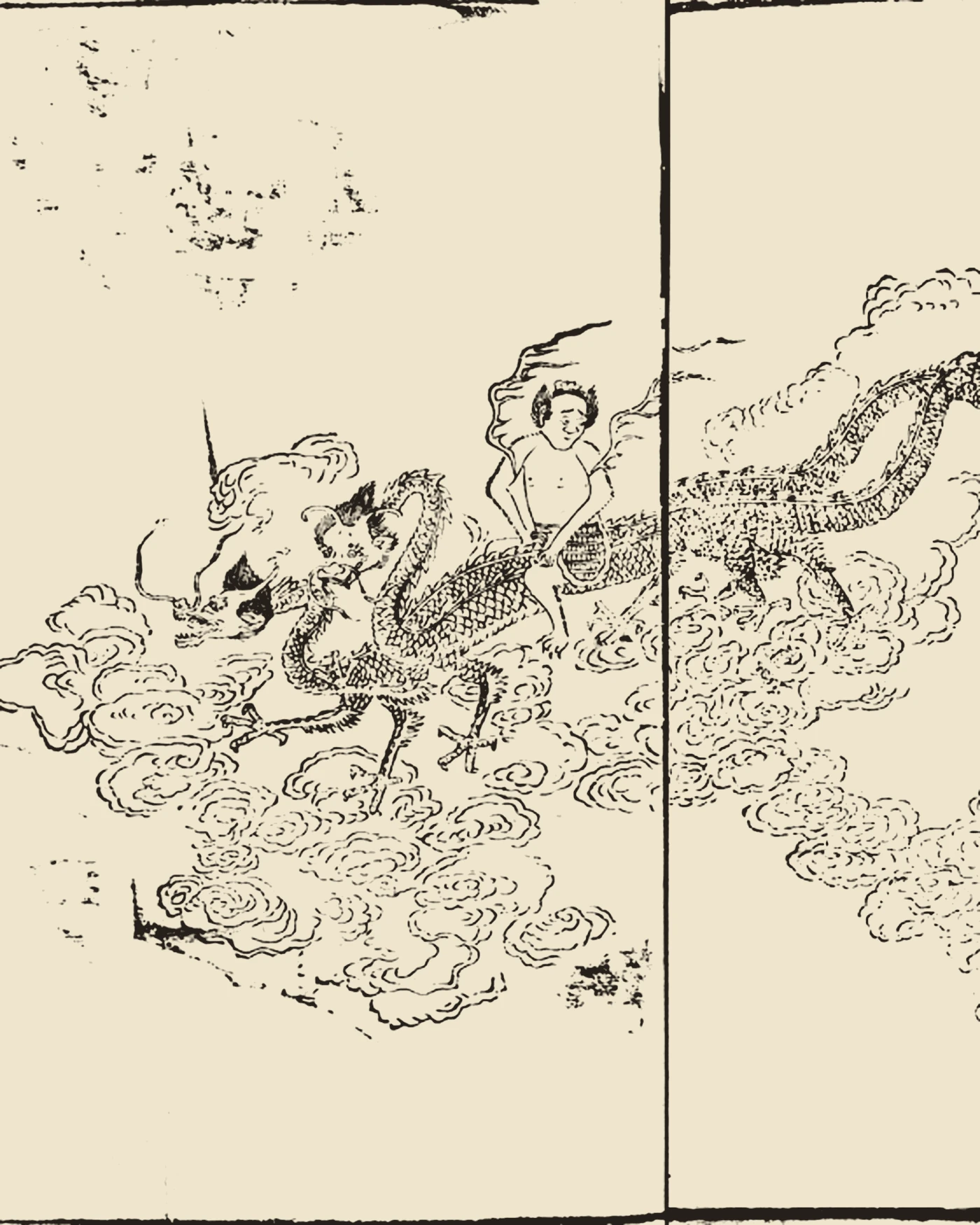
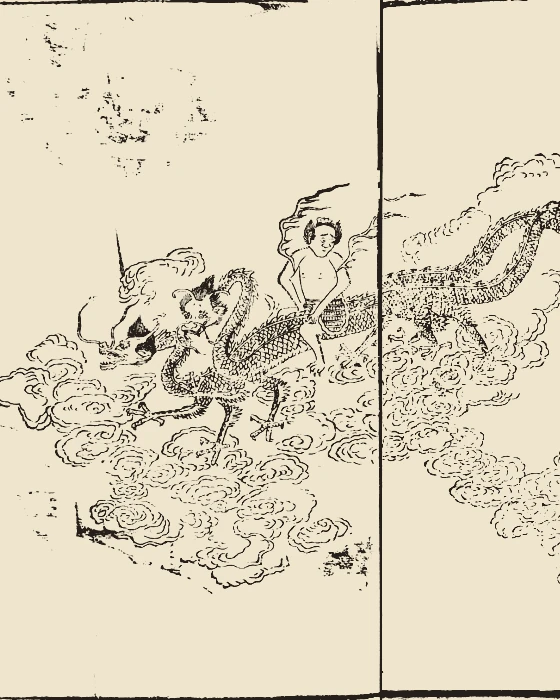
Another 17th-century woodblock print of Zhurong另一明清刻本《山海经》中的祝融图 — Robed scholar figure riding a dragon, unlike the main image's wild beast body祝融作宽袍博带文官乘龙之状,与主图威猛兽身神貌迥异
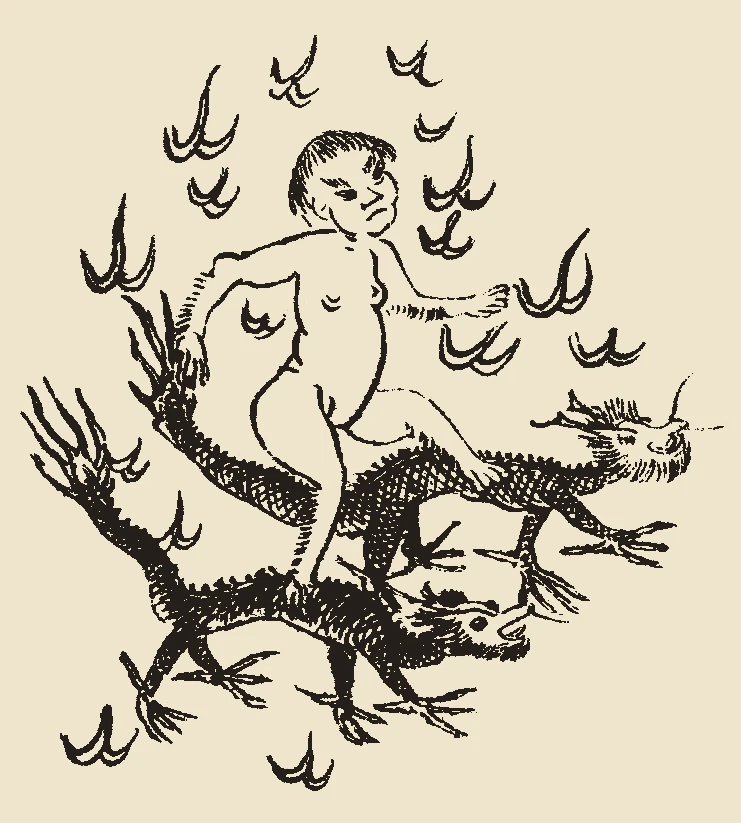
Woodblock print of Zhurong riding twin dragons from Jiang Yinghao's Classic of Mountains and Seas Illustrated (Shan Hai Jing Tu Hui), plate XLIII, 1597 (Wanli era, Ming dynasty)明万历二十五年(1597)蒋应镐绘《山海经图绘》第四十三幅“祝融”木刻版画 · Public domain公有领域Woodblock print of Zhurong riding a dragon from a 17th-century edition of the Shan Hai Jing十七世纪刻本《山海经》插图“祝融”乘龙木刻版画 · Anonymous (17th century)17世纪佚名画家, 17th century17世纪
Highlighted words: anatomy part · feature · form type — tap to jump标色词:形态部位 · 特征 · 形态类别,点击可跳转
Xiqi begot Zhurong; Zhurong descended to dwell by the Jiang River, and begot Gonggong.
Comparing the Books典籍对比
The Shan Hai Jing presents Zhurong in a dual light: as a primeval deity with a beast body and human face riding twin dragons, and as a pivotal ancestor in two contrasting genealogical traditions—one fathering the musician Changqin who composed the airs of Yao Mountain, and another fathering the destructive water god Gonggong.
The story来历与故事
The ancient fire deity and southern sovereign from the Shan Hai Jing: a formidable god with a beast body and human face who rides upon twin dragons, renowned for two contrasting lineages of music and water.
The Fire Sovereign Riding Twin Dragons南方火神:兽身人面与乘龙巡天
Recorded in the Overseas South, Zhurong has a beast body and a human face and rides two dragons.《山海经·海外南经》记载南方祝融兽身人面,乘两条龙。
In the Classic of Regions Beyond the South within the Shan Hai Jing, Zhurong is immortalized as the majestic sovereign of fire and the southern cardinal direction: 'Zhurong of the south has a beast body and a human face, and rides upon two dragons.' His striking zoomorphic form—merging the raw predatory power of a beast with the noble countenance of human wisdom—epitomizes the primordial divine beings of ancient Chinese cosmology.
In Ming dynasty woodblock engravings by Jiang Yinghao, Zhurong is depicted standing triumphantly upon the undulating bodies of two serpentine dragons amongst soaring clouds.
Woodblock print of Zhurong riding a dragon from a 17th-century edition of the Shan Hai Jing十七世纪刻本《山海经》插图“祝融”乘龙木刻版画
The Dual Genealogies of Yao Mountain and Jiangshui两部世系:太子长琴与水神共工
Ancient traditions trace two lineages: one fostering musical harmony, another fathering water strife.《山海经》记载其两支世系:一支传自颛顼并孕育乐神太子长琴,另一支则生下引发滔天水患的共工。
The Shan Hai Jing uniquely preserves two divergent genealogical traditions for Zhurong across different chapters. In the Classic of the Great Western Wilderness, he is celebrated as the grandson of Emperor Zhuanxu and father to Prince Changqin: 'Zhuanxu begot Laotong; Laotong begot Zhurong; Zhurong begot Prince Changqin, who dwelt upon Mount Yao and first composed musical airs.' Here, Zhurong is the fountainhead of sublime cultural invention and musical harmony.
Conversely, the Classic Within the Seas presents an alternative mythic descent: 'Xiqi begot Zhurong; Zhurong descended to dwell by the Jiang River, and begot Gonggong.' This lineage links the god of fire with Gonggong, the god of water. Rather than smoothing over these discrepancies, the text presents both living traditions.
Zhurong in Later Tradition后世的祝融
Later Chu tradition honoured Zhurong as an ancestor and as god of fire.后世楚国奉祝融为先祖,也把他当作火神。
Across thousands of years of Chinese history, Zhurong remained revered as the embodiment of beneficent heat, summer vitality, and martial valor. In the ancient Kingdom of Chu, royal lineages traced their divine descent from Zhurong, offering sacrifices at fire altars to safeguard their communities from pestilence and cold. His name became synonymous with blacksmithing, metallurgy, and righteous fire that purges deceit.
Record档案
Record Card档案卡
Type
Fire Deity (beast-bodied master of twin dragons)
Also known as
God of Fire; Flame Sovereign; Southern Thearch's Assistant; Lord of Summer
Earliest source
Shan Hai Jing 山海經 (Classic of Regions Beyond the South, Classic of the Great Western Wilderness & Classic Within the Seas, c. 4th–2nd c. BCE)
Mount
Rides upon two great dragons as his celestial steeds across the southern skies
Lineages
Grandson of Emperor Zhuanxu and father of the musician Changqin; or son of Xiqi who begot the water god Gonggong
Symbolism
God of the south, linked with fire; one lineage makes him father of the music-maker Prince Changqin
According to the Classic of Regions Beyond the South, Zhurong possesses the body of a beast, the face of a human, and rides upon two coiled dragons as his divine mounts.
Why does Zhurong ride two dragons?
The Shan Hai Jing does not say why. It records only that the god of the south rides two dragons; gods riding two dragons also appear elsewhere in the book.
How is Zhurong related to Gonggong and Prince Changqin?
The Shan Hai Jing records two distinct genealogies: in the Great Western Wilderness, Zhurong is the father of Prince Changqin (the inventor of music); in the Classic Within the Seas, he is the father of Gonggong (the water god).