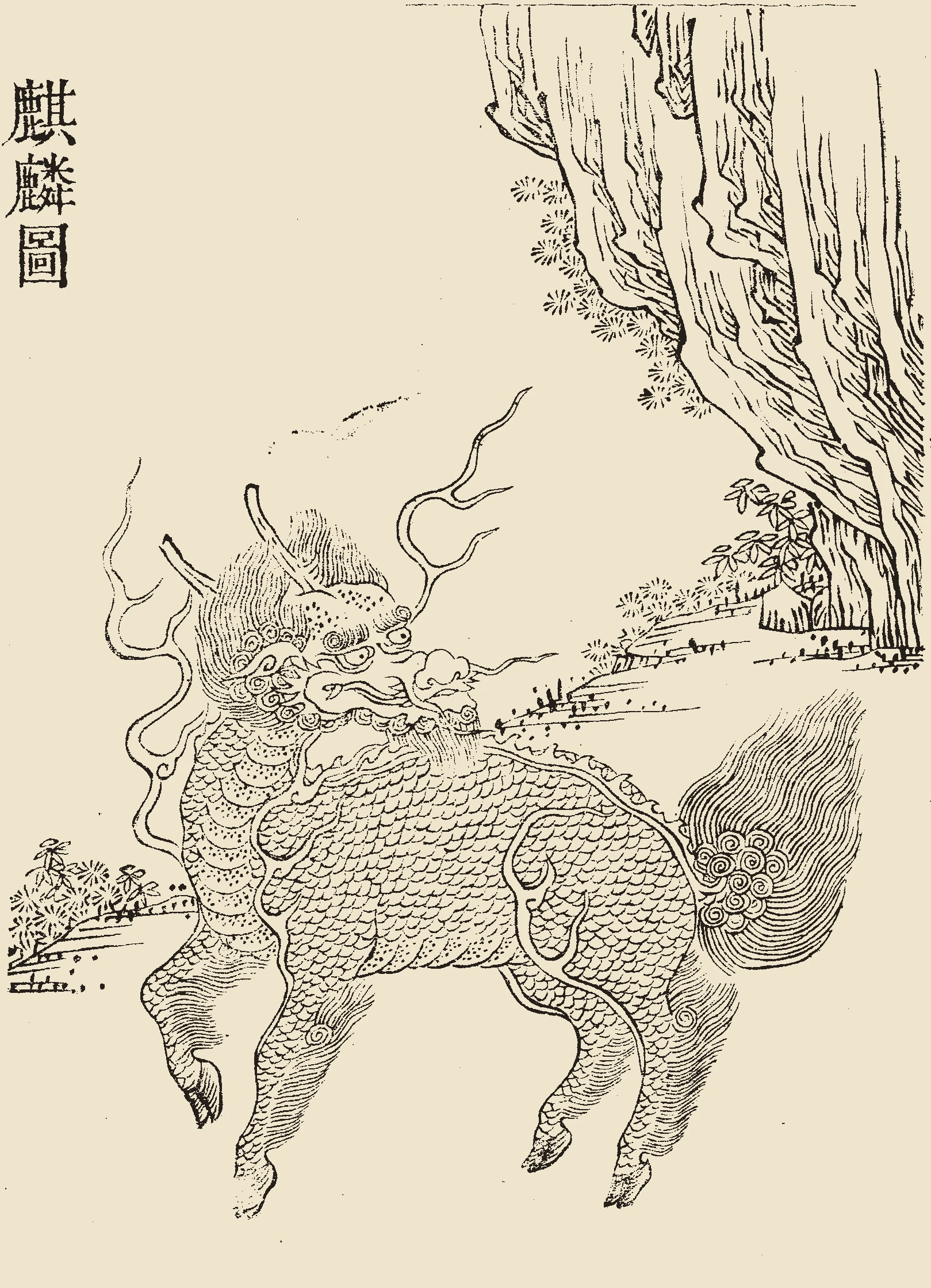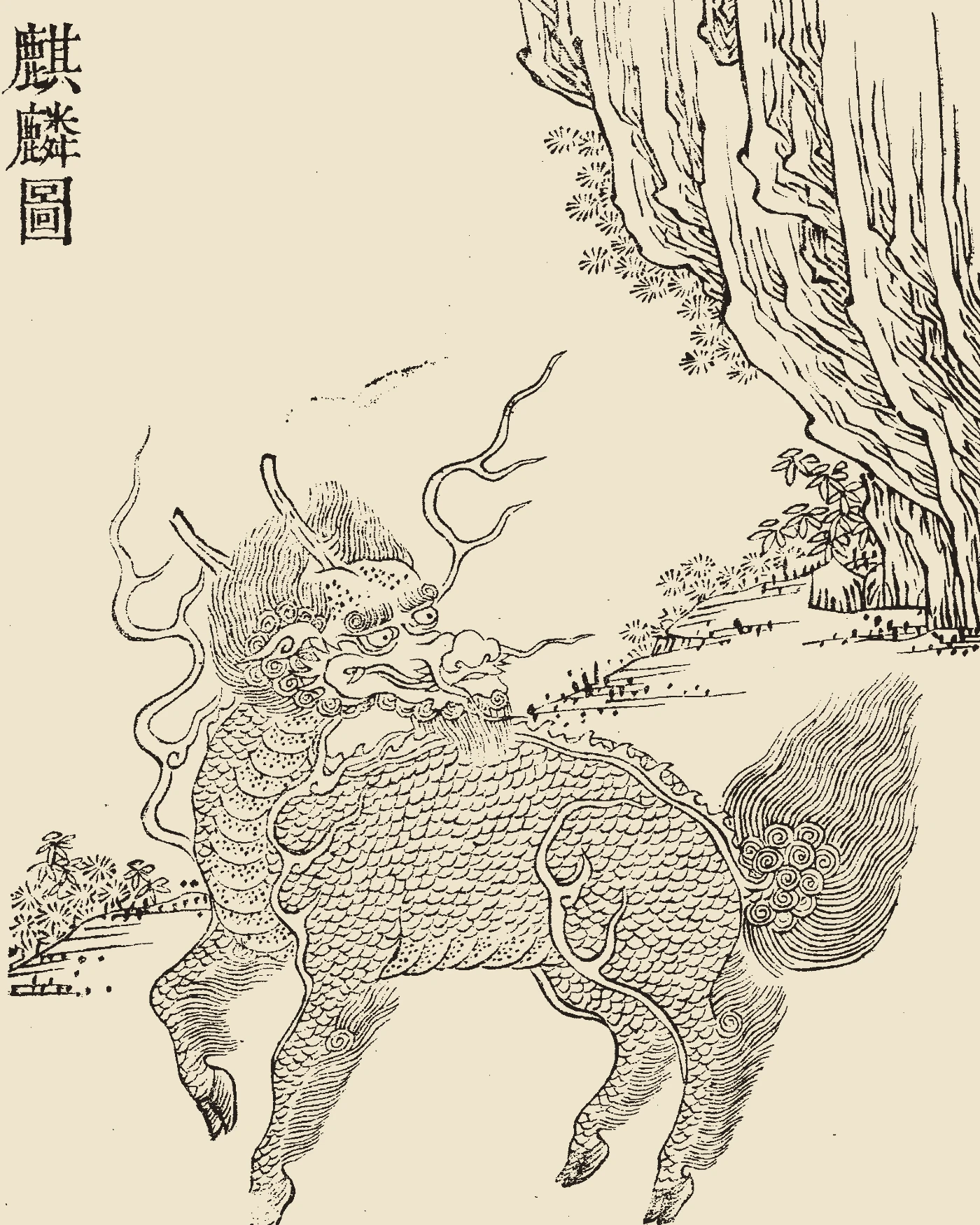
The benevolent sovereign of beasts with a scaled deer body, an ox tail, and a single flesh-tipped horn.身披五彩鳞甲、长有肉角牛尾,不伤生灵、见则天下太平的仁兽之长。
Body身形
Deer-like body, ox tail鹿一样的身子,牛尾
麕身,牛尾
Horn角
One horn, fleshy at the tip一只角,角端有肉
角頭有肉
Rank地位
Chief of all furred beasts众多毛兽之首
而麒麟爲之長
Omen祥瑞
Comes only under true kings有圣王才会出现
有王者則至
麒麟
Gujin Tushu Jicheng’s 1726 imperial woodblock print of the Qilin, illustrating the classical chimeric traits of the sovereign of hairy beasts.清代《古今图书集成》中的麒麟图,逐一呈现古籍所载毛虫之长的神异形貌。
麒,仁獸也。麋身牛尾,一角。
The Qi is a benevolent beast, with the body of an elk, the tail of an ox, and a single horn.
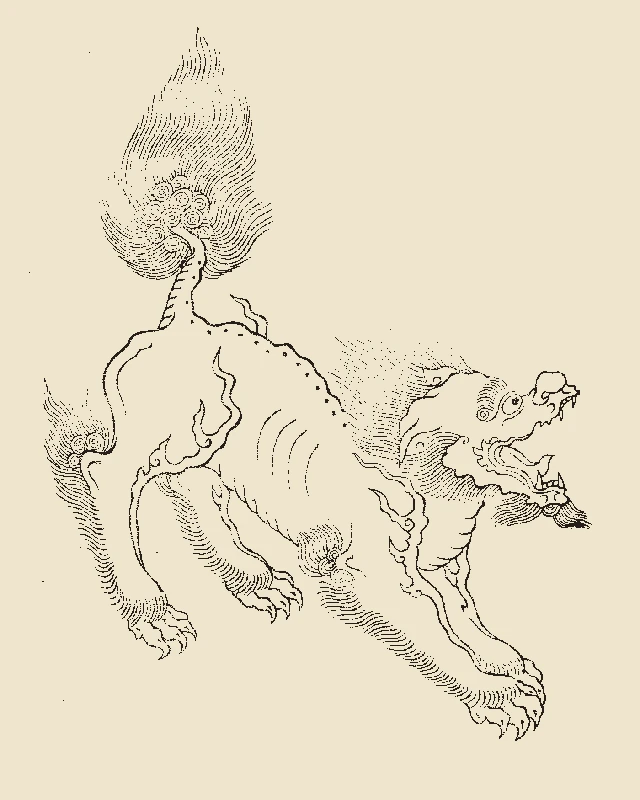
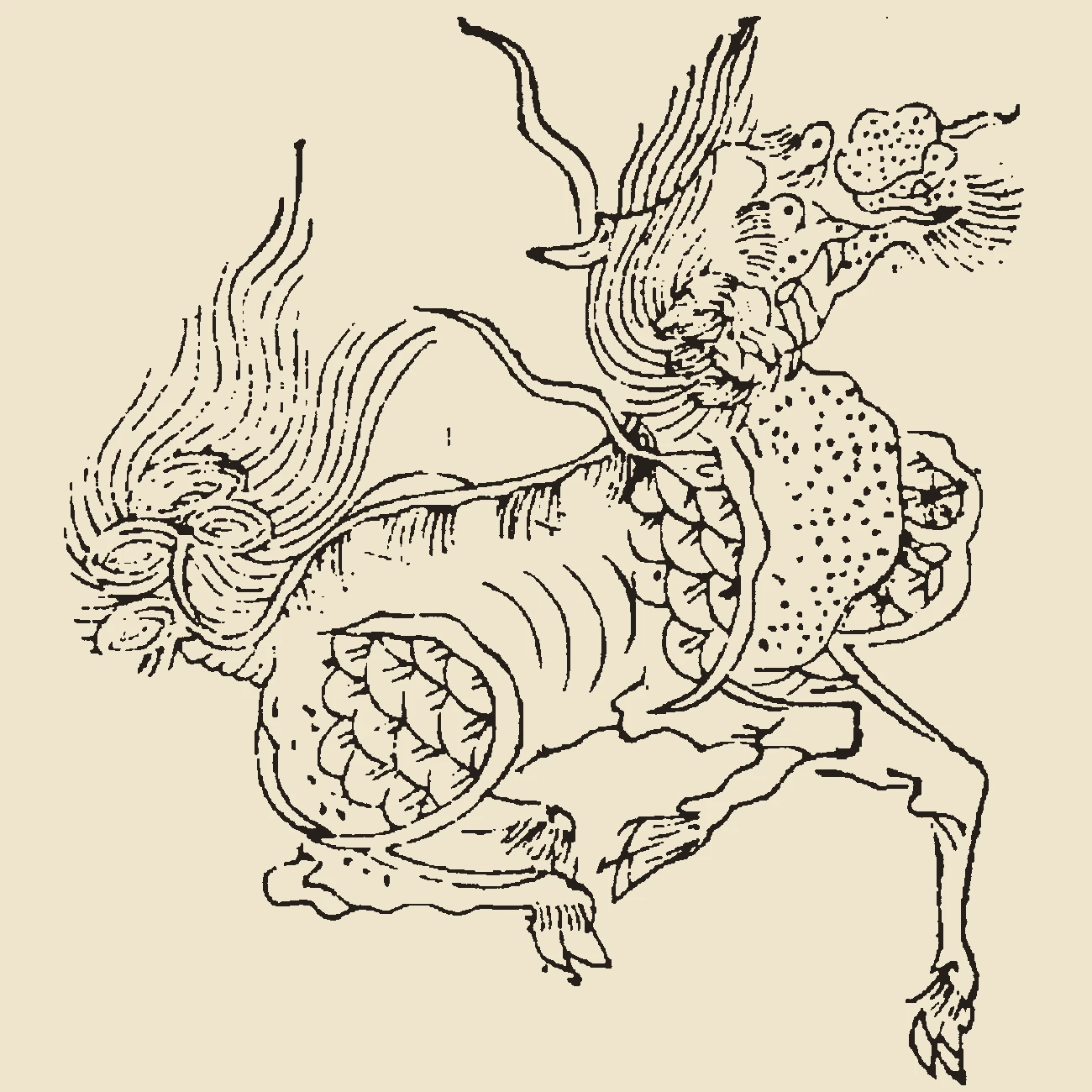
Leaping beast with spotted chest and shell-like plate armor回首上跃、斑纹胸甲与带壳鳞甲的异兽 — Head thrown back; spotted chest (麕文), bare ribs, scale plates only on shoulders and hips回首后仰;胸有斑纹,两肋露皮,只在肩胯有鳞甲
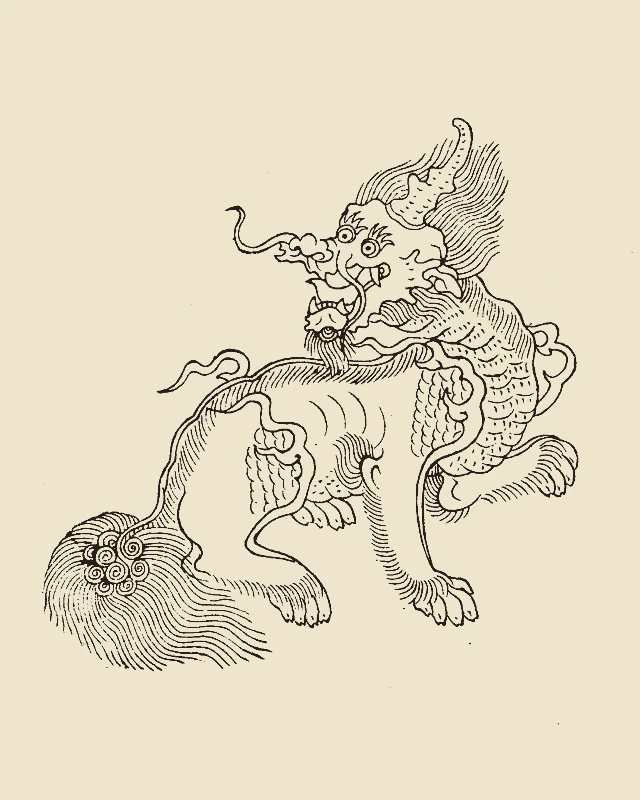
Galloping celestial steed beneath a pine tree松石下长鬃飞扬的疾驰天马形 — In full gallop like a celestial steed; mane fans back, long thin wavy horns如天马般四蹄腾空疾驰;长鬃后扬,双角细长卷曲
Living tribute giraffe identified as the Qilin榜葛剌使者进贡、奉为瑞应麒麟的非洲长颈鹿 — A real giraffe led by an attendant: long neck, net-patterned hide, short skin horns写实的长颈鹿,由番使牵引:长颈、网纹、短茸角
Qilin 麒麟, the benevolent sovereign of hairy beasts. Gujin Tushu Jicheng 古今圖書集成, Qin Chong Dian (Section on Birds and Animals), woodblock print, 1726清·陈梦雷等编《古今图书集成·禽虫典》“麒麟图”,雍正四年(1726)铜活字印本 · Public domain公有领域Lin 麟. Wang Qi and Wang Siyi, Sancai Tuhui 三才圖會 (Collected Illustrations of the Three Realms), Birds and Beasts juan 5, 1609明·王圻、王思义编《三才图会·鸟兽卷五》“麟”,万历三十七年(1609)刊本 · Wang Qi 王圻 & Wang Siyi 王思義 (ed.)王圻、王思义 编, 16091609年Qilin 麒麟. Yang Erzeng, Tuhui Zongyi 圖繪宗彝 (Principles of Painting), juan 7, 1607明·杨尔曾编《图绘宗彝·卷之七》“麒麟”,万历三十五年(1607)刊本 · Yang Erzeng 楊爾曾 (ed.)杨尔曾 编, 16071607年Tribute Giraffe as an Auspicious Qilin (Ruiying Qilin Tu 瑞應麒麟圖), with ode by Shen Du 沈度, Ming dynasty, 1414. National Palace Museum, Taipei明人画《瑞应麒麟图》(附沈度赞序),永乐十二年(1414),台北故宫博物院藏 · Shen Du 沈度 (calligraphy) / Ming court painter沈度(题字)/明代宫廷画家, 14141414年
Highlighted words: anatomy part · feature · form type — tap to jump标色词:形态部位 · 特征 · 形态类别,点击可跳转
In the spring of the fourteenth year, there was a western hunt in the Great Wilds. Chushang, charioteer of the Shusun clan, captured a Qilin. Believing it inauspicious, he gave it to the park-keeper. Confucius examined it and said: "It is a Qilin." Thereupon they took possession of it.
Qi: a benevolent beast. It has the body of an elk, the tail of an ox, and a single horn. Lin: a large female deer... Lin is also the female counterpart to Qi.
The Lin has the body of a muntjac, the tail of an ox, and a single horn. [Guo Pu's commentary: The tip of its horn has flesh. The Gongyang Zhuan says: It is like a muntjac with a horn.]
In the fourteenth year, in spring, a western hunt captured a Qilin. Why was this recorded? To record a wondrous anomaly... Why was the capture of the Qilin treated with such gravity? The Qilin is a benevolent beast: when a true sage reigns it arrives; when there is no sage it does not arrive. A messenger reported: "There is a creature like a muntjac with a horn." Confucius wept: "For whom has it come? For whom has it come?" He turned his sleeve to wipe his face, and his tears soaked his robes.
Thus sweet dew fell from heaven, springs of sweet wine gushed from the earth, the hills yielded ceremonial chariots, and marshes brought forth divine steeds. The Qilin, the Phoenix, the Sacred Turtle, and the Dragon were called the Four Spirits. When the Qilin was domesticated in the royal park, wild beasts were never panicked into flight.
Of the three hundred and sixty hairy animals, the Qilin is their sovereign... Thus if rulers delight in destroying nests and smashing eggs, the Phoenix does not soar; if they drain waters to seize fish, the Flood Dragon does not emerge; if they butcher the pregnant and slaughter the young, the Qilin will not come.
The hooves of the Lin! Gentle and virtuous are the duke’s sons! Oh, praise be to the Lin! The forehead of the Lin! Gentle and virtuous are the duke’s clansmen! Oh, praise be to the Lin! The horn of the Lin! Gentle and virtuous is the duke’s lineage! Oh, praise be to the Lin!
Comparing the Books典籍对比
The Classic of Poetry and Er Ya establish its gentle physical anatomy: a deer-like frame, bovine tail, and horn tipped with harmless flesh. The Spring and Autumn chronicles (Zuo Zhuan and Gongyang Zhuan) elevate it into the ultimate moral bellwether of history, whose capture out of season brought Confucius to tears.
The story来历与故事
The benevolent sovereign of beasts in ancient China: a chimera with the body of an elk or muntjac, an ox's tail, and a single horn tipped with harmless flesh. In classical lore, it walked without crushing living grass or insects, appearing only when wise kings brought peace under heaven.
The Sovereign of Beasts in Early Texts典籍中毛虫之长的神兽源起
Described with a deer-like body, bovine tail, single flesh-tipped horn, and innate benevolence.身如麋鹿、尾如牛、头生肉角,不伤草木虫蚁的仁德之兽。
From the earliest classical records, the Qilin was revered as the epitome of gentle virtue among animals. The ancient lexicon Er Ya describes it as possessing the body of a muntjac, the tail of an ox, and a single horn; Jin-dynasty commentator Guo Pu explicitly added that the tip of its horn was covered in flesh rather than a sharp point. This anatomical paradox—possessing martial strength while refusing to inflict harm—became the fundamental symbol of moral restraint and virtue in early Chinese thought.
In the ritual classic Da Dai Li Ji, ancient cosmologists classified all living creatures into five broad orders, crowning the Qilin as the sovereign of all three hundred and sixty hairy beasts (有毛之蟲三百六十,而麒麟爲之長), standing alongside the Phoenix, Dragon, and Turtle as the Four Spirits (四灵). Ancient texts noted that its stride observed proper rites: it walked in rhythm with the musical bells and pitch-pipes, never crushed living grass, never trampled living insects, and refused to eat flesh or travel in destructive herds.
Lin 麟. Wang Qi and Wang Siyi, Sancai Tuhui 三才圖會 (Collected Illustrations of the Three Realms), Birds and Beasts juan 5, 1609明·王圻、王思义编《三才图会·鸟兽卷五》“麟”,万历三十七年(1609)刊本
The Captured Qilin and Confucius's Tears春秋绝笔:西狩获麟与孔子之叹
Captured out of season in the Great Wilds, its demise prompted Confucius to lay down his brush.生不逢时被猎获于大野,孔子望之掩面而泣,以此绝笔作《春秋》。
The defining historical moment of the Qilin occurred in the spring of 481 BCE (the fourteenth year of Duke Ai of Lu), an event recorded in the Spring and Autumn Annals (Chunqiu) as 'the Western Hunt captured a Qilin' (西狩獲麟). According to the Zuo Zhuan, Chushang, the charioteer of the aristocratic Shusun clan, captured an unfamiliar beast during a seasonal hunt in the Great Wilds. Fearing its bizarre appearance was an omen of disaster, the hunters gave the wounded creature away to a humble park-keeper before Confucius came to examine it.
The Gongyang Zhuan records that when Confucius gazed upon the injured beast, he was overcome with grief. The sage knew that the Qilin was a sacred omen that appeared only to accompany true sage-kings; emerging in an age of chaotic warlords and moral collapse, it had come at the wrong time and met a violent end. Confucius turned his sleeve to wipe his face, wept until his robes were soaked, and lamented: 'For whom has it come? My way has reached its end!' Deeply shaken by the tragedy, Confucius ceased editing the Spring and Autumn Annals, making the capture of the Qilin the final sentence of his historical chronicle.
麒:仁獸也。麋身牛尾,一角。从鹿,其聲。麟:大牝鹿也。从鹿,粦聲。麐:牝麒也。
Qi: a benevolent beast. It has the body of an elk, the tail of an ox, and a single horn. Lin: a large female deer... Lin is also the female counterpart to Qi.
— 說文解字·鹿部 · Shuowen Jiezi
The Ming Giraffes and the Imperial Omen明代榜葛剌贡兽与瑞应麒麟
Zheng He’s voyages brought African giraffes to Nanjing, hailed by the Ming court as the living Qilin.郑和下西洋带回的长颈鹿被永乐帝奉为瑞应麒麟,并深远影响东亚对长颈鹿的称谓。
In 1414 (the twelfth year of the Yongle era), the maritime expeditions commanded by Admiral Zheng He brought about one of the most remarkable encounters in world history. A diplomatic embassy from the Sultanate of Bengal arrived in the Ming capital of Nanjing to present a rare tribute animal acquired from East Africa: a living giraffe. When court ministers and scholars beheld its gentle nature, towering stature, cloven hooves, and skin-covered horns, they immediately proclaimed that the legendary Qilin had finally arrived to endorse Emperor Yongle’s reign.
The court calligrapher Shen Du composed a celebratory ode, which was transcribed alongside imperial paintings depicting the African giraffe tethered by a foreign attendant under the title 'Auspicious Qilin' (Ruiying Qilin Tu 瑞應麒麟圖). This historic episode left an indelible linguistic legacy across East Asia: in modern Japanese, 'kirin' (キリン) remains the standard word for giraffe, as does 'girin' (기린) in modern Korean, forever fusing the mythical chimera with the real African animal.
From Sage Omen to Folk Fertility and Modern Culture从天子祥瑞到民间风俗与当代生机
The imperial omen evolved into folk fertility symbols, lively street dances, and modern fantasy.从庙堂瑞兽演变为民间“麒麟送子”、节庆麒麟舞,并在世界流行文化中延续生机。
As imperial dynasties waned, the lofty political symbol of the Qilin transformed into beloved grassroots folklore. The most widespread belief was 'Qilin Bringing Sons' (麒麟送子), depicted in countless New Year woodblock prints showing the benevolent creature carrying an extraordinary child destined for greatness—a folk memory of the legend that a Qilin appeared before the birth of Confucius. In southern China, particularly Guangdong and Hong Kong, lively Hakka Qilin dances continue to celebrate weddings, temple fairs, and festivals with colorful woven beast-heads.
In modern global popular culture, the Qilin remains an enduring icon of benevolent power and discerning wisdom. Japan's prominent beverage company, Kirin Brewery, adopted the classical Chinese chimera as its iconic corporate trademark. In fantasy literature and cinema—from the mythical beasts of the Twelve Kingdoms to the magical creature in Fantastic Beasts: The Secrets of Dumbledore, where a Qilin bows only before those who are pure of heart—the sovereign of beasts continues to represent the universal human ideal of incorruptible goodness.
Record档案
Record Card档案卡
Type
Auspicious Beast (sovereign of hairy animals)
Also known as
Lin 麟 (female); Qi 麒 (male); Kirin (Japanese); Girin (Korean); Sovereign of Beasts 毛蟲之長; One of the Four Spirits 四靈
Earliest source
Shi Jing 詩經 (Classic of Poetry), Chunqiu 春秋 & Zuo Zhuan (Duke Ai, Year 14), Er Ya 爾雅
Nature
Supreme benevolence (仁獸); does not harm living things, tread on living grass or insects; appears during wise governance
Symbolism
Pinnacle of auspicious omens; sovereign of all 360 hairy animals; moral integrity, sage rule, and flourishing progeny
The Qilin is a revered mythical chimera in ancient Chinese lore, celebrated as the benevolent sovereign of all hairy beasts and one of the Four Spirits alongside the Dragon, Phoenix, and Turtle. Classical texts describe it with an elk or muntjac body, an ox's tail, cloven hooves, scales, and a single horn tipped with harmless flesh. It is celebrated as the ultimate symbol of wise governance, peace, and moral virtue.
Is a Qilin male and female?
Yes. In classical terminology, 'Qi' (麒) specifically denotes the male and 'Lin' (麟) denotes the female, mirroring the male-female pair of Feng and Huang in the Chinese Phoenix. Over the centuries, the two characters merged into the compound 'Qilin' as a general name for the species.
Why did ancient Chinese people call giraffes 'Qilin'?
In 1414, diplomatic embassies returning from Admiral Zheng He’s voyages presented an African giraffe to the Ming court. Emperor Yongle and his scholars noted that the giraffe's gentle demeanor, cloven hooves, and skin-covered horns matched ancient accounts of the Qilin. The court declared it a living omen of sage rule, and court painter Shen Du immortalized it in the painting 'Auspicious Qilin'. This historic identification is why the Japanese and Korean languages still use the word 'Qilin' (Kirin / Girin) for giraffe today.
Why is the Qilin called a 'benevolent beast' (仁兽)?
Ancient texts designate the Qilin as a 'benevolent beast' (仁兽) because its entire anatomy and behavior embody nonviolence and compassion. Its single horn is tipped with soft flesh ('possessing weapons but refusing to harm'), its cloven hooves avoid crushing living grass or tiny insects, and it refuses to eat living creatures. Furthermore, classical legend holds that it emerges only during the reign of an enlightened, compassionate ruler.