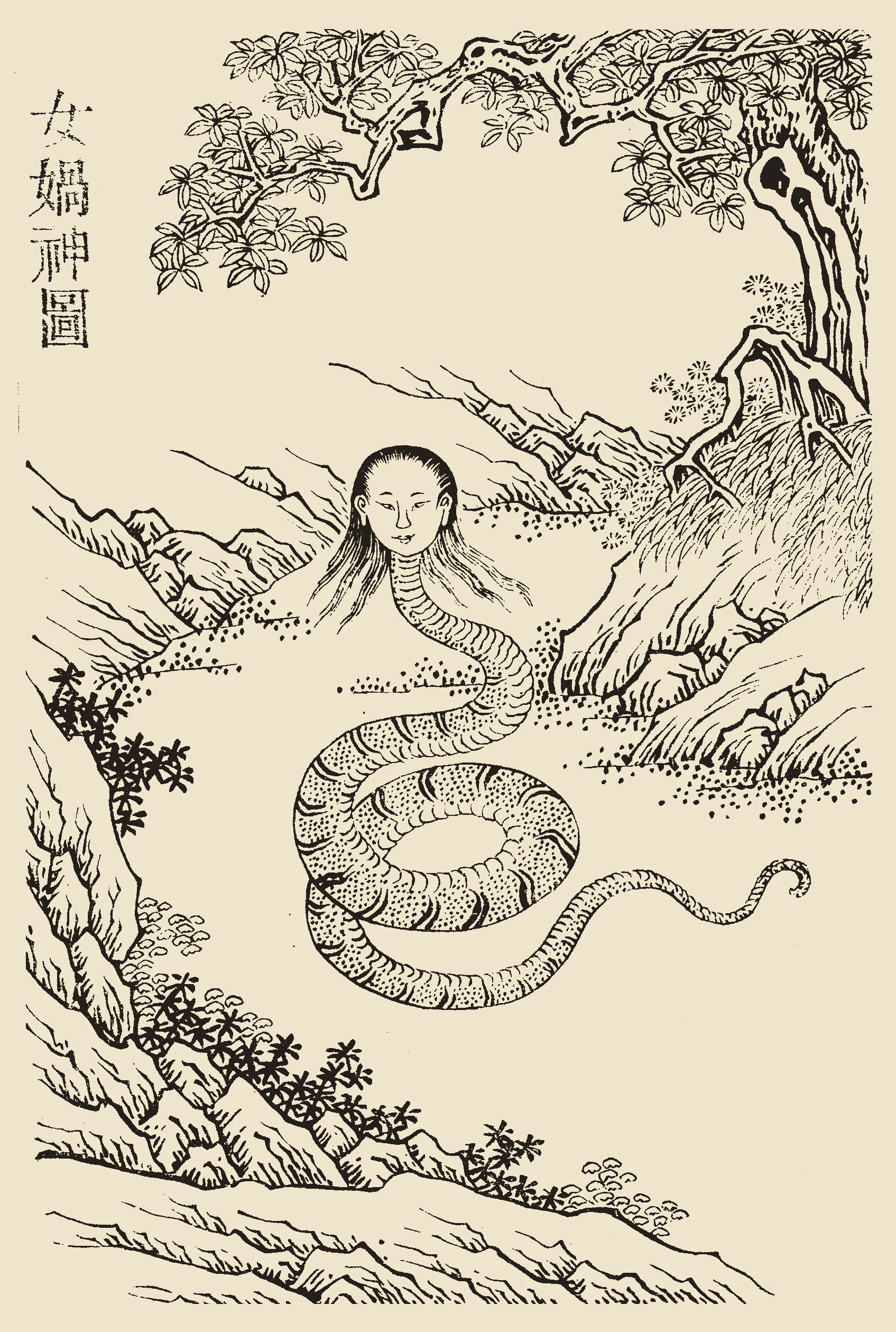
The primeval mother goddess and creatrix of humankind, depicted with a human head and serpentine body, who smelted five-coloured stones to repair the collapsed vault of heaven.抟土造人、炼石补天的创世母神,古籍与图像中常作端穆人首、蜿蜒灵蛇之躯,以无上神能平息大水、拯救苍生。
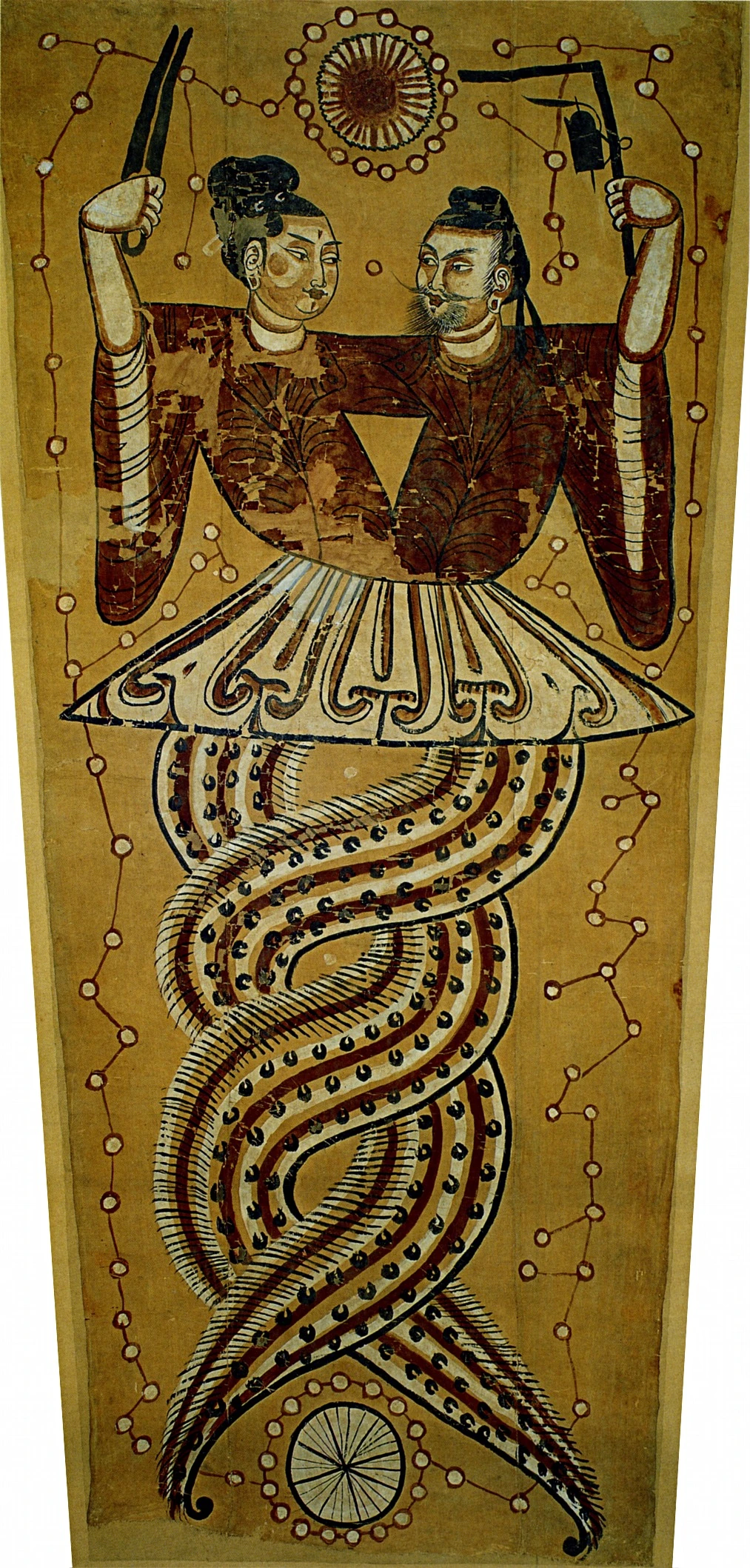
Tang dynasty silk painting of Fuxi and Nüwa with intertwined tails唐代阿斯塔那墓出土伏羲女娲交尾图绢画 — Polychrome silk painting, paired with Fuxi, entwined serpentine tails, astronomical chart彩绘绢画,与伏羲双神并立交尾,手持规矩,背景绘星宿日月中天
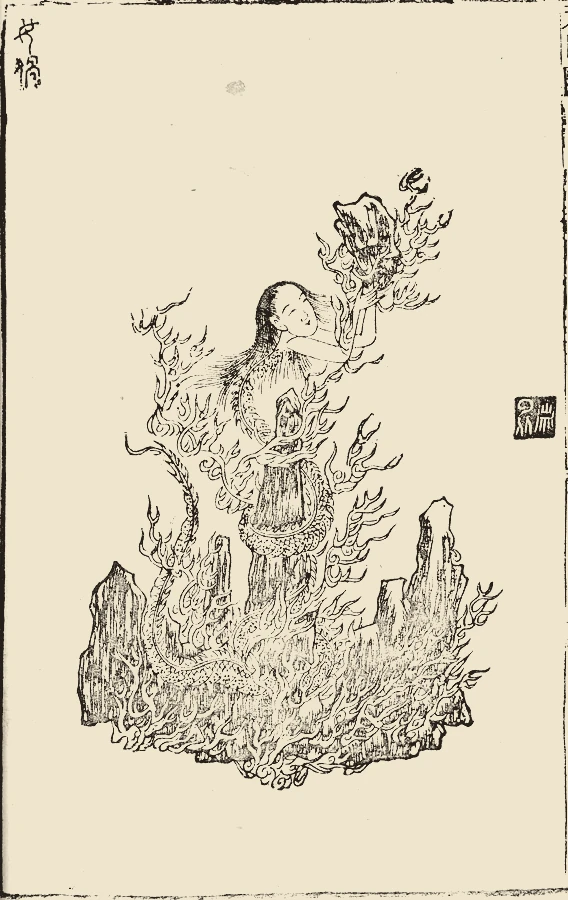
Xiao Yuncong's 1645 woodblock print of Nüwa in heavenly ascent明末清初萧云从《天问图》中的女娲版画 — Dynamic woodblock print of goddess ascending on billowing clouds with flowing drapery版画白描,衣带飘摇,腾云驾雾,呈凌空飞升之态
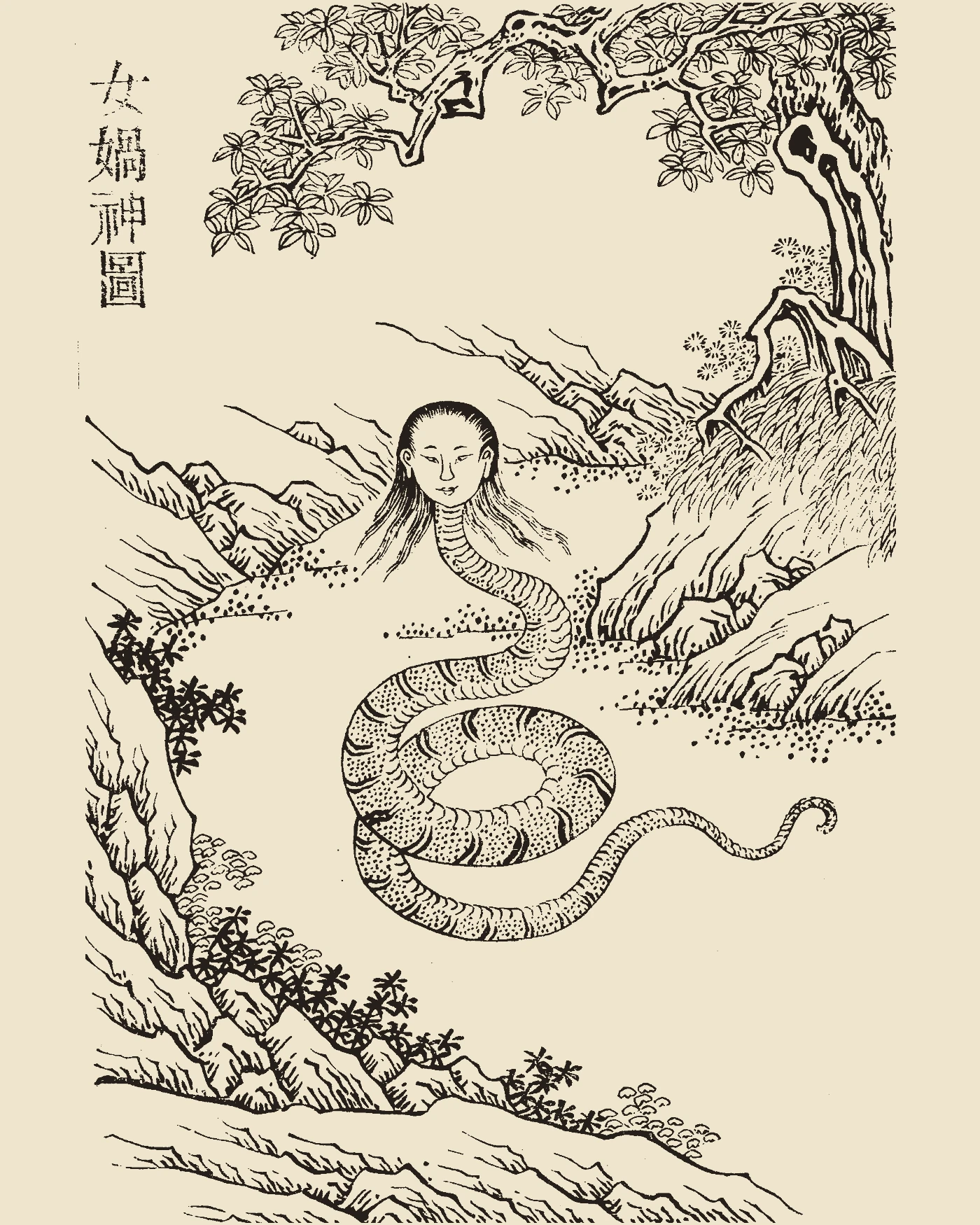
Nüwa Shen Tu 女媧神圖, the creator goddess with human head and serpentine body. Gujin Tushu Jicheng 古今圖書集成, Shen Yi Dian (Spirits and the Supernatural), woodblock print, 1726清·陈梦雷等编《古今图书集成·神异典》“女娲神图”,雍正四年(1726)铜活字印本 · Public domain公有领域Fuxi and Nüwa with intertwined serpent tails, holding compass and carpenter's square under celestial constellations. Polychrome painting on silk from the Astana Cemetery, Turfan, mid-8th century (Tang dynasty)唐代(8世纪中叶)吐鲁番阿斯塔那古墓出土《伏羲女娲图》彩绘绢画,两神蛇尾交缠,上手各执规矩,仰观日月星辰 · Anonymous (Tang dynasty)唐代佚名画家, 8th century8世纪Woodblock print of Nüwa from Xiao Yuncong's Tianwen Tu (Illustrations to Questions of Heaven), 1645 (early Qing)清顺治二年(1645)萧云从绘《天问图》中的女娲插图木刻版画 · Xiao Yuncong 蕭雲從 (1596–1673)明末清初·萧云从(1596–1673), 16451645年
Highlighted words: anatomy part · feature · form type — tap to jump标色词:形态部位 · 特征 · 形态类别,点击可跳转
Thereupon Nüwa smelted five-coloured stones to mend the azure heavens, severed the legs of a giant turtle to erect the four pillars of the earth, slew the black dragon to rescue the land of Jizhou, and heaped up reed ash to stem the boundless floods.
Wa: an ancient divine and holy woman, the one who transforms and creates the myriad things.
Comparing the Books典籍对比
Across early Chinese literature, Nüwa represents the ultimate archetype of maternal creation and cosmic salvation: the Huainanzi celebrates her engineering triumph of repairing heaven and slaying the black dragon, the Shan Hai Jing records her sacred organs transforming into roadside gods, the Chu Ci raises philosophical queries about her physical genesis, and the Shuowen Jiezi canonizes her as the primordial holy woman who brought all things into being.
The story来历与故事
The primeval mother goddess and creatrix of Chinese myth: an ancient sovereign with a human head and an undulating serpent body who fashioned the first mortals from yellow earth, smelted five-coloured stones to mend the cracked vault of heaven, and severed the legs of a cosmic turtle to uphold the celestial firmament.
Mending Heaven and Fashioning Mortals炼石补天与捏土造人
Nüwa smelted five-coloured stones to repair the collapsed vault of heaven and fashioned mortals from sacred clay.抟黄土以造万民,炼五色石以补苍天,以一己神威挽救天地苍生。
In the primeval cosmology of the Huainanzi, Nüwa appears as the ultimate cosmic saviour during a catastrophic rupture of the universe. When the four pillars collapsed and the nine provinces split asunder, fierce fire raged unquenched and boundless waters surged across the land. Rather than abandoning creation, Nüwa smelted sacred five-coloured stones to mend the azure vault, cut off the legs of a celestial turtle to re-erect the four cardinal pillars, and slew the ferocious black dragon to bring peace to the realm.
Alongside her architectural repair of the cosmos, ancient folklore recorded by Ying Shao in the Fengsu Tongyi celebrates Nüwa as the direct mother of mankind. Realizing that heaven and earth lacked mortal company, she knelt beside the riverbank to mold figures from golden clay, giving them life and breath; to populate the vast wilderness swiftly, she dipped a rope into the mire and flung droplets of mud across the earth, creating the ancestors of all generations.
Fuxi and Nüwa with intertwined serpent tails, holding compass and carpenter's square under celestial constellations. Polychrome painting on silk from the Astana Cemetery, Turfan, mid-8th century (Tang dynasty)唐代(8世纪中叶)吐鲁番阿斯塔那古墓出土《伏羲女娲图》彩绘绢画,两神蛇尾交缠,上手各执规矩,仰观日月星辰
The Serpent-Bodied Creators: Nüwa and Fuxi人首蛇身:女娲与伏羲
Depicted with human faces and intertwined serpentine bodies, Nüwa and Fuxi embody cosmic harmony and creation.常与伏羲并列为交尾的人首蛇身创世神偶,手持规矩,象征乾坤开辟与宇宙秩序。
While classical texts like the Shuowen Jiezi define Nüwa simply as an ancient holy woman who transformed all things, Han dynasty tomb art and Tang dynasty manuscripts overwhelmingly depict her with a serene human face and a magnificent coiling serpent body. In the iconic silk paintings unearthed from the Astana Cemetery along the ancient Silk Road, Nüwa is paired with her divine consort Fuxi, their lower bodies intertwined like twin helixes of cosmic energy.
In these sacred ritual portraits, Nüwa holds the compass (gui) while Fuxi wields the carpenter's square (ju), representing the fundamental mathematical and moral instruments used to delineate heaven and earth. Above their heads shines the fiery solar orb, beneath their coils hangs the lunar crescent, and all around them sparkle the constellations of Chinese astronomy, celebrating the cosmic harmony forged by the serpentine creators.
Woodblock print of Nüwa from Xiao Yuncong's Tianwen Tu (Illustrations to Questions of Heaven), 1645 (early Qing)清顺治二年(1645)萧云从绘《天问图》中的女娲插图木刻版画
The Mother Goddess in Modern Legend从创世母神到当代文化图腾
Celebrated across archaeology, animation, and space exploration, Nüwa endures as China's supreme mother goddess.从阿斯塔那墓出土绢画到当代探月工程与奇幻创作,女娲始终是华夏文明至高无上的创世母神。
In modern Sinophone culture, Nüwa occupies an exalted and untouchable position as the supreme maternal deity of the Chinese civilization. School textbooks across the world teach children her noble legends of fashioning mortals and repairing the sky, celebrating her as an enduring metaphor for maternal devotion, scientific ingenuity, and heroic perseverance against impossible natural disasters.
Across contemporary technology, contemporary literature, and digital entertainment, Nüwa's name carries immense symbolic resonance. China's national aerospace and technological initiatives have drawn inspiration from her myth, naming cutting-edge radar constellations and lunar science projects in her honor. In global video games and donghua animation, she inspires godlike characters who command the elements and safeguard humanity, continuing her millennium-long vigil as protectress of heaven and earth.
Record档案
Record Card档案卡
Type
Creator Goddess (serpent-bodied deity)
Also known as
Empress Wa 媧皇; Mother Goddess; Creator of Mankind; Consort of Fuxi 伏羲
Earliest source
Huainanzi 淮南子, Chu Ci 楚辭 & Shan Hai Jing 山海經
Powers
Smelted five-coloured stones to mend the sky; severed the turtle's legs to establish four pillars; fashioned humans from clay
Nature
Benevolent primeval creatrix and cosmic protectress; supreme embodiment of divine sacrifice and celestial order
Symbolism
Supreme mother goddess of Chinese cosmogony, creative fertility, maternal salvation, and cosmic balance
Nüwa is the primeval creator mother goddess of Chinese mythology, revered for fashioning the first human beings out of yellow clay and repairing the cracked vault of heaven with five-coloured stones during an ancient cosmic deluge.
Why is Nüwa depicted with a human head and a snake body?
In ancient Chinese cosmogony, the serpent symbolized fertility, life renewal, and mystical transformation. Depicting Nüwa with a human face and a snake body emphasizes her divine role as a primeval shapeshifter and creatrix intertwined with the cosmic forces of the earth.
How did Nüwa repair the fallen sky?
According to the Huainanzi, when the heavenly pillars collapsed, Nüwa smelted sacred stones of five colours to patch the tears in the sky, cut off the four legs of a giant sea turtle to serve as new cosmic pillars, and slew the black dragon to halt the rampaging floodwaters.
What is the relationship between Nüwa and Fuxi?
In early Han and Tang traditions, Nüwa and Fuxi are celebrated as brother and sister or husband and wife, co-creators of cosmic order and progenitors of mankind, famously depicted in tomb murals with intertwined snake tails holding the compass and carpenter's square.