Three hundred and fifty li further west is Mount Tian, rich in gold and jade, with blue realgar. The Ying River rises here and flows southwest into the Hot Spring Valley. A god dwells here, shaped like a yellow sack and red as cinnabar fire, with six legs and four wings. It is a formless blur (hundun) without face or eyes, yet it knows song and dance. This is Dijiang.
莊子·應帝王 · Zhuangzi · Fit for Emperors and Kings · Wikisource
The emperor of the Southern Sea was Shu, the emperor of the Northern Sea was Hu, and the emperor of the Centre was Hundun. Shu and Hu often met in Hundun's land, and Hundun treated them very well. They plotted to repay his kindness: "All men have seven openings, to see, hear, eat and breathe. He alone has none — let us try boring some." Each day they bored one hole, and on the seventh day Hundun died.
Thematic parallel only: Zhuangzi does not name Dijiang. Later commentators link the faceless 渾敦 of the Shanhaijing with Zhuangzi's 渾沌.
Show all sources (3)展开全部出处(3)
左傳·文公十八年 · Zuo Zhuan, Duke Wen year 18 · Wikisource
昔帝鴻氏有不才子,掩義隱賊,好行凶德,醜類惡物,頑嚚不友,是與比周,天下之民,謂之渾敦,
Long ago the clan of Dihong had a worthless son who hid righteousness and harboured villainy, delighted in wicked deeds, kept company with the vile and the evil, was stubborn, deceitful and unbrotherly, and allied himself with such people. The people of the world called him Hundun.
Comparing the Books典籍对比
The Shanhaijing describes a physical god with a 'hundun' (formless) body; Zhuangzi turns a faceless Hundun into a philosophical parable. The link is a traditional reading, not an explicit identification.
The story来历与故事
Dijiang is the most abstract god in the Shan Hai Jing: a yellow sack glowing red like fire, with six legs, four wings and no face at all, who nevertheless understands song and dance. Commentators have linked it to Hundun, the primordial chaos of Chinese philosophy.
What the Shan Hai Jing says《山海经》怎么说
Dijiang is a faceless, sack-shaped mountain god who understands song and dance.帝江是一位没有面目、形如口袋、却懂得歌舞的山神。
Dijiang appears in the Classic of the Western Mountains. On Mount Tian, rich in gold and jade, there is a god shaped like a yellow sack, red as cinnabar fire, with six legs and four wings. It is hundun, a word meaning a formless, undivided blur, and it has no face or eyes. Yet it knows singing and dancing. The text ends: this is Dijiang.
The Qing scholar Bi Yuan, in his edition of the Shan Hai Jing, read the name Dijiang as Dihong (帝鴻), another name of the Yellow Emperor, and some later scholars followed him. The reading is a commentator's interpretation, not something the original passage states, but it explains why some books call Dijiang the Yellow Emperor in his chaotic, pre-human form.
Dijiang's home, Mount Tian, appears in the third section of the Classic of the Western Mountains, a list of peaks with their minerals, rivers and resident beings. The text says the mountain has plenty of gold and jade and blue realgar, and that the Ying River rises there and flows south-west into the Tang Valley. The Shan Hai Jing's geography is hard to map onto real places, and readers should be cautious about identifying this Mount Tian with the modern Tian Shan range in Xinjiang.
What the setting does tell us is that Dijiang is a local mountain god, one of dozens in the book. The Shan Hai Jing usually closes each mountain sequence with instructions for sacrifices to its gods, which suggests these beings were worshipped rather than feared. Dijiang may have begun as the spirit of one particular peak long before philosophers turned it into a symbol.
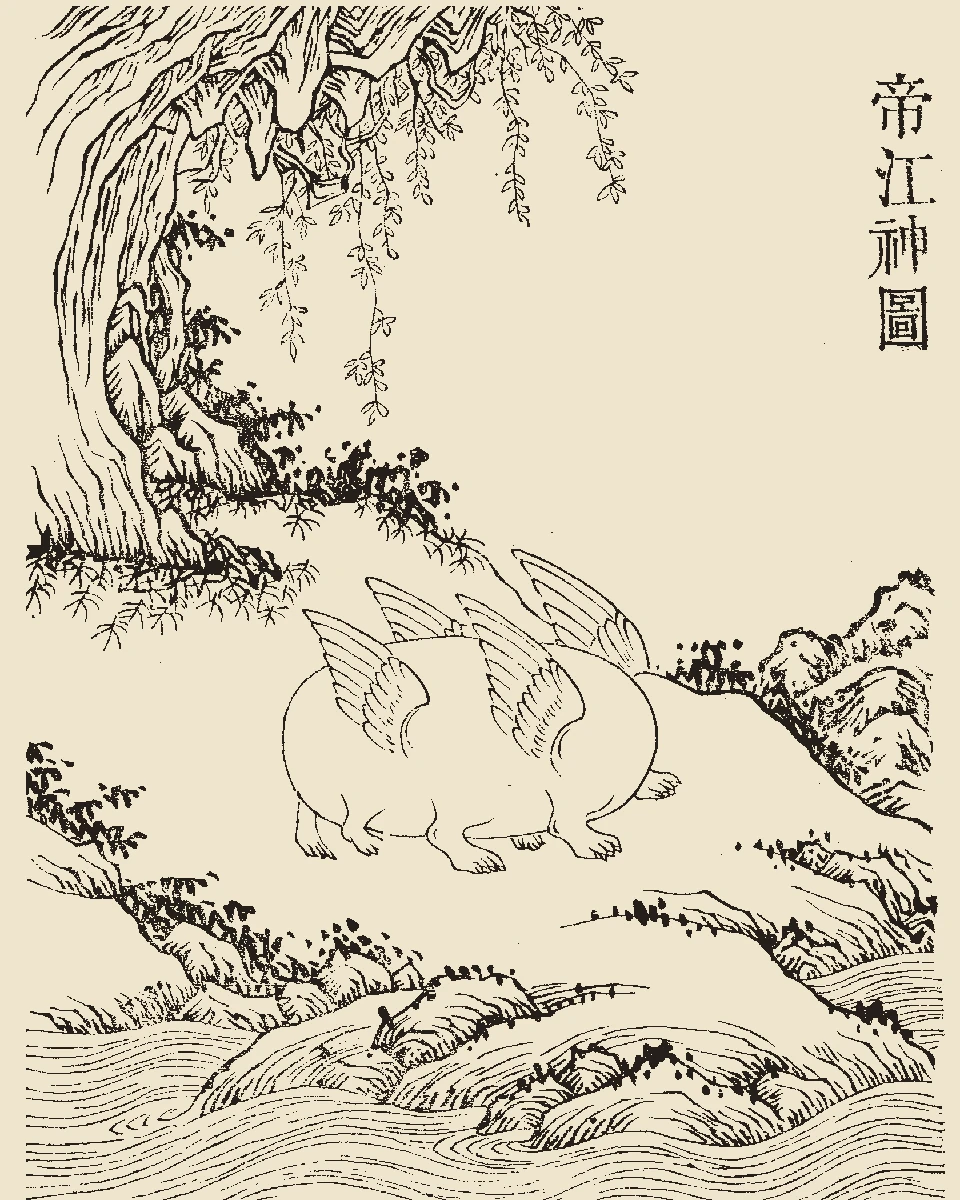
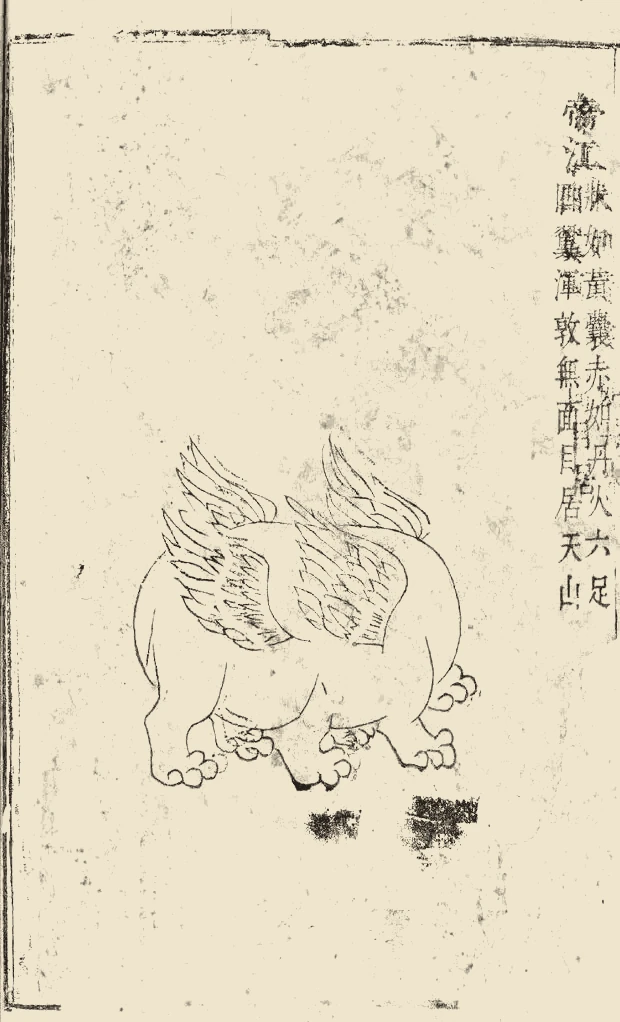
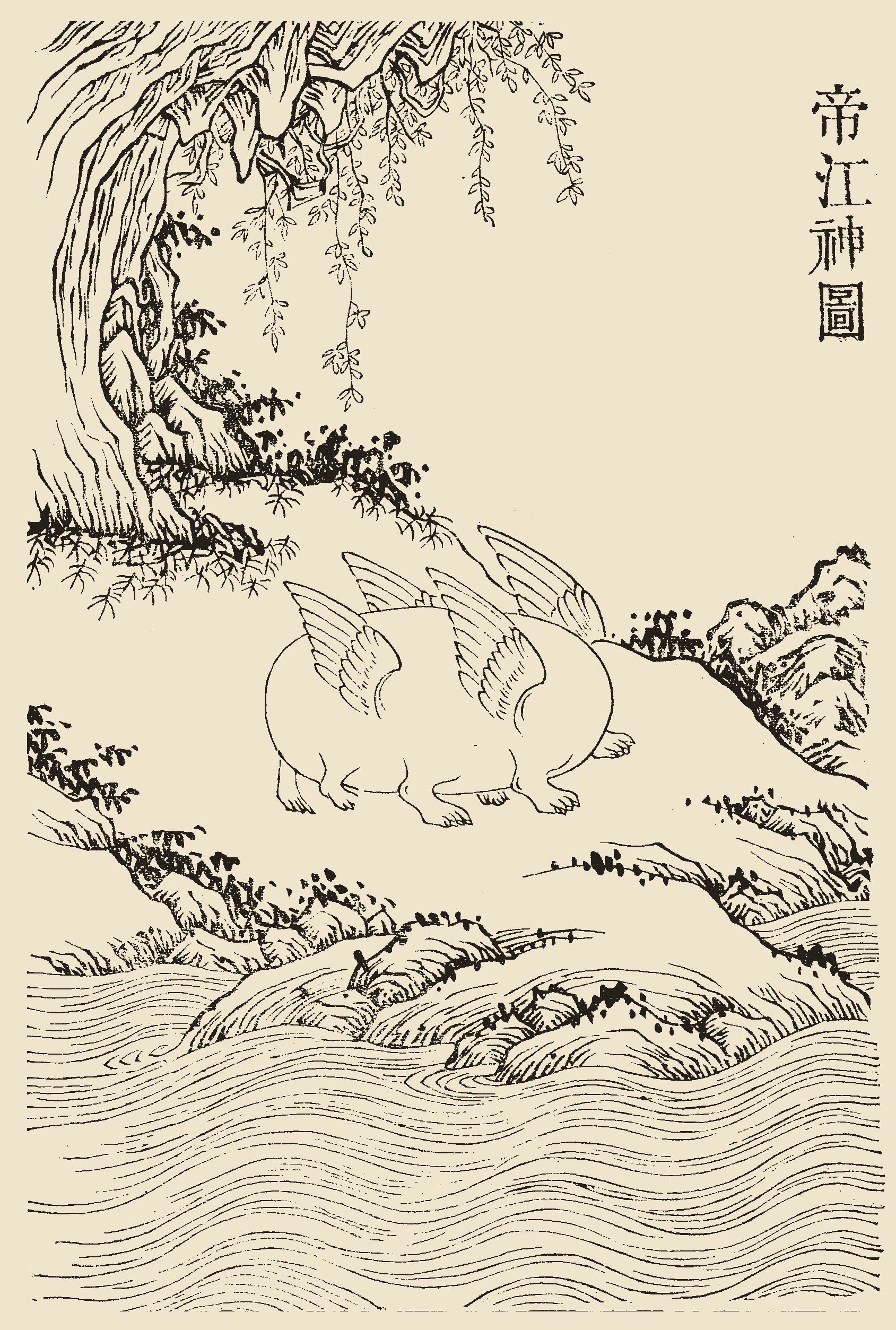
Drawing a creature with no face is a real problem, and the illustrators solved it in different ways. The Hu Wenhuan picture book of 1593 shows a round, feathered body with wings spread like a cloud. The Qing Gujin Tushu Jicheng places a plump, faceless sack-creature with stubby legs beside a river under willows. Both keep the defining absence: no eyes, no mouth.
Wu Renchen, Shanhaijing Guangzhu (Extended Commentary on the Shan Hai Jing), illustrated volumes, Kangxi-era printing. National Library of China copy清·吴任臣《山海经广注》图卷,康熙年间刊本,中国国家图书馆藏本
Dijiang and Hundun帝江与浑沌
Its description shares the word hundun with Zhuangzi's faceless emperor and the Zuo Zhuan's villain.描写它的“浑敦”一词,也出现在《庄子》的中央之帝和《左传》的恶子身上。
The word used for its body, hundun, is the same word Zhuangzi uses for the Emperor of the Centre in one of the most famous parables in Chinese philosophy. Shu and Hu, emperors of the southern and northern seas, are well treated by Hundun, who has no openings in his face. To repay him they bore seven holes, one a day, so he can see, hear, eat and breathe like everyone else. On the seventh day Hundun dies.
Zhuangzi never mentions Dijiang, and the Shan Hai Jing never mentions Shu and Hu. The connection is a traditional reading. Still, the two texts share a striking image: a being without a face, whole and content, that would be destroyed by being made ‘normal’.
There is a third Hundun, and he is not pleasant. The Zuo Zhuan, the great historical commentary on the Spring and Autumn Annals, lists four wicked sons of ancient clans who were banished by the sage ruler Shun. The first belonged to the clan of Dihong: he hid righteousness, harboured villainy and delighted in wicked deeds, and the people called him Hundun.
This passage matters for Dijiang because it puts the names Dihong and Hundun side by side. Qing scholars such as Bi Yuan used exactly this link to argue that Dijiang (帝江) should be read Dihong (帝鴻), and that the faceless god of Mount Tian, Zhuangzi's Emperor of the Centre and the banished son of the Zuo Zhuan all grow from one old name. It is an elegant theory, but it remains a theory built from sound and spelling.
Notice how far the moral colour shifts. In the Shan Hai Jing, Hundun is simply a shape. In Zhuangzi he is generous and innocent. In the Zuo Zhuan he is a byword for moral chaos. Chaos in Chinese thought can be the creative wholeness before order, or the disorder that order must defeat, and Dijiang sits right on that line.
Why a faceless god loves dance无面之神为何懂歌舞
A god with no senses that still knows music is the detail readers remember most.没有感官却懂音乐,是读者最难忘的细节。
The most memorable detail is the last one: 識歌舞, it knows song and dance. A creature with no eyes or ears understanding music sounds like a paradox, and Guo Pu's commentary leans into it, suggesting that a being whose form is not complete is spiritually perceptive in a way that does not depend on the senses.
Modern readers often see Dijiang as a god of rhythm itself, or of the pure enjoyment of movement before thought. That is interpretation, but it explains why the creature has become a favourite of modern artists and designers working with the Shan Hai Jing.
Dijiang Today今天的帝江
From classical mythology to Marvel’s Morris, the faceless god lives on in modern fantasy.从上古神话到漫威电影里的莫里斯,无面之神在当代奇幻作品中依然活跃。
In modern culture, Dijiang's bizarre, faceless form has inspired some of the most memorable creature designs in global fantasy. Most famously, Marvel Studios adapted Dijiang into the adorable, six-legged, four-winged companion Morris in Shang-Chi and the Legend of the Ten Rings (2021). Living in the mystical realm of Ta Lo, Morris guides the heroes through the treacherous bamboo maze, turning an ancient, enigmatic god into a globally beloved screen presence.
Beyond Hollywood, Dijiang's striking imagery continues to inspire modern fantasy writers, creature designers and mythologists who celebrate the ancient god of dance and primordial rhythm.
In film, TV & games影视与游戏中的形象
Listed by how familiar each work is to English-speaking audiences; each note says what it keeps from the Shan Hai Jing and what it changes.按在英语世界的知名度排列;每条说明它沿用了《山海经》的什么、又有哪些再创作。
The furry, six-legged, four-winged faceless creature Morris is a hundun (渾敦), the name the Shan Hai Jing gives to Dijiang's faceless form; he befriends Trevor Slattery in Ta Lo and guides the heroes through the shifting bamboo maze.片中毛茸茸、六只脚、四只翅膀、没有面目的生物莫里斯被设定为“浑敦”(渾敦),即《山海经》中帝江混沌无面的形态;他在大罗仙境与特雷弗·斯莱特里结为好友,并带领主角穿过移动的竹林迷阵。
Source: Wikipedia来源:Wikipedia
Text only: no posters or screenshots. Facts checked against official pages and Wikipedia.仅文字介绍,不使用海报或截图;信息已对照官方页面与维基百科核实。
A mountain deity from the Classic of the Western Mountains in the Shan Hai Jing. A completely faceless, pouch-shaped god of music and dance, it is celebrated for its instinctive joy and primordial rhythm.
Is Dijiang the same as Hundun?
The Shan Hai Jing describes Dijiang's body as hundun, ‘formless’, and later readers linked it to the faceless Emperor Hundun in Zhuangzi. The texts never say they are the same, so the link is traditional rather than certain.
Why does Dijiang have no face, yet understand song and dance?
The text says it is formless and faceless, yet knows song and dance. Commentators read its lack of eyes and ears as a sign of primordial wholeness before the world was divided into separate senses, while its love of music represents natural rhythm and joy before conscious thought.
Which movies feature Dijiang?
Dijiang inspired Morris, the adorable six-legged, four-winged faceless creature in Marvel’s Shang-Chi and the Legend of the Ten Rings (2021), who befriends Trevor Slattery and guides the heroes through Ta Lo’s shifting bamboo maze.