Polychrome manuscript illustration of the Nine-Headed Phoenix清代彩绘本《山海经》中的九凤图 — Vibrant bird with nine crowned human heads, unlike the main monochrome print设色绢绘长颈并列的九首彩凤,与主图单色版画风格迥异
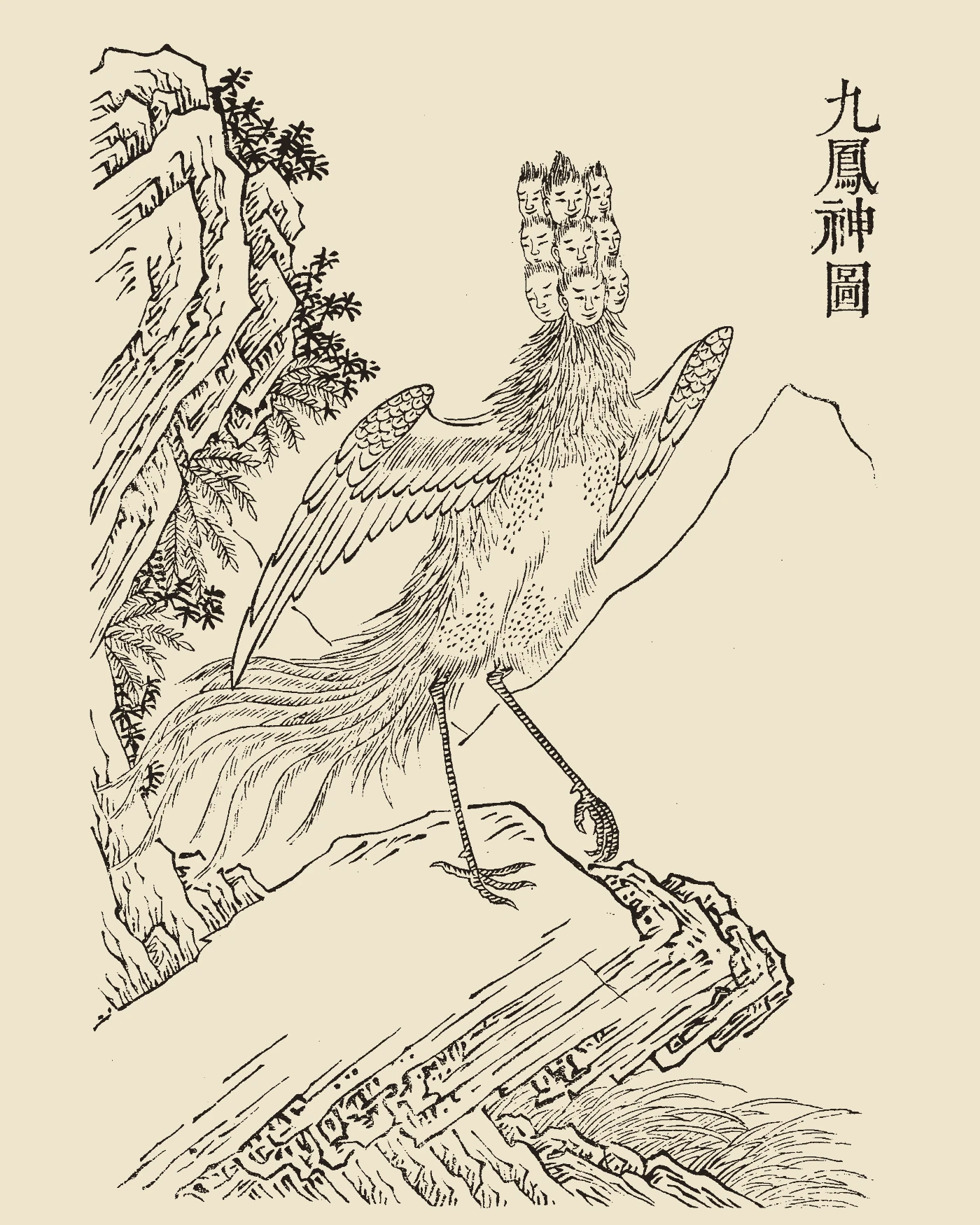
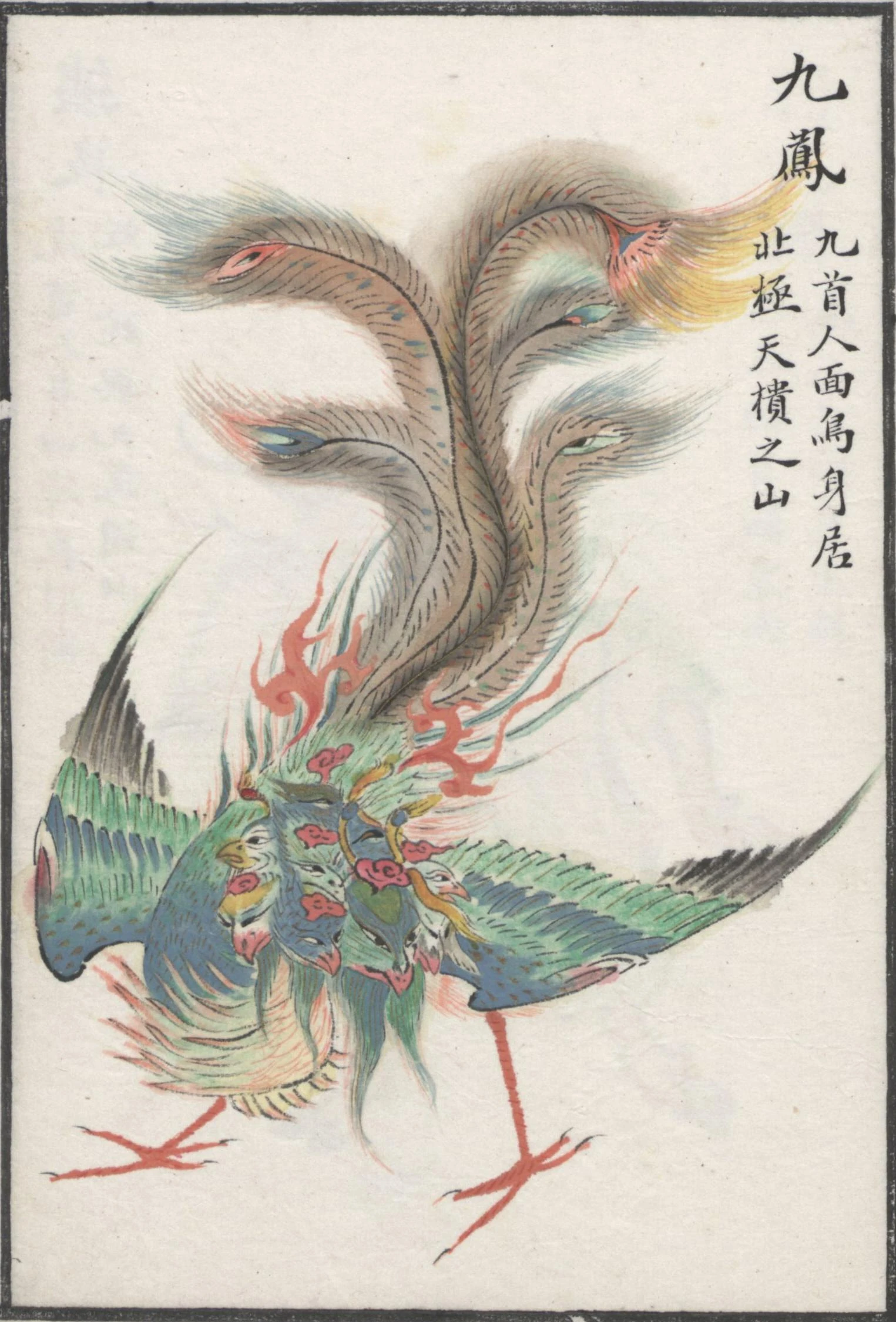
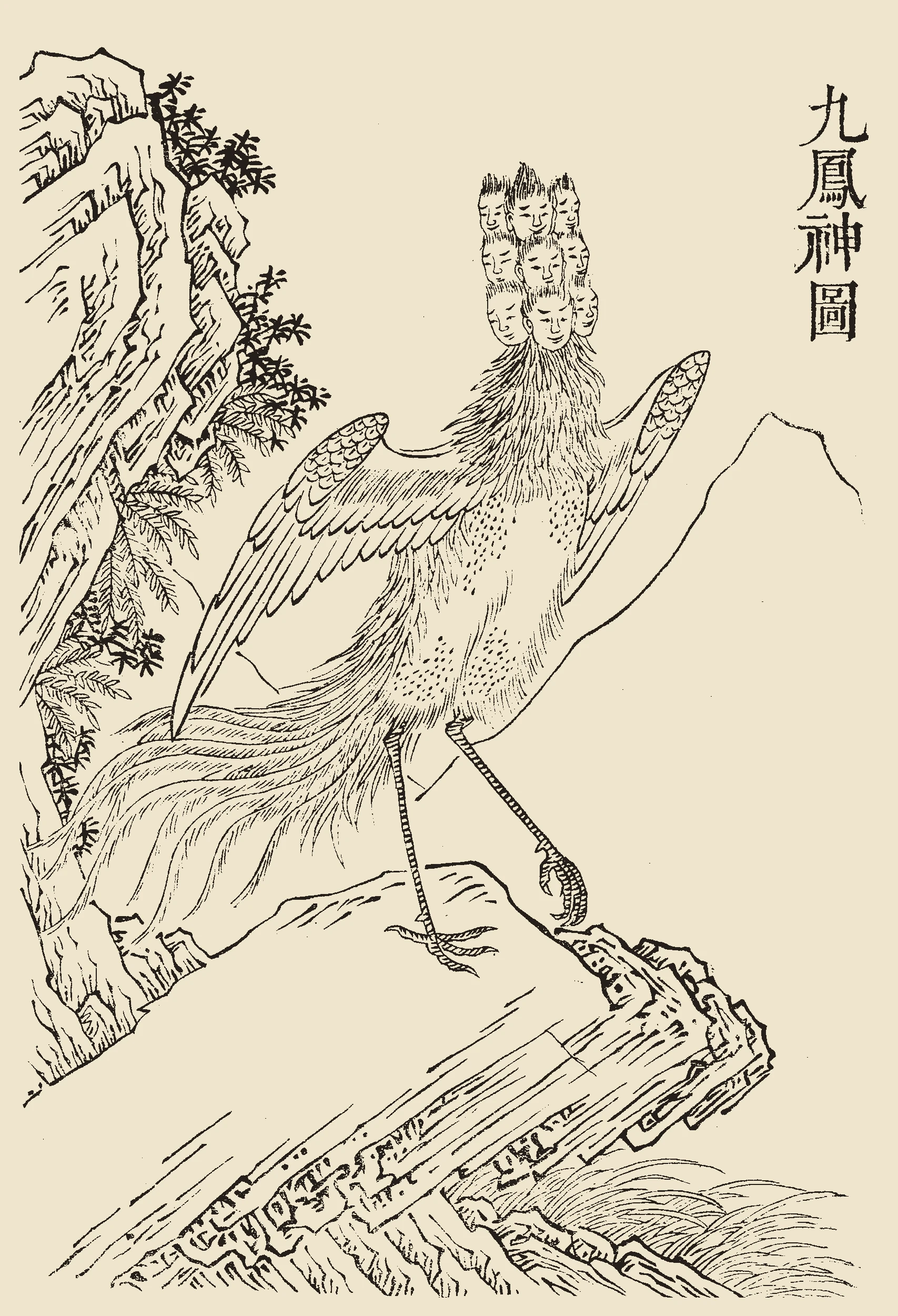
Jiufeng Shen Tu 九鳳神圖, the nine-headed divine bird perched upon rocky heights. Gujin Tushu Jicheng 古今圖書集成, Shen Yi Dian (Spirits and the Supernatural), woodblock print, 1726清·陈梦雷等编《古今图书集成·神异典》“九凤神图”,雍正四年(1726)铜活字印本 · Public domain公有领域Polychrome illustration of the nine-headed phoenix from a color edition of the Shan Hai Jing (Library of Congress, World Digital Library 2875)清代彩绘本《山海经》插图“九头凤”(美国国会图书馆藏,World Digital Library 2875) · Anonymous (Qing dynasty)清代佚名画家, c. 19th centuryc. 19th century
Highlighted words: anatomy part · feature · form type — tap to jump标色词:形态部位 · 特征 · 形态类别,点击可跳转
In the midst of the Great Wilderness, there is a mountain named the Northern Pole Sky Cabinet, where the sea pours northwards. There is a god with nine heads and human faces and a bird's body, named Jiufeng (Nine Phoenix).
Comparing the Books典籍对比
The Shan Hai Jing's one-line entry is the classical description of Jiufeng: a nine-headed, human-faced, bird-bodied god of the far north. The ill-omened nine-headed bird of later folklore is not described in the Shan Hai Jing.
The story来历与故事
The god of Mount Beiji Tiangui in the Shan Hai Jing: nine heads, each with a human face, on the body of a bird.
The Nine-Headed Deity of Mount Tiangui天柜神山:九首人面与大荒北注
The Shan Hai Jing places Jiufeng on Mount Beiji Tiangui as a nine-headed god.《山海经·大荒北经》记载九凤在北极天柜山,是一位九首人面的神。
In the Classic of the Great Northern Wilderness within the Shan Hai Jing, Jiufeng is introduced in a single short entry: 'In the midst of the Great Wilderness, there is a mountain named Beiji Tiangui, where the sea flows north. There is a god with nine heads, human faces and a bird's body, named Jiufeng.' The text calls it a god (有神), not a beast.
The entry gives no story, no deeds and no omen: only the place, the nine human-faced heads, the bird body and the name. Everything else said about Jiufeng comes from later writers and artists.
Polychrome illustration of the nine-headed phoenix from a color edition of the Shan Hai Jing (Library of Congress, World Digital Library 2875)清代彩绘本《山海经》插图“九头凤”(美国国会图书馆藏,World Digital Library 2875)
How the Pictures Show Jiufeng图中的九凤
Qing artists drew Jiufeng as a phoenix-like bird with nine heads.清代画工把九凤画成长着九个头的凤形大鸟。
The 1726 Gujin Tushu Jicheng woodblock print stands Jiufeng on a rocky crag as a long-tailed bird with a cluster of nine small human heads rising from one neck, keeping close to the wording of the text.
A coloured Qing-dynasty edition of the Shan Hai Jing now in the Library of Congress paints it differently: a brightly coloured phoenix whose nine long necks end in bird heads rather than human faces. The two pictures show how freely artists treated the same short text.
From Divine Phoenix to Ghost Bird Folklore从上古九凤到后世九头鸟传说
Later folklore told of a sinister nine-headed bird, a separate tradition from the Shan Hai Jing god.后世民间另有不祥的“九头鸟”传说,与《山海经》里的九凤神并不是一回事。
Later folklore tells of an ill-omened 'nine-headed bird' (jiutouniao 九頭鳥), also called the Ghost Carriage (guiche 鬼車). That creature is not described in the Shan Hai Jing, and the classic does not link it to Jiufeng.
Reading the original entry keeps the two apart: Jiufeng is simply a nine-headed, human-faced god of the far north, recorded in one line of the Shan Hai Jing.
In the Classic of the Great Northern Wilderness, Jiufeng is a god with nine heads, human faces and the body of a bird, living on Mount Beiji Tiangui.
Is Jiufeng the same as the ominous Nine-Headed Bird (Jiutouniao)?
No. The Shan Hai Jing calls Jiufeng a god (有神). The ill-omened nine-headed bird, or Ghost Carriage, belongs to later folklore and does not appear in the Shan Hai Jing.
Why does Jiufeng have nine human faces?
The Shan Hai Jing does not say. It only records the form: nine heads with human faces, on a bird's body.
Do all old pictures give Jiufeng human faces?
No. The 1726 Gujin Tushu Jicheng print gives it nine small human heads, while the coloured Qing edition in the Library of Congress gives it nine bird heads.