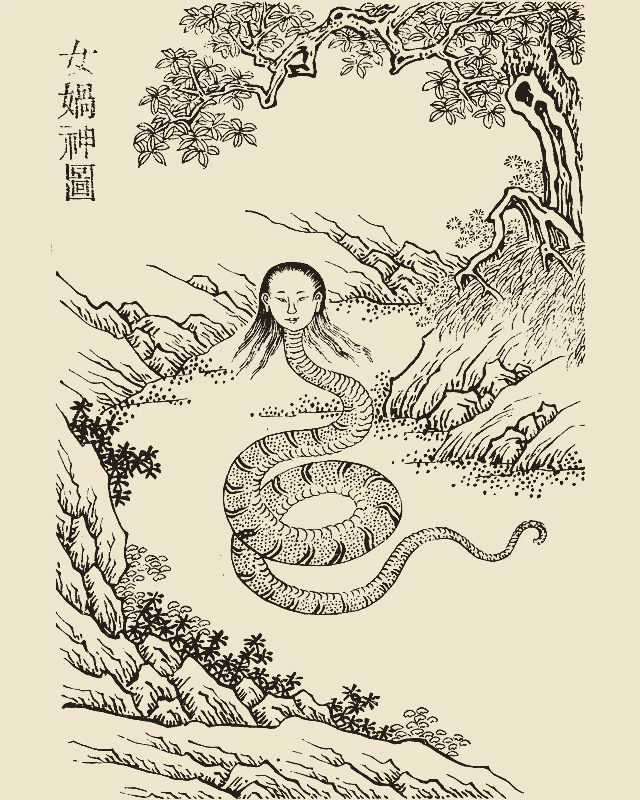
The human-faced solar serpent of primeval myth: dwelling on sunless northern peaks, he creates day with open eyes and night with closed eyes, his breath turning the seasons.人面赤身的极北创世神蛇:睁眼为昼、闭目为夜,吹息为冬、呼气为夏,以神光烛照九幽幽冥。
Face人面
Human face长着人的脸
人面蛇身而赤
Body蛇身
Red serpent, a thousand li long红色蛇身,长达千里
身長千里
Home居所
On Mount Zhangwei住在章尾山
赤水之北,有章尾山
Eyes眼睛
Eyes open: day; eyes shut: night睁眼白天,闭眼黑夜
視為晝,瞑為夜
燭龍
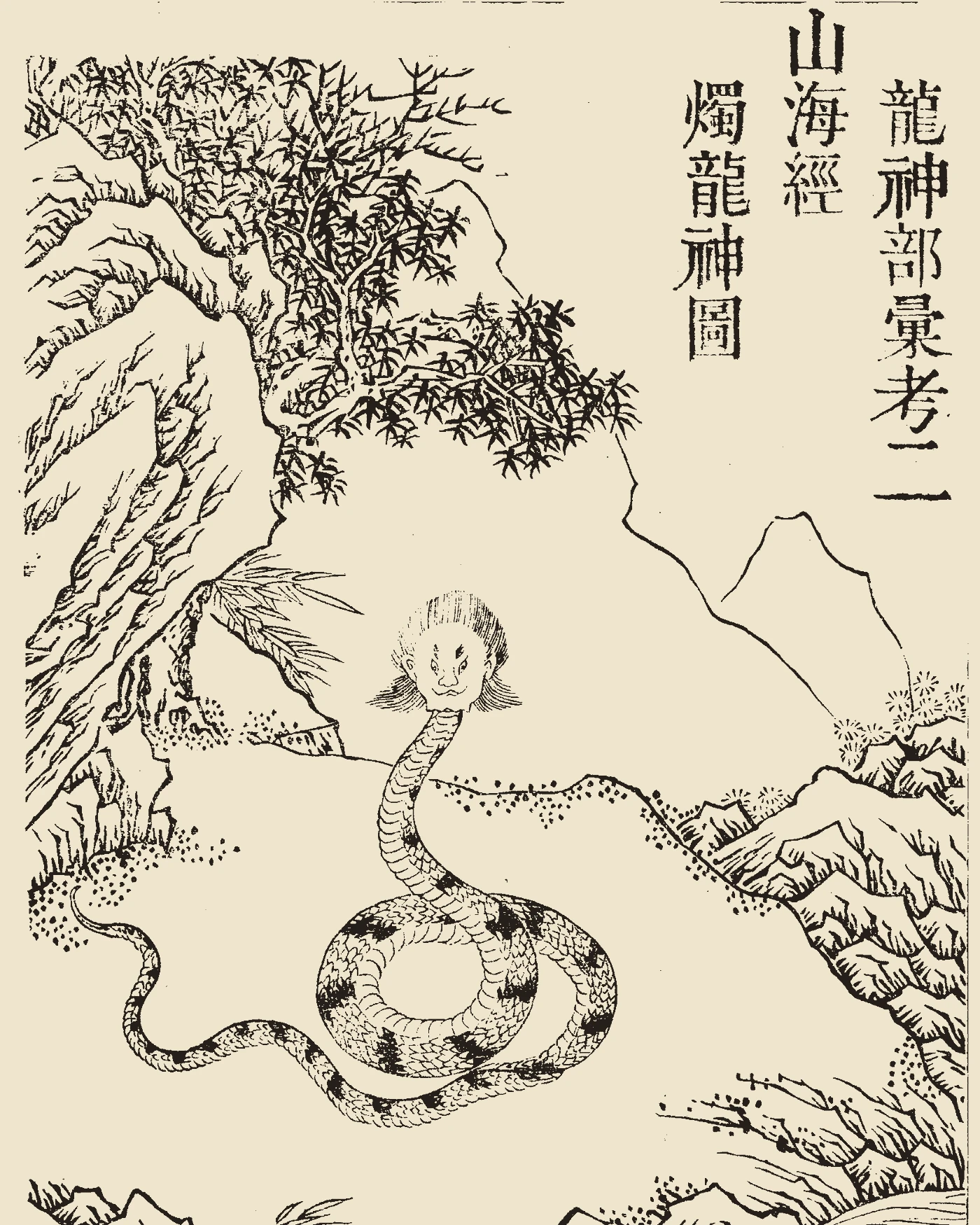
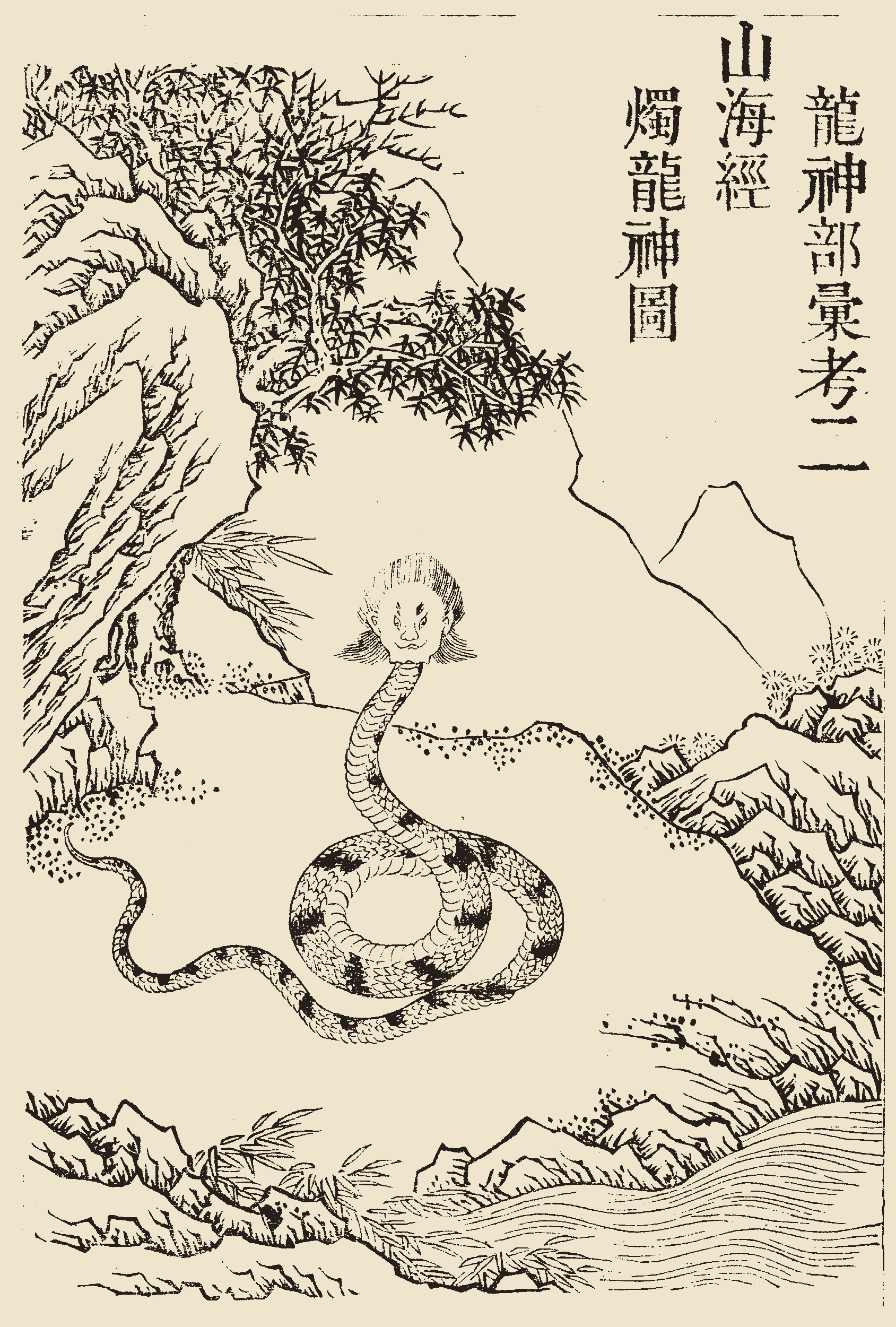
Gujin Tushu Jicheng’s 1726 imperial woodblock print depicting Zhulong, the human-faced solar serpent coiled on Mount Zhangwei.清代《古今图书集成》中的烛龙神图,呈现人面蛇身盘踞于章尾山上的创世神祇形貌。
其暝乃晦,其視乃明,不食不寢不息,風雨是謁。
When he shuts his eyes it is dark; when he opens his eyes it is daylight. He neither eats nor sleeps nor breathes, but commands the wind and the rain.
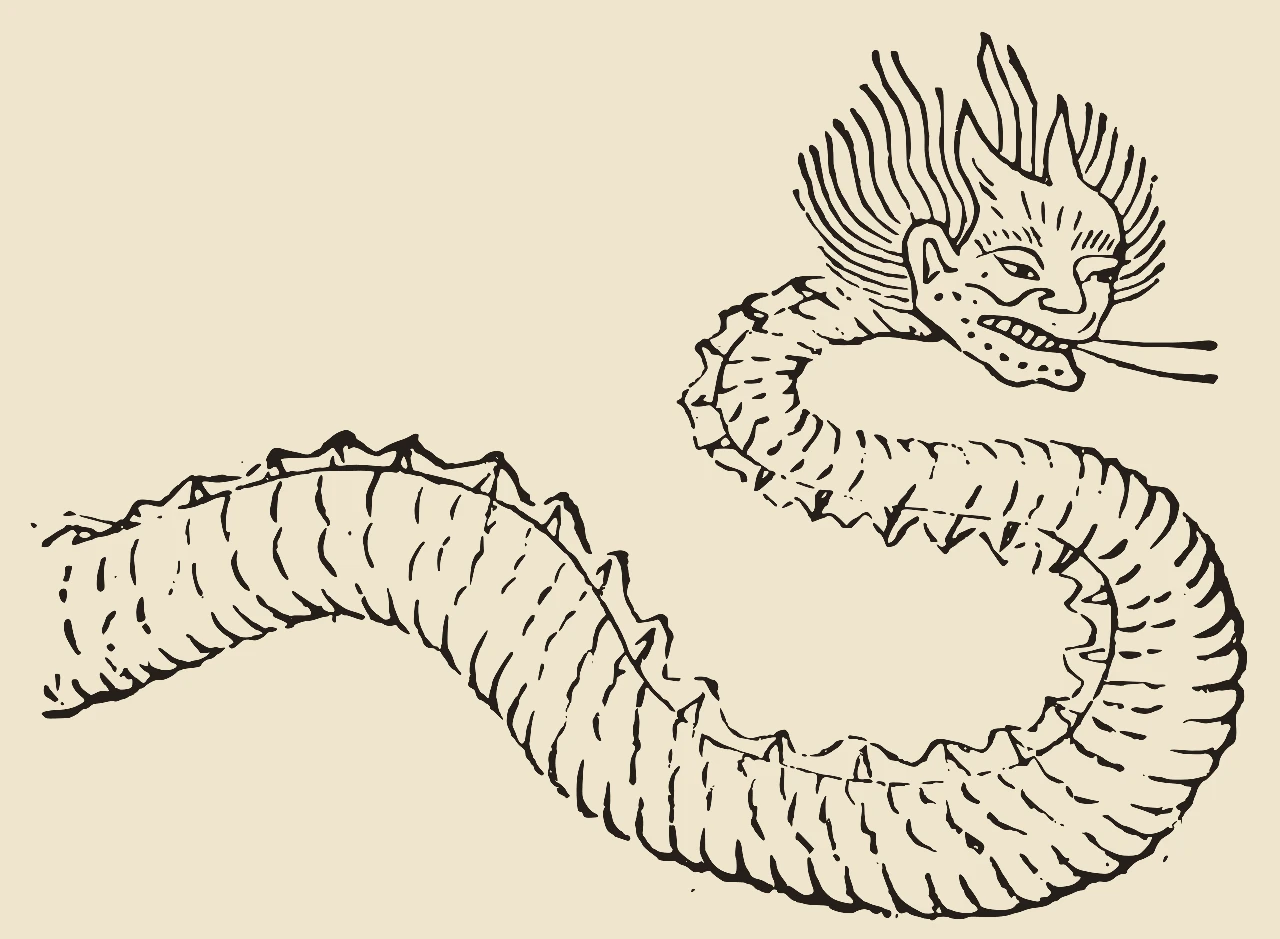
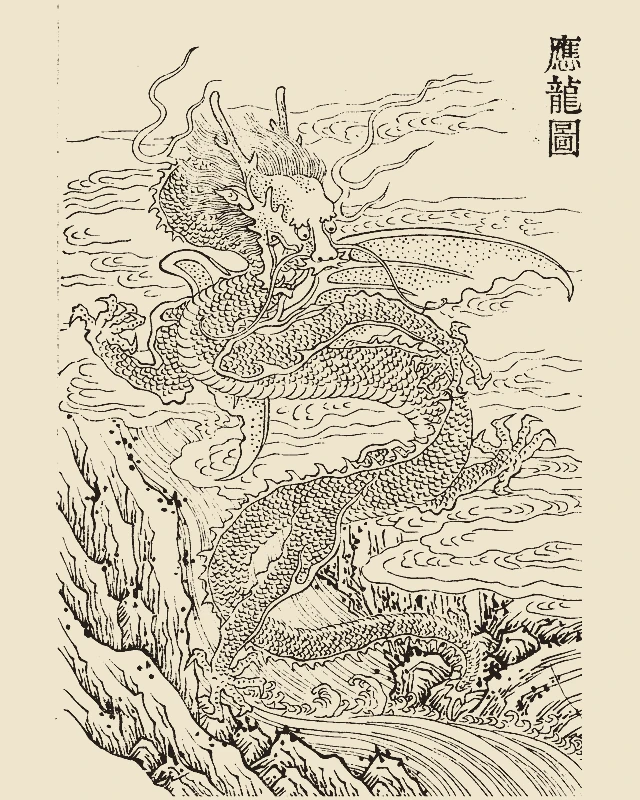
Hu Wenhuan (1593): soaring serpent with flame-mane and serrated ridge胡文焕(1593):生有烈焰神鬃与锯齿背鳍的腾空飞蛇 — Arches through empty space, not coiled; flame-like mane, mouth streamers, serrated ridge凌空拱身而非盘绕;头生烈焰状鬃,口飘长须,背有锯齿鳍
Toriyama Sekien (1780): bearded titan coiling Mount Zhong鸟山石燕(1780):盘踞钟山绝顶、须发戟张的苍髯巨龙 — A bearded elder’s face on a pinnacle; the scaly body wraps the whole mountain长者面貌,须发戟张,立于峰顶;鳞身缠绕整座山
Zhulong Shen Tu 燭龍神圖, the Torch Dragon coiled upon the northern mountains. Gujin Tushu Jicheng 古今圖書集成, Shen Yi Dian (Spirits and the Supernatural), woodblock print, 1726清·陈梦雷等编《古今图书集成·神异典·龙神部》“烛龙神图”,雍正四年(1726)铜活字印本 · Public domain公有领域Zhuyin 燭陰. Hu Wenhuan, Shanhaijing Tu 山海經圖 (Illustrated Classic of Mountains and Seas), juan 2 (Overseas North), 1593明·胡文焕编《山海经图·海外北经》“烛阴”,万历二十一年(1593)刊本 · Hu Wenhuan 胡文煥 (ed.)胡文焕 编, 15931593年Shokuin (Zhuyin) 燭陰 coiled around Mount Zhong. Toriyama Sekien, Konjaku Hyakki Shūi 今昔百鬼拾遺 (Supplement to the Hundred Demons from the Present and the Past), woodblock print, 1780日·鸟山石燕绘《今昔百鬼拾遗》“烛阴”,安永九年(1780)木刻版画 · Toriyama Sekien 鳥山石燕 (1712–1788)鸟山石燕(1712–1788), 17801780年
Highlighted words: anatomy part · feature · form type — tap to jump标色词:形态部位 · 特征 · 形态类别,点击可跳转
Beyond the Northwestern Sea, north of the Red Waters, lies Mount Zhangwei. There is a deity with a human face and a serpent body, entirely scarlet in color. His eyes are set vertically aligned. When he closes his eyes, darkness falls; when he opens his eyes, light shines forth. He does not eat, does not sleep, and does not breathe; he summons wind and rain. He illuminates the ninefold abysses; he is called Zhulong (the Torch Dragon).
The spirit of Mount Zhong is named Zhuyin. When he opens his eyes, it is day; when he closes his eyes, it is night. When he blows his breath, it becomes winter; when he exhales, it becomes summer. He does not drink, does not eat, and does not breathe; yet when he does exhale, his breath becomes the wind. His body is a thousand li in length. He dwells east of the Land of Wuqi, at the foot of Mount Zhong; as a creature, he has a human face, a serpent body, and is scarlet in color.
Where does the sun not reach? What does the Torch Dragon illuminate?
Comparing the Books典籍对比
The Classic of Mountains and Seas records two complementary traditions of this primeval solar deity: the Great Wilderness chapter calls him Zhulong, dwelling on Mount Zhangwei with vertical eyes that illuminate the ninefold abyss, while the Overseas North chapter calls him Zhuyin of Mount Zhong, whose seasonal breathing creates winter and summer. The Tianwen in the Chu Ci also asks what the Torch Dragon lights where the sun does not reach.
The story来历与故事
The cosmic solar serpent of primeval Chinese myth: a colossal deity a thousand li long with a human face and a scarlet serpent body, dwelling upon the sunless northern peaks. By opening his eyes he brings daylight, by closing them he creates night, and by his cosmic breath he governs the cycles of winter and summer.
The Master of Cosmic Light and Seasons掌控光阴与寒暑的原初神祇
By opening his eyes he brings day, by closing them night; his breath governs winter and summer.睁眼为昼、闭目为夜,吹息定天地寒暑,以一己神威烛照九阴。
In the ancient cosmology of the Shan Hai Jing, Zhulong (the Torch Dragon) reigns as one of the most sublime and awe-inspiring primordial deities. Recorded in both the Classic of the Great Wilderness: North and the Classic of Regions Beyond the Northern Sea, he is described not as a terrestrial beast, but as an elemental sovereign who embodies the celestial mechanics of illumination and time itself. Bearing a serene human face upon an immense scarlet dragon torso, his supernatural gaze commands the cosmic order: when he opens his luminous eyes, radiant dawn floods across the universe; when his eyelids close, deep impenetrable night envelops all creation.
Beyond governing the alternation of light and dark, Zhulong's respiration commands the turning of the seasons. Ancient chroniclers note that the sovereign needs neither mundane food, drink, nor rest; yet when he blows his icy breath across the frozen northern wastes, bitter winter blankets the world, and when he exhales his warm breath, radiant summer awakens the land. When he rests his coiled body upon the summit of the world, his gentle respiration becomes the planetary wind that sweeps across the seas, sustaining life across realms that the sun's earthly rays could never reach.
Zhuyin 燭陰. Hu Wenhuan, Shanhaijing Tu 山海經圖 (Illustrated Classic of Mountains and Seas), juan 2 (Overseas North), 1593明·胡文焕编《山海经图·海外北经》“烛阴”,万历二十一年(1593)刊本
Mount Zhong and Mount Zhangwei章尾与钟山:极北无日之地
Dwelling upon the northern frontiers where the sun never shines, illuminating the ninefold darkness.居于西北海之外委羽、章尾与钟山之下,终年不见日光。
The earliest geographies place the sanctuary of the Torch Dragon in the remote, mist-shrouded northern frontier beyond the terrestrial bounds of ancient China. The Great Wilderness North records that he dwells atop Mount Zhangwei (章尾之山), situated far beyond the Northwestern Sea and north of the mythic Red Waters. In the Overseas North, the sanctuary is identified as Mount Zhong (鍾山), rising in perpetual shadow where the chariot of the sun god Xihe can never journey and mortal navigators could never penetrate.
In the Han-dynasty philosophical compendium Huainanzi, scholar Liu An recorded in the Treatises on Topography that Zhulong resides north of Yanmen, shielded beneath the crags of Mount Weiyu where sunlight is unknown, describing him as a deity with a human face, a dragon body, and no feet. Coiled atop Mount Zhong and Mount Zhangwei, the crimson titan holds a celestial flare or illuminates the abyssal void through his own incandescent radiance, banishing the perpetual twilight of the northern gate of heaven.
日安不到,燭龍何照?
Where does the sun not reach? What does the Torch Dragon illuminate?
— 楚辭·天問 · Tian Wen
The Tianwen's Question《天问》之问
The Tianwen in the Chu Ci asks: 'Where does the sun not reach? What does the Torch Dragon illuminate?'《楚辞·天问》问道:“日安不到,烛龙何照?”
The Tianwen in the Chu Ci, a set of questions about heaven and earth, asks: 'Where does the sun not reach? What does the Torch Dragon illuminate?' (日安不到,燭龍何照?). The question presupposes a place the sun does not reach, lit instead by the Torch Dragon.
The name 'Ninefold Illuminator' (燭九陰) signifies the dragon's miraculous ability to cast light into the nine subterranean realms of primordial darkness (jiuyin), where neither sun nor moon can cast their beams. From the crown of his head to the tip of his tail stretching a thousand leagues across the rocky ridges, Zhulong was celebrated in Han and Tang dynasty poetry as the undying cosmic torch, embodying the ancient Chinese vision of an orderly universe sustained even at its outermost edges by benevolent divine luminescence.
The Torch Dragon in Modern Fantasy从极北创世神到当代奇幻经典
From classical myth to modern gaming and literature, Zhulong remains the pinnacle of ancient draconic powers.从先秦古籍到当代国风奇幻游戏与文学,烛龙始终是神龙与创世信仰的至高符号。
In modern Chinese culture and education, Zhulong occupies an exalted status as the supreme serpentine deity of early mythology, rivaling Nüwa and Fuxi as a cornerstone of prehistoric cosmogony. While many beasts of the Shan Hai Jing were later demoted to wild fauna or folkloric monsters, Zhulong's primordial majesty as a god who commands the day, night, and seasons has kept his legend pristine, symbolizing humanity's ancient quest to comprehend cosmic cycles and overcome primeval darkness.
Across global digital entertainment, video gaming, and popular fantasy literature, Zhulong has inspired some of the most celebrated masterworks of contemporary Sinophone culture. Leading game developer Shanghai Aurogon took its Chinese corporate name directly from the god (上海烛龙), weaving the primordial dragon into the core cosmogony and divine lineage of the acclaimed Swords of Legends (Gujian Qitan) franchise. Similarly, in best-selling modern adventure literature like Daomu Biji (The Grave Robbers' Chronicles), the subterranean legend of 'Zhu Jiuyin' evokes ancient subterranean terror beneath prehistoric sacred trees. From classical woodblocks to cutting-edge digital worlds, Zhulong endures as an everlasting monument to primeval draconic majesty.
Record档案
Record Card档案卡
Type
Deity (human-faced solar serpent)
Also known as
Zhuyin 燭陰; Torch Dragon; Master of Mount Zhong; Ninefold Illuminator 燭九陰
Earliest source
Shan Hai Jing 山海經 (Great Wilderness North & Overseas North, c. 4th–2nd c. BCE)
What is Zhulong (the Torch Dragon) in Chinese mythology?
Zhulong, also known as Zhuyin or the Torch Dragon, is a supreme primordial deity in the Shan Hai Jing (Classic of Mountains and Seas). He is described as a scarlet serpent a thousand li in length with a human face, dwelling upon the sunless northern peaks of Mount Zhong and Mount Zhangwei, governing the cycles of cosmic illumination and weather.
How does Zhulong control day, night, and the seasons?
According to ancient classical texts, Zhulong creates daylight when he opens his eyes ('其視乃明') and plunges the world into darkness when he closes them ('其暝乃晦'). Furthermore, when he blows his breath, it creates winter ('吹為冬'), and when he exhales, it becomes summer ('呼為夏'), with his breath becoming the wind.
What is the difference between Zhulong and Zhuyin?
Yes. In the Shan Hai Jing, the Classic of the Great Wilderness: North calls him Zhulong ('是謂燭龍') dwelling on Mount Zhangwei, while the Classic of Regions Beyond the Northern Sea calls him Zhuyin ('名曰燭陰') dwelling on Mount Zhong. Ancient scholars and modern mythologists regard them as two recordings of the same primeval solar deity tradition.
Where does Zhulong dwell in ancient Chinese geography?
Zhulong dwells in the extreme northwest beyond the northern seas, upon Mount Zhangwei and Mount Zhong. In ancient Chinese cosmology, this was an arctic, sunless frontier beyond the path of the sun chariot; because solar rays could never penetrate this realm, Zhulong's supernatural radiance was necessary to illuminate the ninefold abyss ('燭九陰').