Crouching fox with flame-like tails, redrawn by Jiang Yinghao伏身、尾如火焰的狐:蒋应镐重绘 — Nine tails (九尾) drawn as spiky flames, not a fan; the fox crouches low九尾画成尖焰状,而不是扇形;狐身四足伏低,而不是蹲坐
Korean tomb mural高句丽墓室壁画 — A long, red-striped, almost dragon-like body; the tails merge into one plume身体细长、带红色条纹,几乎像龙,而不是狐形;尾巴并成一束尖羽
Japanese book illustration of the fox legend日本读本中的九尾狐故事插图 — The fox is a small figure inside a crowded human scene, not a single animal study狐只是热闹人物场景中的一个小角色,而不是单独的动物图
Hokusai’s golden nine-tailed fox葛饰北斋笔下的金毛九尾狐 — Nine tails as separate flame-shaped plumes; the fox twists in mid-leap, mouth open九尾画成一根根火焰状的羽毛;狐在半空扭身跃起,张着嘴
Ukiyo-e: the fox looming over Prince Hanzoku浮世绘:九尾狐威吓班足太子 — A huge flying fox with billowing golden tails (九尾), attacking a man一只巨大的飞狐,金色的尾巴翻卷,正在扑向一个人
Ukiyo-e: the fox spirit Tamamo-no-Mae浮世绘:狐妖玉藻前 — No fox body at all: the fox spirit appears in human form as a court lady完全没有狐身:狐妖以宫廷女子的人形出现
Ukiyo-e: Gekkō’s nine-tailed fox浮世绘:尾形月耕的九尾狐 — A fox’s head on a figure in flowing robes, flying through the air穿着飘逸长袍、长着狐头的身影在空中飞行
Three hundred li further east is Green Hill Mountain. Its sunny slopes are rich in jade, its shaded slopes in blue cinnabar. There is a beast here shaped like a fox but with nine tails. Its cry is like an infant's. It can eat people; whoever eats it will not fall prey to gu sorcery.
山海經·海外東經 · Shan Hai Jing · Classic of Regions Beyond the Eastern Sea · Wikisource
青丘國在其北,其狐四足九尾。
The State of Qingqiu lies to its north. Its foxes have four legs and nine tails.
Some editions add 「其人食五穀,衣絲帛」 (its people eat the five grains and wear silk).
Show all sources (5)展开全部出处(5)
山海經·大荒東經 · Shan Hai Jing · Classic of the Great Wilds: East · Wikisource
有青丘之國,有狐,九尾。
There is the State of Qingqiu, where there are foxes with nine tails.
Why does the fox have nine tails? When a fox dies it turns its head toward its home hill: it does not forget its roots, and in safety it does not forget danger. Why must it be nine tails? Because when the nine consorts are each in their proper place, sons and grandsons multiply. Why in the tail? It shows that later generations will flourish.
吳越春秋·越王無余外傳 · Wu Yue Chunqiu, Yu the Great · Wikisource
Yu was thirty and still unmarried. Reaching Mount Tu, he worried that time was running late and he would miss the proper season, so he declared: “If I am to marry, there will surely be a sign.” Then a white fox with nine tails came to Yu. Yu said: “White is the colour of my robes; the nine tails are proof of kingship.”
Comparing the Books典籍对比
All three passages tie the fox to the name Qingqiu, but the mountain chapter treats it as a dangerous, edible beast with a medicinal use, while the two outer-region chapters simply list it as a feature of a distant country.
The story来历与故事
The nine-tailed fox is one of the oldest shape-shifting animals in Chinese writing, and one of the strangest reversals in mythology: it starts as a man-eating beast, becomes a sign of good government, and ends up as the seductive fox demon of Ming novels and Japanese prints.
Origins in the Shan Hai Jing《山海经》里的源头
The first nine-tailed fox is a strange beast of Green Hill, not a seductress.最早的九尾狐只是青丘山上的一种异兽,并不是魅惑人的妖精。
The earliest description is a single sentence in the Classic of the Southern Mountains, part of the Shan Hai Jing (Classic of Mountains and Seas), a compilation whose oldest layers are usually dated to the Warring States period. On Green Hill (Qingqiu), the text says, lives a beast shaped like a fox with nine tails. Its cry sounds like a baby, it can eat people, and whoever eats it will be protected from gu, a kind of sorcery or poisoning.
That is the whole entry. There is no seduction, no human form and no magic beyond the medicinal one. The same fox appears twice more in the book, in the Classic of Regions Beyond the Eastern Sea and the Classic of the Great Wilds: East, both times tied to a Qingqiu State, and both times described only as a fox with nine tails. Ancient readers seem to have treated it as a remarkable animal of the far east rather than as a spirit.
The classical texts agree on very little beyond the nine tails. The Southern Mountains entry adds a baby-like cry; the Classic of Regions Beyond the Eastern Sea adds that it has four legs, which sounds obvious but was apparently worth saying in a book full of six-legged gods. Colour only enters with the Wu Yue Chunqiu, where the fox is white, a colour associated with the west, mourning and, for Yu, his own robes.
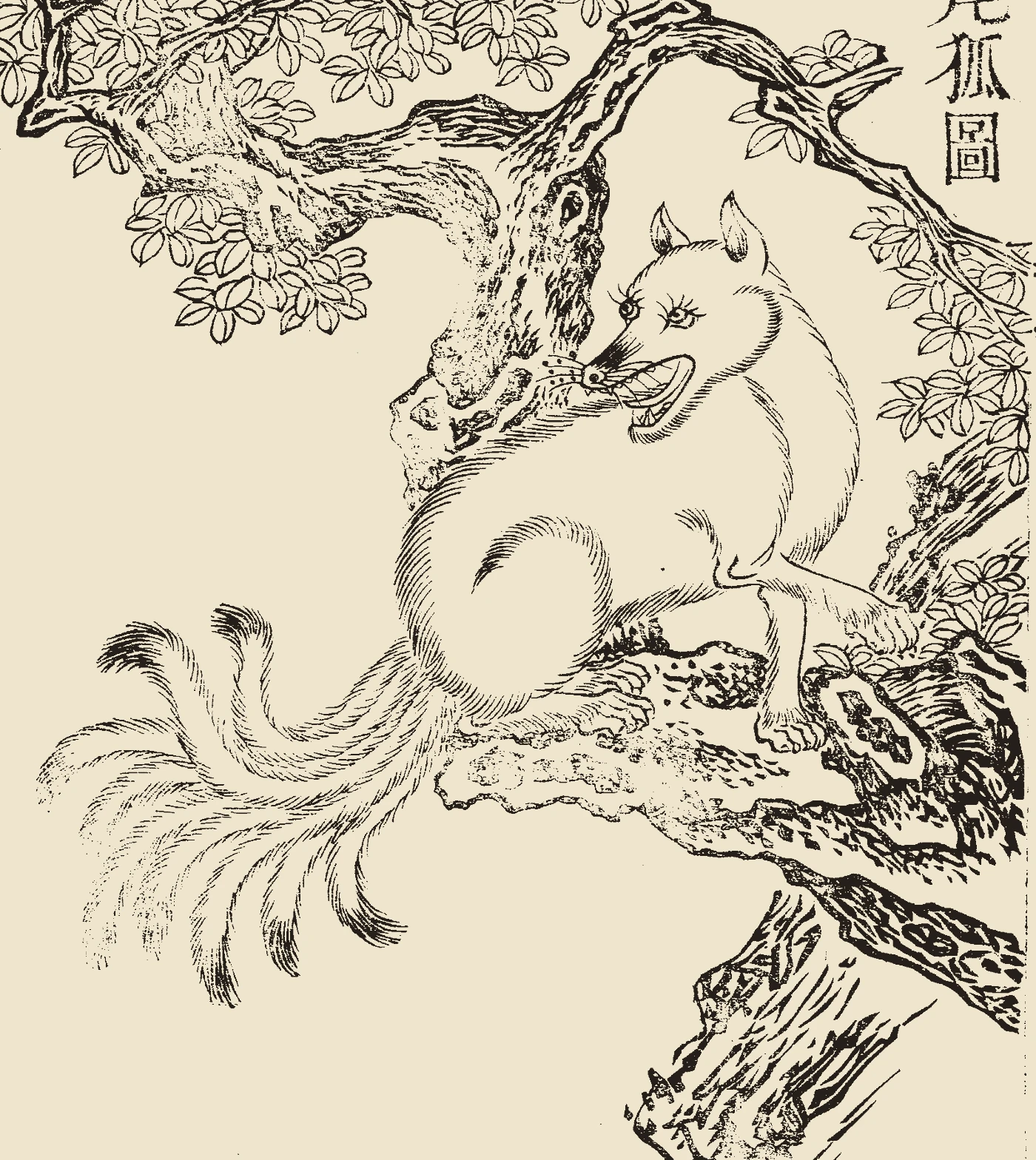
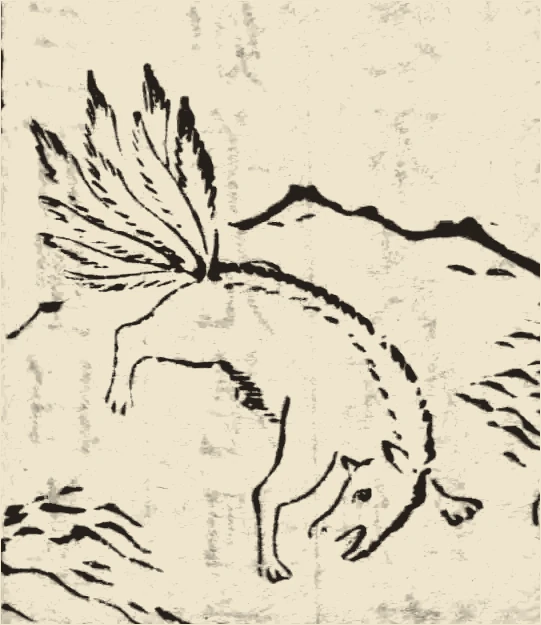
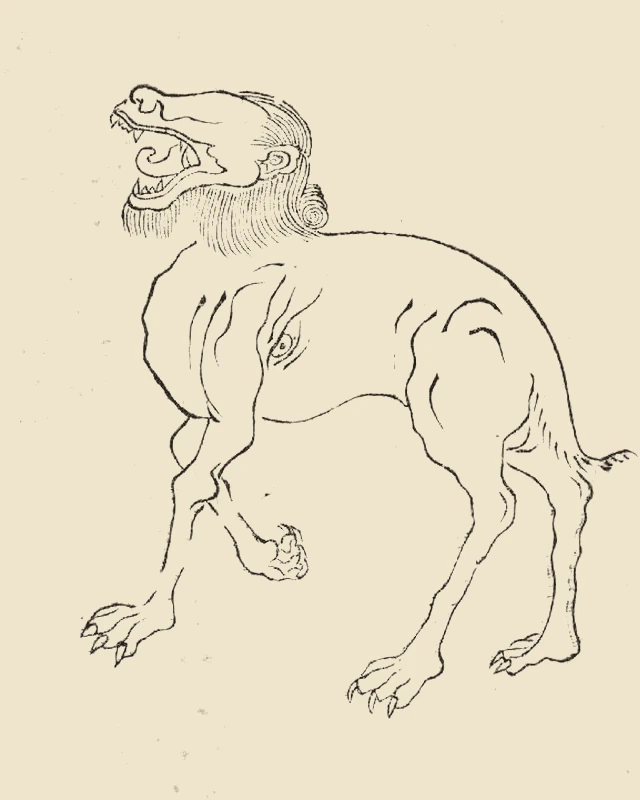
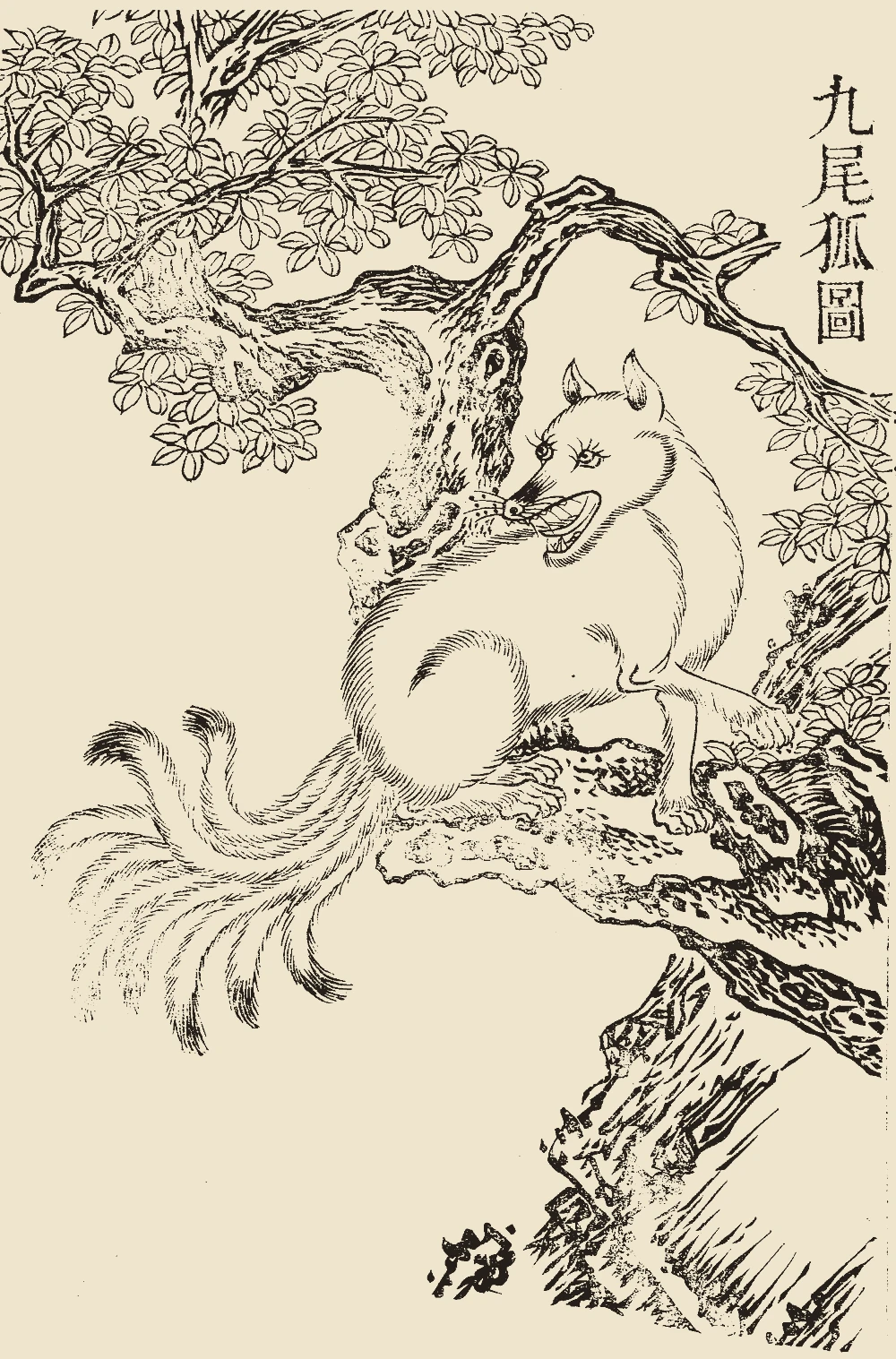
Illustrators filled the gaps in their own way. The late-Ming edition illustrated by Jiang Yinghao gives the fox a fan of plume-like tails; the Hu Wenhuan picture book of 1593 draws a sleek, alert animal; the Qing encyclopaedia Gujin Tushu Jicheng puts it in a landscape under a pine. Japanese artists usually show the fox golden or white, mid-transformation, with tails curling like smoke.
Illustrated Shan Hai Jing, Chongzhen era (1628–1644), drawings by Jiang Yinghao明崇祯年间(1628–1644)刊《山海经》插图,蒋应镐绘
From Beast to Good Omen从异兽到祥瑞
In the Han dynasty the fox became a sign of virtue and royal heirs.到了汉代,九尾狐成了德政和子孙繁盛的祥瑞。
By the Han dynasty the fox had changed sides. The Baihu Tong, a record of court debates held in 79 CE, lists the nine-tailed fox among the signs that appear when a ruler's virtue reaches the birds and beasts, alongside the qilin and the white tiger. It then explains the symbolism: a fox dies facing its home hill, so it stands for remembering one's roots, and nine tails stand for a ruler's many descendants.
The Wu Yue Chunqiu, an Eastern Han collection of stories about the southern states, gives the fox a starring role in the founding legend of the Xia dynasty. Yu the Great, still unmarried at thirty, meets a white nine-tailed fox at Mount Tu and reads it as proof that he will become king. He marries a woman of the Tushan clan. The story ends with a short song about the fox, which is why the passage is often called the Song of Tushan.
Han tomb art shows the same idea. Nine-tailed foxes appear in carved stone reliefs as attendants of the Queen Mother of the West, next to the three-legged crow and the hare pounding the elixir of immortality. In this period the fox is a heavenly creature, not a demon.
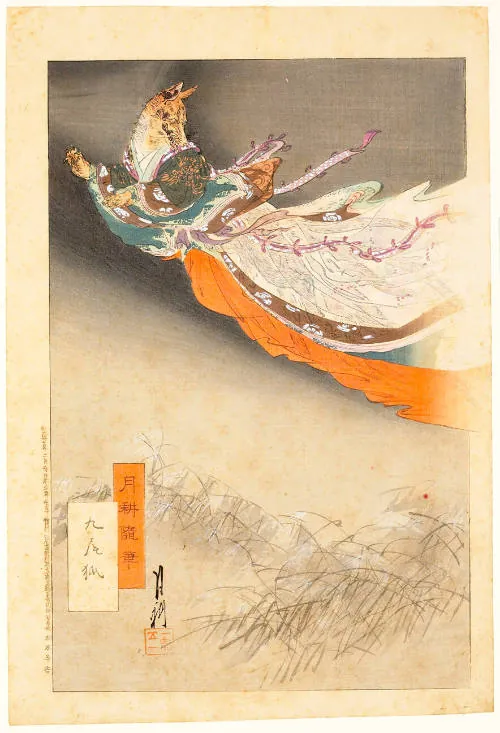
Ogata Gekkō, Fox with Nine Tails, 1898. Honolulu Museum of Art尾形月耕《九尾狐》,1898年,檀香山艺术博物馆藏
How It Became a Demon如何变成妖狐
Later fiction turned the fox into the shape-shifting temptress Daji and Japan's Tamamo-no-Mae.后世小说把它变成化身妲己的狐妖,传到日本又成了玉藻前。
The darker image grew slowly. Stories of foxes that take human form to seduce people multiply in Tang and Song collections such as the Taiping Guangji, and the number of tails becomes a measure of age and power. The decisive step comes in the Ming novel Fengshen Yanyi (Investiture of the Gods), where a thousand-year fox spirit possesses Daji, the consort of the last Shang king, and helps bring down the dynasty. Later retellings and stage plays routinely give this fox nine tails.
The same plot travelled to Japan as the legend of Tamamo-no-Mae, a fox who serves as a royal consort in India, then China, then the Japanese court, before being unmasked and killed on Nasu Moor, where her spirit lives on in the Killing Stone. Katsushika Hokusai, Utagawa Kuniyoshi and Tsukioka Yoshitoshi all illustrated episodes of this three-country fox story, and several of those prints are in the gallery below.
The Nine-Tailed Fox Today今天的九尾狐
Most fans today know it through Korean and Japanese retellings.如今多数人是通过韩国和日本的再创作认识它的。
The fox is now one of the most widely recognised Chinese mythological animals outside China, but most people meet it second-hand. It travelled early to Korea and Japan, where it became the kumiho and the kyūbi no kitsune, and it is mostly those retellings, not the Shan Hai Jing, that modern manga, games and dramas draw on.
Because the creature has been both a blessing and a curse, this site tags it as both Auspicious and Malevolent. Which one you meet depends on which century you are reading.
In film, TV & games影视与游戏中的形象
Listed by how familiar each work is to English-speaking audiences; each note says what it keeps from the classical fox and what it changes.按在英语世界的知名度排列;每条说明它沿用了古籍九尾狐的什么、又改变了什么。
Keeps the classical nine tails, but by way of Japanese kitsune lore: a colossal chakra beast sealed inside the hero, not the Shan Hai Jing's man-eating omen.保留了古籍中的“九尾”,但取道日本狐妖传说:它是被封印在主角体内的巨型查克拉尾兽,而不是《山海经》里那只吃人的异兽。
Riot set out to “bring the story of the nine-tailed fox to League”, working from the Korean kumiho; she keeps the tails and the life-draining charm, but is a remorseful fox-woman who wants to become human.拳头公司明确表示要“把九尾狐的故事带进游戏”,并以韩国九尾狐(gumiho)为蓝本;她保留了九尾与吸取精气的魅惑,却成了一个心怀愧疚、渴望成为人的狐女。
Its Japanese name Kyukon is thought to draw on kyūbiko, the Japanese reading of 九尾狐, and its design on the kitsune; a golden fox said to live 1,000 years, it drops the classical man-eating and omen roles.日文名“キュウコン”被认为取自“九尾狐”的日语读音,造型则借鉴日本狐妖;它是一只据说能活千年的金色狐狸,去掉了古籍中吃人和祥瑞的角色。
The only Chinese retelling on this list, released in the US by Well Go USA. Following the Ming novel Fengshen Yanyi, a nine-tailed fox spirit possesses the consort Daji: the later demon image, not the Han-dynasty omen.列表中唯一的中国作品,由Well Go USA在美国发行:改编自明代小说《封神演义》,九尾狐妖附身于妲己——这是后世的妖狐形象,而非汉代的祥瑞。
A Korean kumiho story: the nine-tailed fox is a male former mountain spirit who hunts supernatural criminals in modern Seoul — a guardian role the Chinese texts never give it.韩国九尾狐题材:九尾狐是一位曾任山神的男性,在现代都市追捕作恶的妖怪——中国古籍从未赋予它这种守护者角色。
Source: Wikipedia来源:Wikipedia
Text only: no posters or screenshots. Facts checked against official pages and Wikipedia.仅文字介绍,不使用海报或截图;信息已对照官方页面与维基百科核实。
Record档案
Record Card档案卡
Type
Beast (fox)
Also known as
Huli jing 狐狸精 (fox spirit, in later folklore); kumiho 구미호 (Korean); kyūbi no kitsune 九尾の狐 (Japanese)
Habitat
Green Hill (Qingqiu), in the Southern Mountains; the State of Qingqiu beyond the eastern sea
Power
Can eat people
Use
Eating its flesh wards off gu (sorcery / bewitchment)
Not always; it depends on the period. The Shan Hai Jing describes a man-eating beast, Han texts such as the Baihu Tong treat it as an auspicious omen of good rule, and from the Ming dynasty onward it is best known as a seductive fox demon, as in the Daji story of Fengshen Yanyi.
What is the nine-tailed fox called in Chinese, Korean and Japanese?
In Chinese it is jiǔwěihú (九尾狐), literally “nine-tailed fox”; in Korea it is the kumiho and in Japan the kitsune. All three traditions descend from Chinese fox lore. The Chinese huli jing ranges from omen to seductress; the Korean kumiho is almost always a dangerous fox woman; the Japanese kitsune can be a trickster, a lover or a messenger of the Shinto god Inari.
Where does the nine-tailed fox legend come from?
The oldest written source is the Classic of the Southern Mountains in the Shan Hai Jing, which places it on Green Hill (Qingqiu). Later Chinese, Korean and Japanese fox legends all build on this Chinese original.
Which games and shows feature the nine-tailed fox?
Well-known examples include Kurama in Naruto, Ahri in League of Legends (based on the Korean kumiho), Ninetales in Pokémon, the Chinese film Creation of the Gods I (2023), where a fox spirit possesses Daji, and the Korean drama Tale of the Nine Tailed (2020).