The ancient guardian beast of Mount Yin described in the Shan Hai Jing: a white-headed wildcat that chirps melodiously and possesses the supernatural ability to ward off misfortune.《山海经》所载栖息于阴山之巅的辟邪神兽,形如野狸而生有纯白之首,鸣声如榴榴清越,蓄养佩戴可以御除凶祟。后世民俗渐演变为吞食日月之天狗,然先秦古义实为护佑生灵之仁兽。
Body身形
Shaped like a wildcat样子像狸猫
其狀如狸
Head头颅
Has a white head脑袋是白色的
而白首
Home居所
Dwells on Mount Yin常年居于西陲阴山
曰陰山
Power辟邪
Wards off misfortune可以抵御凶祸
可以禦凶
其音如榴榴
Its cry sounds like 'liuliu', chanting through the mountains.
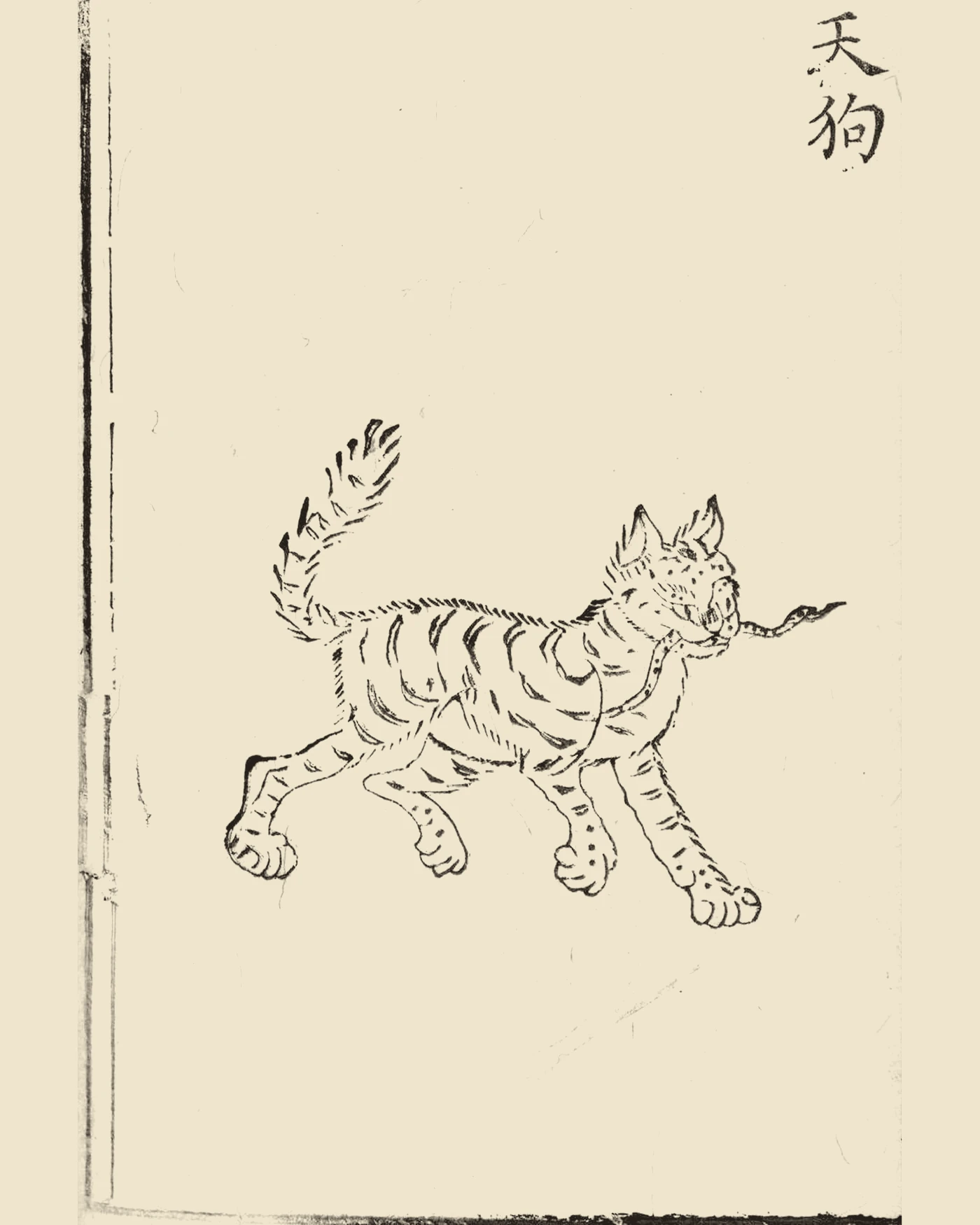
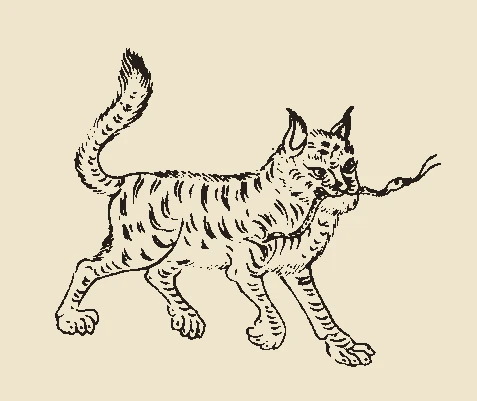
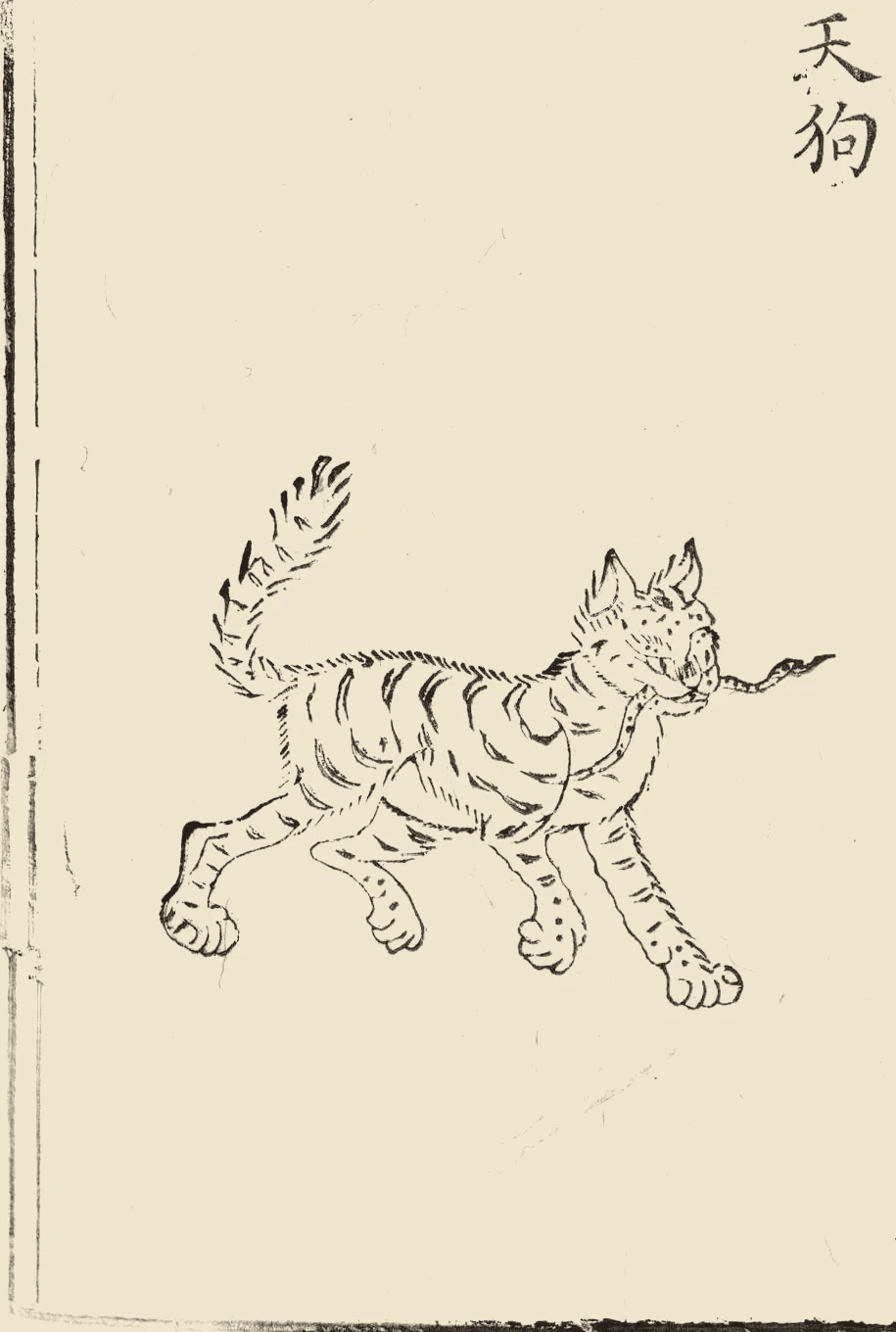
Gujin Tushu Jicheng's 1726 woodblock print of Tiangou清代《古今图书集成》中的天狗图 — Qing imperial print showing the striped beast biting a snake without background清代铜活字印本版画,呈白底口中衔蛇奔行之状,无页缘边框
Woodblock print of Tiangou from Hu Wenhuan's Xin Ke Shan Hai Jing Tu, juan 2, page 139, 1593 (Wanli era, Ming dynasty)明万历二十一年(1593)胡文焕编《新刻山海经图》卷二第139页“天狗”插图木刻版画 · Public domain公有领域Tiangou Tu 天狗圖, the cat-like beast striding with prey in its mouth. Gujin Tushu Jicheng 古今圖書集成, Qin Chong Dian (Section on Birds and Animals), woodblock print, 1726清·陈梦雷等编《古今图书集成·禽虫典》“天狗图”,雍正四年(1726)铜活字印本 · Chen Menglei 陳夢雷 (ed.)陈梦雷 编, 17261726年
Highlighted words: anatomy part · feature · form type — tap to jump标色词:形态部位 · 特征 · 形态类别,点击可跳转
Three hundred li further west is Mount Yin. The Zhuoyu River rises here and flows south to empty into the Fan Marsh; within it are many patterned shells. A beast dwells here shaped like a wildcat with a white head, named Tiangou; its cry sounds like 'liuliu', and keeping it can ward off misfortune.
Comparing the Books典籍对比
The Shan Hai Jing describes Tiangou not as a monstrous dog or eclipse demon, but as a benevolent feline guardian beast shaped like a wildcat with a white head whose presence averts evil. Later Han dynasty astronomical treatises used the same name for fiery meteors, which eventually fused in folk myth into the moon-swallowing celestial dog.
The story来历与故事
The ancient feline guardian of Mount Yin from the Shan Hai Jing: a white-headed wildcat whose melodious cry warded off misfortune, distinct from later folklore of moon-eating celestial hounds.
The White-Headed Cat of Mount Yin阴山灵兽:如狸白首与榴榴之鸣
On Mount Yin, Tiangou is a white-headed wildcat whose cry sounds like liuliu and which wards off misfortune.《西山经》记载天狗在阴山,样子像狸而白首,叫声如“榴榴”,可以御凶。
In the Classic of the Western Mountains within the Shan Hai Jing, Tiangou makes its earliest textual appearance not as a canine demon, but as an uncanny mountain quadruped: 'Three hundred li further west is Mount Yin. The Zhuoyu River rises here and flows south to empty into the Fan Marsh; within it are many patterned shells. A beast dwells here shaped like a wildcat with a white head, named Tiangou; its cry sounds like 'liuliu', and keeping it can ward off misfortune.'
The text compares it to a li 狸, a wildcat. The Ming dynasty scholar Hu Wenhuan portrayed the animal in his 1593 woodblock print as a striped, agile feline striding forward with alert ears and an upright bushy tail, grasping a serpent firmly in its jaws—the classic posture of an apex predator eliminating venomous vermin.
Tiangou Tu 天狗圖, the cat-like beast striding with prey in its mouth. Gujin Tushu Jicheng 古今圖書集成, Qin Chong Dian (Section on Birds and Animals), woodblock print, 1726清·陈梦雷等编《古今图书集成·禽虫典》“天狗图”,雍正四年(1726)铜活字印本
Warding off Misfortune in Ancient Lore先秦古意:从佩御凶祟到护宅吉兽
In the Shan Hai Jing, Tiangou is a helpful beast that wards off misfortune, not a monster.在《山海经》里,天狗不是凶兽,而是可以御凶的吉兽。
The defining attribute of Tiangou in the Shan Hai Jing is its apotropaic efficacy: 'keeping it can ward off misfortune' (可以禦凶). The text does not explain how this worked; it simply lists the power alongside the creature's look and cry.
This protective reputation stands in stark opposition to later dark celestial interpretations. In the Shan Hai Jing it is a helpful mountain animal, not a sky monster.
From Mountain Feline to Celestial Eclipse Dog从山海灵狸到后世天狗食月
The Shiji names a falling meteor Tiangou; later folk belief turned the name into an eclipse-eating dog.《史记·天官书》把坠地的大流星称为“天狗”,后世民间才有天狗吃月的说法。
During the Han dynasty, ancient cosmologists began applying the term 'Tiangou' to astronomical phenomena. Sima Qian's Shiji (Treatise on the Celestial Offices) records the 'Tiangou star'—a blazing bolide or meteor that streaked across the night sky with a roaring thunderous rumble and landed like a burning dog. Over centuries of oral folklore, this name for a meteor became linked in folk belief with eclipses.
In modern Sinophone pop culture, the mythical figure of Tiangou is frequently celebrated across video games, web novels, and anime. While international audiences sometimes confuse Chinese Tiangou with the bird-beaked or red-faced Japanese tengu (which originated from the same linguistic root but diverged into mountain goblins), rediscovering the original Shan Hai Jing feline Tiangou restores a vital, protective chapter of China's classical bestiary.
Record档案
Record Card档案卡
Type
Auspicious Beast (white-headed wildcat warding off evil)
Also known as
Heavenly Dog; Celestial Hound; Mountain Cat of Yin
Earliest source
Shan Hai Jing 山海經 (Classic of the Western Mountains, c. 4th–2nd c. BCE)
Power
Possesses the supernatural power to repel misfortune and ward off evil spirits (禦凶)
Symbolism
Wards off misfortune in the Shan Hai Jing; later folklore turned the name into the moon-eating celestial dog
In the Shan Hai Jing, Tiangou is an auspicious feline beast resembling a wildcat with a white head. It lives on Mount Yin and possesses the power to ward off evil and misfortune.
Why do people believe Tiangou eats the moon?
The 'moon-eating celestial hound' is a later folklore development. In the Shiji (Treatise on the Celestial Offices), a roaring meteor that falls to earth is called Tiangou; over centuries, this celestial phenomenon merged with folk eclipse stories to create the myth of the moon-swallowing dog.
Is Chinese Tiangou the same as Japanese Tengu?
No. While the name was borrowed into Japanese from Chinese star and bird-spirit lore, the Japanese tengu evolved into mountain goblins with long red noses or bird beaks, completely different from China's Shan Hai Jing white-headed wildcat.
Why is Tiangou depicted biting a snake in woodblock prints?
Both Hu Wenhuan's 1593 print and the Gujin Tushu Jicheng depict Tiangou biting a snake, representing its role as a fierce predator of venomous creatures and symbolizing its ability to conquer malicious poison and evil.