Kuí

夔Kui, the One-Legged Thunder Beast

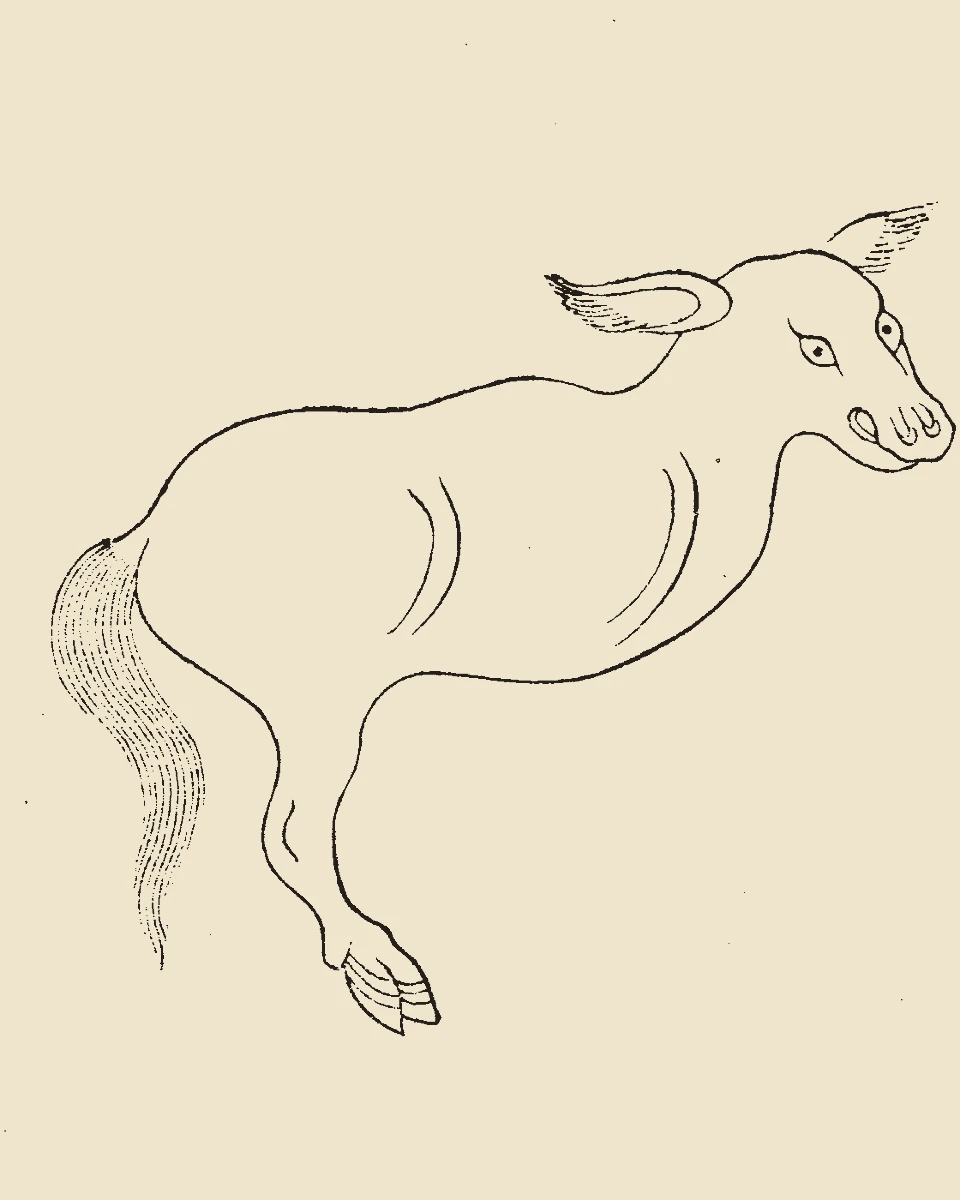
A hornless, one-legged ox of the Eastern Sea that shines like the sun and roars like thunder.东海流波山上出入伴随风雨、状如青牛而无角、光如日月、声如雷鸣的独足神兽。

Body身形

Like an ox, grey-blue body状如青牛,苍身

狀如牛,蒼身

Head头面

Hornless无角

無角

Legs足

One leg独足而立

一足

Voice叫声

Like thunder吼声像打雷

其聲如雷

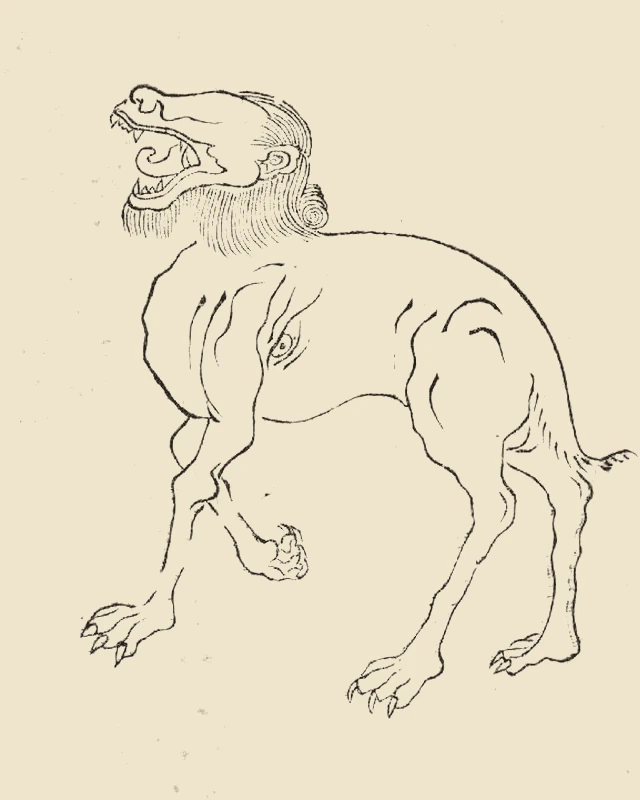
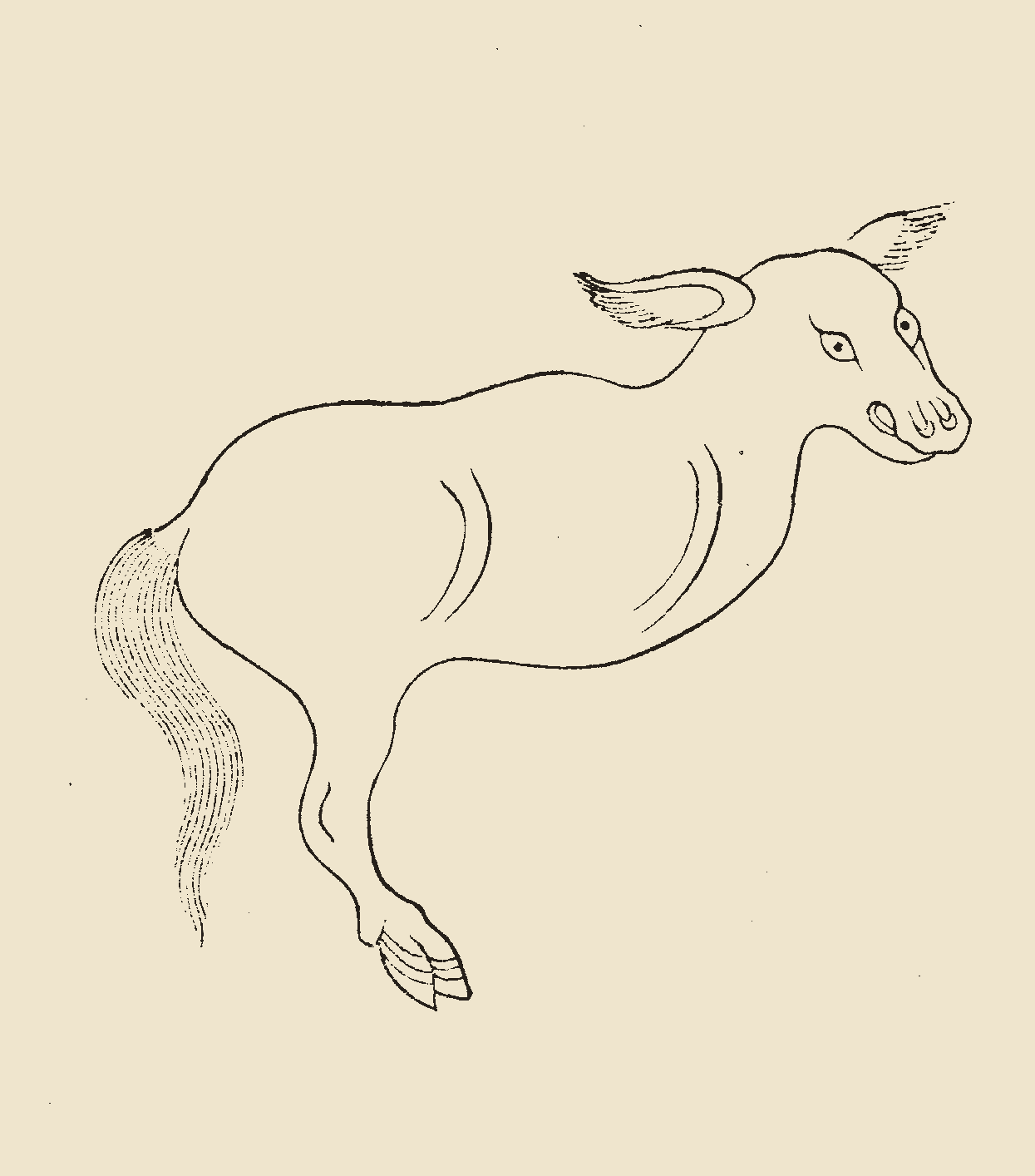
Woodblock print from the Gujin Tushu Jicheng showing Kui, a hornless one-legged ox-like beast無角Hornless head头上无角無角Hornless head头上无角狀如牛,蒼身Ox-like body, grey-blue状如青牛,苍身狀如牛,蒼身Ox-like body, grey-blue状如青牛,苍身其聲如雷Roar like thunder叫声如雷鸣其聲如雷Roar like thunder叫声如雷鸣一足A single leg独足而立一足A single leg独足而立
出入水則必風雨,其光如日月

Whenever it goes in or out of the water there is wind and rain; its light is like the sun and moon.

山海經·大荒東經
Kui, from the Gujin Tushu Jicheng imperial encyclopaedia (1700–1725), ed. Chen Menglei夔图,出自《古今图书集成》(1700–1725),陈梦雷编 · Public domain公有领域Same design also in: 同一图样亦见于:Hu Wenhuan 胡文煥 (ed.)胡文焕 编, 15931593年; Wu Renchen (ed.)吴任臣 编, 17861786年

Highlighted words: anatomy part · feature · form type — tap to jump标色词:形态部位 · 特征 · 形态类别,点击可跳转

The texts原文

Original Text & Translation原文与译文

山海經·大荒東經 · Shan Hai Jing · Classic of the Great Wilds: East · Wikisource

東海中有流波山,入海七千里。其上有獸,狀如牛,蒼身而無角,一足,出入水則必風雨,其光如日月,其聲如雷,其名曰夔。黃帝得之,以其皮為鼓,橛以雷獸之骨,聲聞五百里,以威天下。
In the Eastern Sea is Mount Liubo, seven thousand li out into the sea. On it lives a beast shaped like an ox, with a grey-blue body, no horns and a single leg. Whenever it goes into or out of the water there is wind and rain. It shines like the sun and moon and its voice is like thunder. Its name is Kui. The Yellow Emperor captured it and made a drum from its hide, beating it with the bone of the Thunder Beast. Its sound carried five hundred li and overawed all under heaven.

莊子·秋水 · Zhuangzi · Autumn Floods · Wikisource

夔憐蚿,蚿憐蛇,蛇憐風,風憐目,目憐心。夔謂蚿曰:「吾以一足趻踔而行,予无如矣。今子之使萬足,獨奈何?」
The Kui envies the millipede, the millipede envies the snake, the snake envies the wind, the wind envies the eye, and the eye envies the mind. The Kui said to the millipede: "I hop along on one leg, and nothing is simpler. Now you manage ten thousand legs — how on earth do you do it?"
Show all sources (5)展开全部出处(5)

韓非子·外儲說左下 · Han Feizi, Outer Collected Sayings (Lower Left) · Wikisource

魯哀公問於孔子曰:「吾聞古者有䕫一足,其果信有一足乎?」孔子對曰:「不也,䕫非一足也。䕫者忿戾惡心,人多不說喜也。雖然,其所以得免於人害者,以其信也。人皆曰:『獨此一,足矣。』䕫非一足也,一而足也。」
Duke Ai of Lu asked Confucius: “I have heard that in ancient times there was a Kui with one foot. Did it really have only one foot?” Confucius replied: “No, Kui did not have one foot. Kui was hot-tempered and ill-natured, and many people disliked him. Even so, he escaped harm because he was trustworthy. Everyone said: ‘This one quality alone is enough.’ Kui did not have one foot; one was enough.”

呂氏春秋·察傳 · Lüshi Chunqiu, Examining What Is Heard · Wikisource

魯哀公問於孔子曰:「樂正夔一足,信乎?」孔子曰:「昔者舜欲以樂傳教於天下,乃令重黎舉夔於草莽之中而進之,舜以為樂正。夔於是正六律,和五聲,以通八風,而天下大服。重黎又欲益求人,舜曰:『夫樂,天地之精也,得失之節也,故唯聖人為能和。樂之本也。夔能和之,以平天下。若夔者一而足矣。』故曰夔一足,非一足也。」
Duke Ai of Lu asked Confucius: “Is it true that Kui the music master had one foot?” Confucius said: “Long ago Shun wished to teach the world through music, so he had Chongli find Kui among the common people and bring him forward, and Shun made him music master. Kui then set the six pitch-pipes in order and harmonised the five notes so as to open the eight winds, and the whole world submitted. Chongli wanted to look for more men, but Shun said: ‘Music is the essence of heaven and earth, the measure of gain and loss, so only a sage can harmonise it. Kui can harmonise it and so bring peace to the world. One like Kui is enough.’ So ‘Kui one foot’ means not one foot but ‘one is enough’.”

尚書·舜典 · Book of Documents, Canon of Shun · Wikisource

帝曰:「夔!命汝典樂,教冑子,直而溫,寬而栗,剛而無虐,簡而無傲。詩言志,歌永言,聲依永,律和聲。八音克諧,無相奪倫,神人以和。」夔曰:「於!予擊石拊石,百獸率舞。」
The Emperor said: “Kui! I appoint you to direct music and teach the young nobles: to be upright yet gentle, generous yet strict, firm without cruelty, simple without arrogance. Poetry expresses intent, song prolongs the words, notes follow the prolonging, and the pitch-pipes harmonise the notes. When the eight kinds of instrument are in concord and none disturbs another, spirits and men are brought into harmony.” Kui said: “Oh! I strike the stone, I tap the stone, and the hundred beasts dance together.”

Comparing the Books典籍对比

Both books agree on the defining trait: a single leg. The Shanhaijing makes Kui a storm beast and war-drum; Zhuangzi uses it as the opening figure of a parable on natural spontaneity.
The story来历与故事

Kui is a one-legged ox of the Eastern Sea that brings storms, shines like the sun and moon and roars like thunder. The Yellow Emperor turned its hide into a war drum. The same name also belongs to a legendary music master, and the confusion between the two gave Chinese one of its oldest jokes.

Kui the storm beast风雨之兽夔

A one-legged ox of the sea whose hide became the Yellow Emperor's drum.一只单足的大海异兽,其皮制成了上古轩辕战鼓。

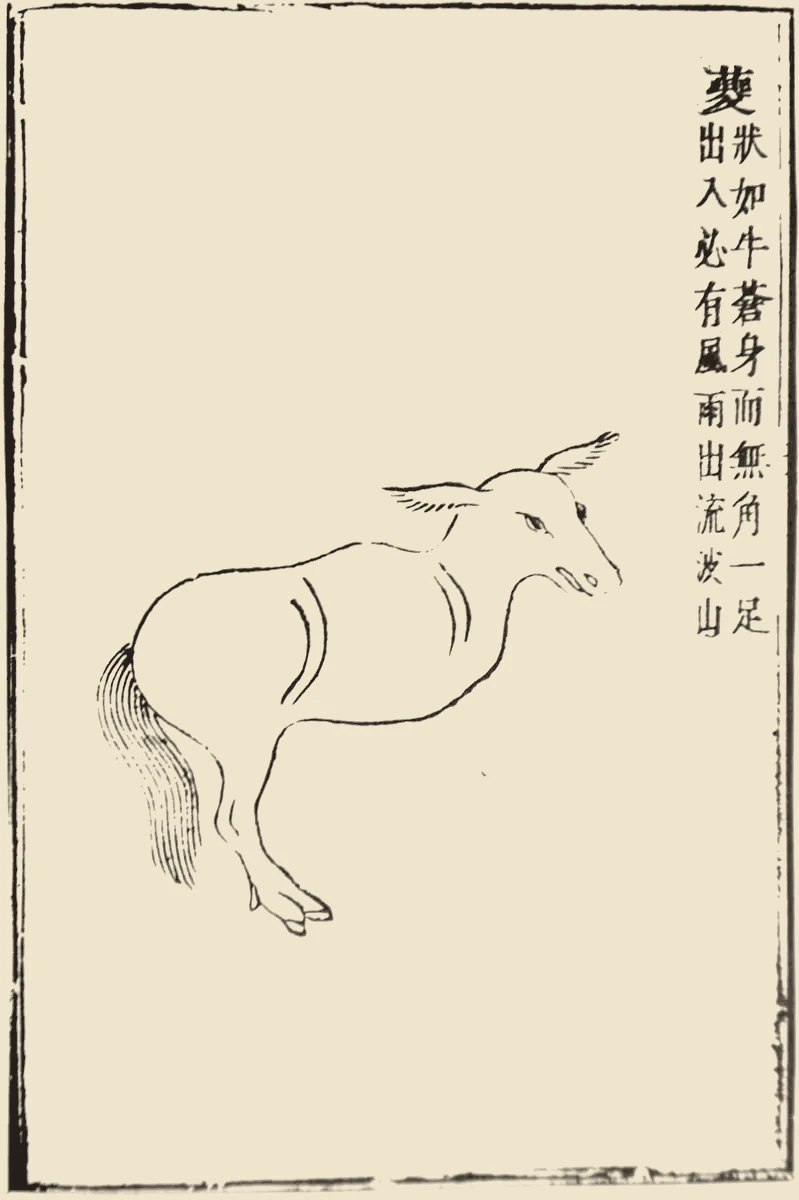
The Classic of the Great Wilds: East places Kui on Mount Liubo, seven thousand li out in the Eastern Sea. It looks like an ox with a grey-blue body and no horns, and it has only one leg. Whenever it enters or leaves the water there is wind and rain; its light is like the sun and moon, and its voice is like thunder.

The Yellow Emperor captured it and made a drum from its hide, beating it with a bone from the Thunder Beast. The drum could be heard five hundred li away and was used to overawe the world. Later tradition links this drum to the Yellow Emperor's war against Chiyou, though the Shan Hai Jing passage itself says only that it was used to inspire awe.

Kui, from Wu Renchen's Shanhaijing Guangzhu (Extended Commentary on the Shan Hai Jing), 1786 printing
Kui, from Wu Renchen's Shanhaijing Guangzhu (Extended Commentary on the Shan Hai Jing), 1786 printing吴任臣《山海经广注》中的夔,1786年刊本

Kui the music master乐官夔

A second Kui was Shun's minister of music, and a pun on 'one foot' joined the two.另一个夔是舜的乐官,一个关于“唯此一人已足”的双关把两者联系了起来。

A completely different Kui appears in the Book of Documents. In the Canon of Shun, the sage emperor appoints Kui as director of music and gives him a short speech on what music should do. Kui answers that when he strikes the stone chimes, the hundred beasts dance. This Kui is a human official, the patron figure of Chinese ritual music.

The two Kuis share a name, and both stories are about sound with power over nature: a thunder-voiced beast whose hide becomes a drum heard five hundred li away, and a musician whose stone chimes make the hundred beasts dance. Neither text connects them, so this is a resemblance, not an established link.

By the Warring States period people were already confused. Two books record the same anecdote. Duke Ai of Lu asks Confucius whether it is true that Kui had only one foot. Confucius explains that the saying 夔一足 does not mean ‘Kui, one foot’ but ‘Kui, one is enough’, because the character 足 means both ‘foot’ and ‘enough’.

The Lüshi Chunqiu version credits Shun himself: when advised to look for more musicians, he says one like Kui is enough. The Han Feizi gives two versions, one saying Kui was bad-tempered but trusted, so ‘this one quality is enough’. Both stories are told as lessons in checking what you hear, and both show that the one-legged monster was already familiar enough to need explaining away.

Kui in Zhuangzi and bronze art《庄子》与青铜器上的夔

From Zhuangzi's fable of envy to bronze dragon motifs, the one-legged figure lived on.从《庄子》的羡慕链寓言到商周青铜器上的夔龙纹,独足的形象流传深远。

Zhuangzi uses the one-legged beast as the opening voice of a famous chain of envy in the chapter Autumn Floods. The Kui envies the millipede, which has countless legs; the millipede envies the snake, which needs none; the snake envies the wind; the wind envies the eye; the eye envies the mind. Kui is the clumsy hopper who cannot understand how anyone manages with more legs, a joke that only works because readers already knew it had just one.

Art historians use the name kui for a third thing: a stylised one-legged dragon seen in profile on Shang and Zhou bronze vessels, jade and later mirrors. Whether ancient casters actually called it kui is uncertain; the label comes from later antiquarians who connected the single visible leg with the one-legged Kui of the texts. The gallery includes a Han mirror and a Zhou ding with this motif.

Kui today今天的夔

In modern fantasy and gaming, Kui endures as a colossal mythical creature of the sea.在现代奇幻创作与游戏中,它作为撼动天地的上古异兽活跃至今。

In modern fantasy literature and video games, Kui is almost always reimagined as a colossal thunder ox or ancient divine beast, commanding tempests and lightning strikes across the sea.

Across contemporary adaptations, Kui remains a powerful symbol of primordial storm and thunder, carrying forward the Shan Hai Jing's vision of a one-legged beast whose presence shakes the sea and sky.

Record档案

Record Card档案卡

TypeBeast (one-legged ox)
Also known asKui Ox (夔牛); One-Legged Thunder Beast (獨足雷獸); Kui Dragon (夔龍); Music Master Kui (樂正夔)
HabitatMount Liubo, 7,000 li out in the Eastern Sea
PowerBrings wind and rain whenever it enters or leaves the water
UseThe Yellow Emperor drummed on its hide (beaten with a thunder-beast bone) — heard 500 li away, to awe the world
Earliest source山海經·大荒東經
Source books山海經·大荒東經
莊子·秋水
Image sourceChen Menglei 陳夢雷 (ed.) · Wikimedia Commons
LicensePublic domain

Frequently Asked Questions

What is the Kui in Chinese mythology?

A one-legged, hornless ox-like beast from the Eastern Sea, described in the Shan Hai Jing. It causes wind and rain, shines like the sun and moon and roars like thunder. The Yellow Emperor made a drum from its hide.

Did Kui really have one leg?

In the Shan Hai Jing the beast does. But the Han Feizi and Lüshi Chunqiu record Confucius explaining that the saying 夔一足 about Kui the music master means ‘one is enough’, not ‘one foot’.

What did the Yellow Emperor do with the Kui?

He made a war drum from its hide and beat it with a bone of the Thunder Beast. According to the Shan Hai Jing the sound carried five hundred li and overawed the world.