The supreme auspicious bird of Chinese myth with five-coloured patterned feathers, whose body inscriptions embody the five cardinal virtues.身披五彩斑斓文彩的百鸟之王,首翼背膺腹各具德性之纹,自歌自舞、见则天下安宁。
Body身形
Like a rooster样子像鸡
其狀如雞
Colour羽色
Five colours, patterned五种颜色带花纹
五采而文
Voice歌舞
Sings and dances by itself自己唱歌跳舞
自歌自舞
Omen祥瑞
Its coming means peace出现则天下太平
見則天下安寧
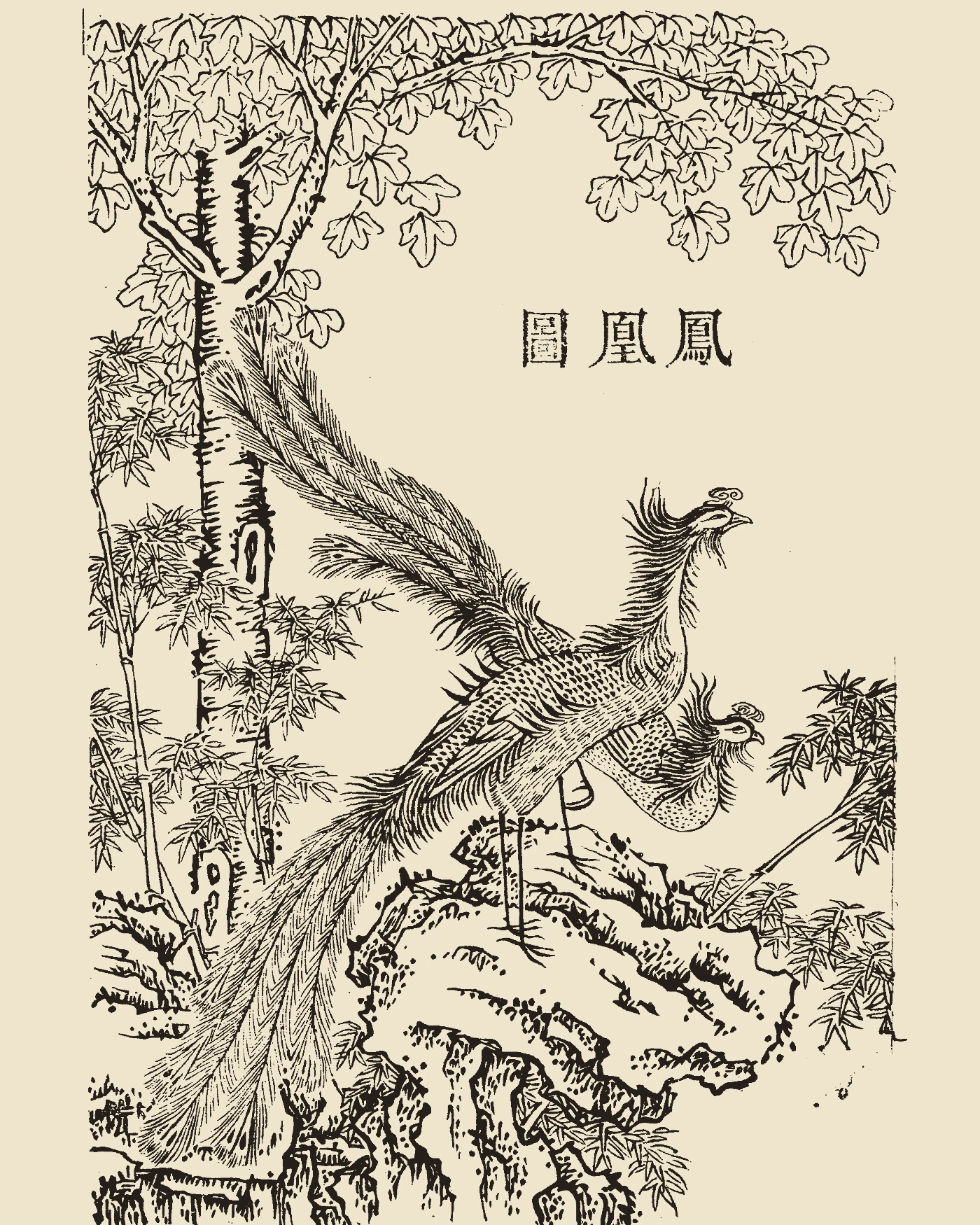
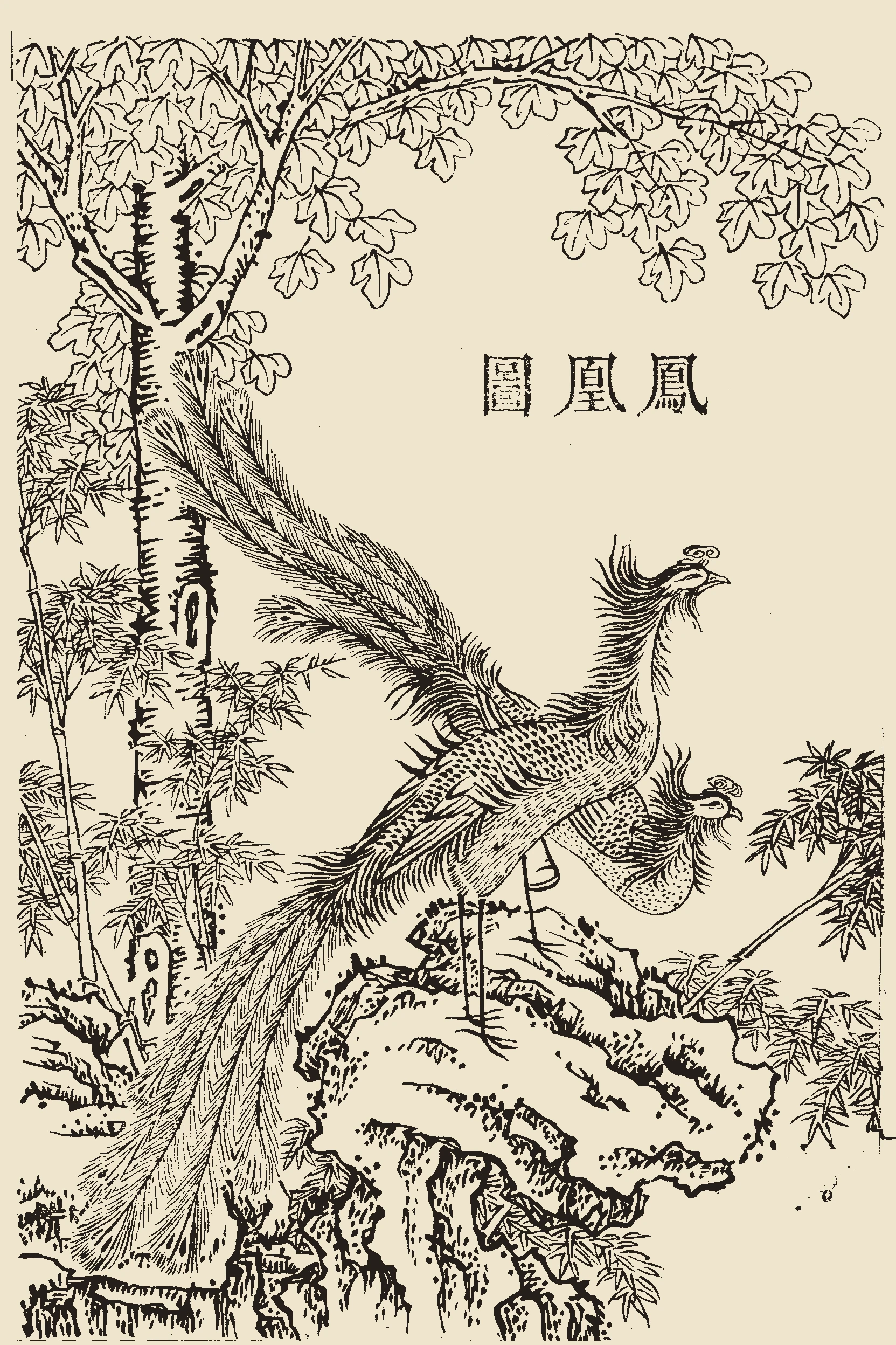
Gujin Tushu Jicheng’s 1726 imperial woodblock print depicting the Fenghuang perched in rocky groves.清代《古今图书集成》中的凤凰图,呈现五彩神鸟伫立于山石幽林间的瑞兽形貌。
首文曰德,翼文曰義,背文曰禮,膺文曰仁,腹文曰信
The markings on its head say Virtue; on its wings, Righteousness; on its back, Propriety; on its breast, Benevolence; and on its belly, Faithfulness.
European Baroque engraving of the phoenix perched on a crag欧洲巴洛克铜版画中的立岩长尾凤凰 — Baroque shading, crest of plumes, long peacock-like tail feathers draped over rocks巴洛克铜版排线阴影,顶生羽冠,孔雀般长尾垂于山石之上
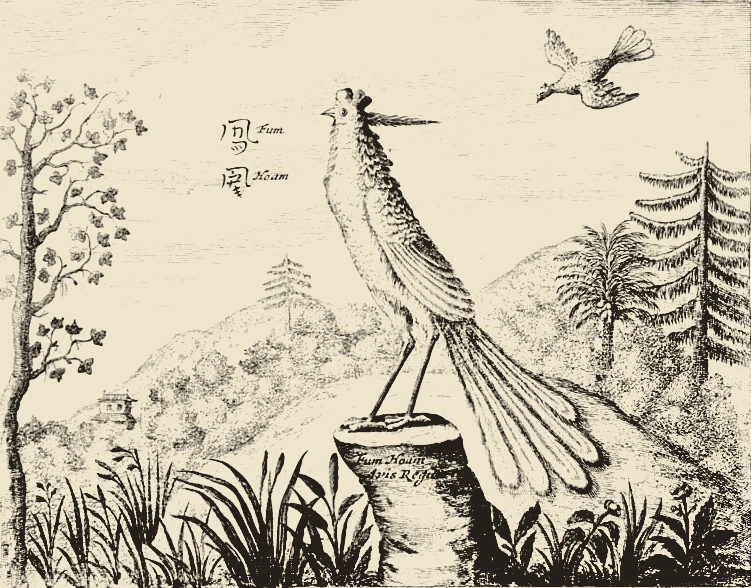
Fenghuang Tu 鳳凰圖, the auspicious phoenix perched by paulownia and bamboo. Gujin Tushu Jicheng 古今圖書集成, Qin Chong Dian (Section on Birds and Animals), woodblock print, 1726清·陈梦雷等编《古今图书集成·禽虫典》“凤凰图”,雍正四年(1726)铜活字印本 · Public domain公有领域European engraving of the Fenghuang from Johannes Nieuhof's Toonneel van China, published by J. J. van Waesberge, Amsterdam, 1664荷兰 1664 年《Toonneel van China》(中国舞台)铜版画中的凤凰插图,J. J. van Waesberge 刊印于阿姆斯特丹 · Johannes Nieuhof (1618–1672) / J. J. van Waesberge约翰内斯·纽霍夫/J. J. 范·瓦斯伯赫, 16641664年
Highlighted words: anatomy part · feature · form type — tap to jump标色词:形态部位 · 特征 · 形态类别,点击可跳转
On Mount Danxue, there is much gold and jade above. The Dan River issues from here and flows south into the Bohai Sea. There is a bird here shaped like a rooster, patterned with five radiant colours, named the Fenghuang. The markings on its head say Virtue; on its wings, Righteousness; on its back, Propriety; on its breast, Benevolence; and on its belly, Faithfulness. This bird eats and drinks according to nature, sings and dances by itself, and when it is seen, there is peace under heaven.
The Master said: 'The phoenix does not come, and the Yellow River brings forth no chart. It is all over with me!'
Comparing the Books典籍对比
The Classic of Mountains and Seas depicts the Fenghuang as a rooster-like bird of Mount Danxue whose plumage physically embodies the five Confucian virtues; Confucius in the Analects laments its absence as a cosmic sign of moral decline in turbulent times.
The story来历与故事
The supreme auspicious bird of Chinese myth: a feathered sovereign patterned in five colours, whose body characters symbolize the five cardinal virtues of benevolence, righteousness, propriety, virtue, and faithfulness. Its singing and dancing herald profound harmony across heaven and earth.
The Bird of Five Virtues on Danxue Mountain丹穴之山与五德之鸟
Perched upon Mount Danxue, its five-coloured plumage bears inscriptions proclaiming the five cardinal virtues.栖于丹穴之山,身披五彩文锦,其身躯各部文彩分别昭示仁、义、礼、德、信。
The Shan Hai Jing records in the Classic of the Southern Mountains that Mount Danxue abounds in gold and jade, with the Dan River flowing southward into the Bohai Sea. Upon this sacred peak dwells the Fenghuang, a glorious avian shaped like a rooster, draped in patterned plumage of five radiant colours. Ancient scribes observed that the celestial patterns inscribed upon its feathers correspond directly to cosmic virtues: the head patterns signify Virtue (De), the wing patterns Righteousness (Yi), the back patterns Propriety (Li), the breast patterns Benevolence (Ren), and the belly patterns Faithfulness (Xin).
Unlike terrestrial predators, the Fenghuang partakes of food and drink only in natural accordance with the wild cosmos. It sings and dances by its own spontaneous joy. Classical accounts affirm that its arrival is no ordinary portent: wherever the phoenix appears, celestial peace, abundant harvest, and universal harmony blanket all under heaven.
European engraving of the Fenghuang from Johannes Nieuhof's Toonneel van China, published by J. J. van Waesberge, Amsterdam, 1664荷兰 1664 年《Toonneel van China》(中国舞台)铜版画中的凤凰插图,J. J. van Waesberge 刊印于阿姆斯特丹
The Auspicious Portent and the Sages孔子叹凤与圣王瑞应
Regarded as one of the Four Sacred Spirits, its absence prompted Confucius to lament the decay of moral order.列为上古四灵之一,乱世不现,曾引得孔子发出“凤鸟不至,吾已矣夫”之叹。
Throughout early Chinese literature, the phoenix was celebrated alongside the dragon, the qilin, and the sacred tortoise as one of the Four Sacred Spirits (Si Ling). In the Analects, Confucius lamented the moral decline of his era by invoking the bird's absence: 'The phoenix does not arrive; the River produces no chart. It is all over with me!' (子曰:鳳鳥不至,河不出圖,吾已矣夫!). To the sages of the Zhou dynasty, the bird appeared only when true moral kings governed the land.
Later classical compendia such as the Classic of Filial Piety and the Song Shu recorded that when sage emperors like Shun and King Wen of Zhou held sway, flocks of phoenixes descended upon the imperial courts and palatial groves, their melodious cries harmonizing with classical reed pipes and zithers. The female was traditionally distinguished as the Huang and the male as the Feng, united into the single title Fenghuang to represent supreme marital harmony and imperial majesty.
子曰:鳳鳥不至,河不出圖,吾已矣夫!
The Master said: 'The phoenix does not come, and the Yellow River brings forth no chart. It is all over with me!'
— 論語·子罕第九 · Analects
The Phoenix in Global Imagination从凤鸣岐山到全球文化象征
Unlike the Western fire-dying bird, the immortal Chinese Fenghuang remains an eternal emblem of peace and virtue.与西方火中重生的不死鸟不同,华夏凤凰始终是不死不灭、象征仁德与大治的祥瑞。
In modern global culture, the Fenghuang is widely recognized as the definitive 'Chinese Phoenix', though mythologists take care to distinguish it from the Western fire-resurrecting bird (the Egyptian Bennu or Greek Phoinix). Where the Greco-Roman phoenix dies in flames and rises from its ashes, the Chinese Fenghuang is an immortal sovereign of peace, virtue, and natural balance that never combusts.
Across contemporary East Asian art, cinema, and digital video games, Fenghuang continues to reign as an immortal icon of beauty and sovereign power. From classic Peking opera headdresses to international fantasy games like Final Fantasy and Genshin Impact, and high-profile wuxia animations, the five-coloured bird remains one of the most beloved and noble emissaries of traditional Chinese mythology.
Record档案
Record Card档案卡
Type
Auspicious Bird (sovereign of five virtues)
Also known as
Chinese Phoenix; Bird of Five Virtues 五德之鳥; Vermilion Bird 朱雀 (distinct in origin but conflated in popular lore)
Earliest source
Shan Hai Jing 山海經 (Classic of the Southern Mountains) & Analects 論語
Markings
Head markings say Virtue (De), wings Righteousness (Yi), back Propriety (Li), breast Benevolence (Ren), belly Faithfulness (Xin)
Nature
Spontaneous song and dance; feeds naturally without harming living creatures; appears only when peace and sage virtue prevail
Symbolism
Supreme symbol of imperial peace, virtuous governance, and auspicious cosmic harmony
The Fenghuang is the supreme sovereign of all birds in ancient Chinese mythology, renowned for its five-coloured plumage and body markings that symbolize the five cardinal Confucian virtues. First recorded in the Shan Hai Jing on Mount Danxue, its appearance is the ultimate omen of peace and harmony.
How is the Fenghuang different from the Western Phoenix?
While the Western Phoenix (from Greek and Egyptian myth) periodically burns itself in flames and is reborn from ashes, the Chinese Fenghuang does not burn or die. Instead, it is an immortal emblem of moral perfection, peace, and natural harmony.
What do the five colours and body patterns of the Fenghuang represent?
According to the Shan Hai Jing, the plumage characters on its body symbolize five virtues: head markings represent Virtue (De), wings represent Righteousness (Yi), back represents Propriety (Li), breast represents Benevolence (Ren), and belly represents Faithfulness (Xin). Its five colours reflect the Five Cosmic Elements (Wu Xing).
Is the Fenghuang male or female?
In early tradition, Feng was the male bird and Huang was the female bird, together forming a harmonious couple that symbolizes marital bliss. In later imperial times, the Fenghuang as a unified entity was paired with the male Dragon to symbolize the Empress and female royal power.