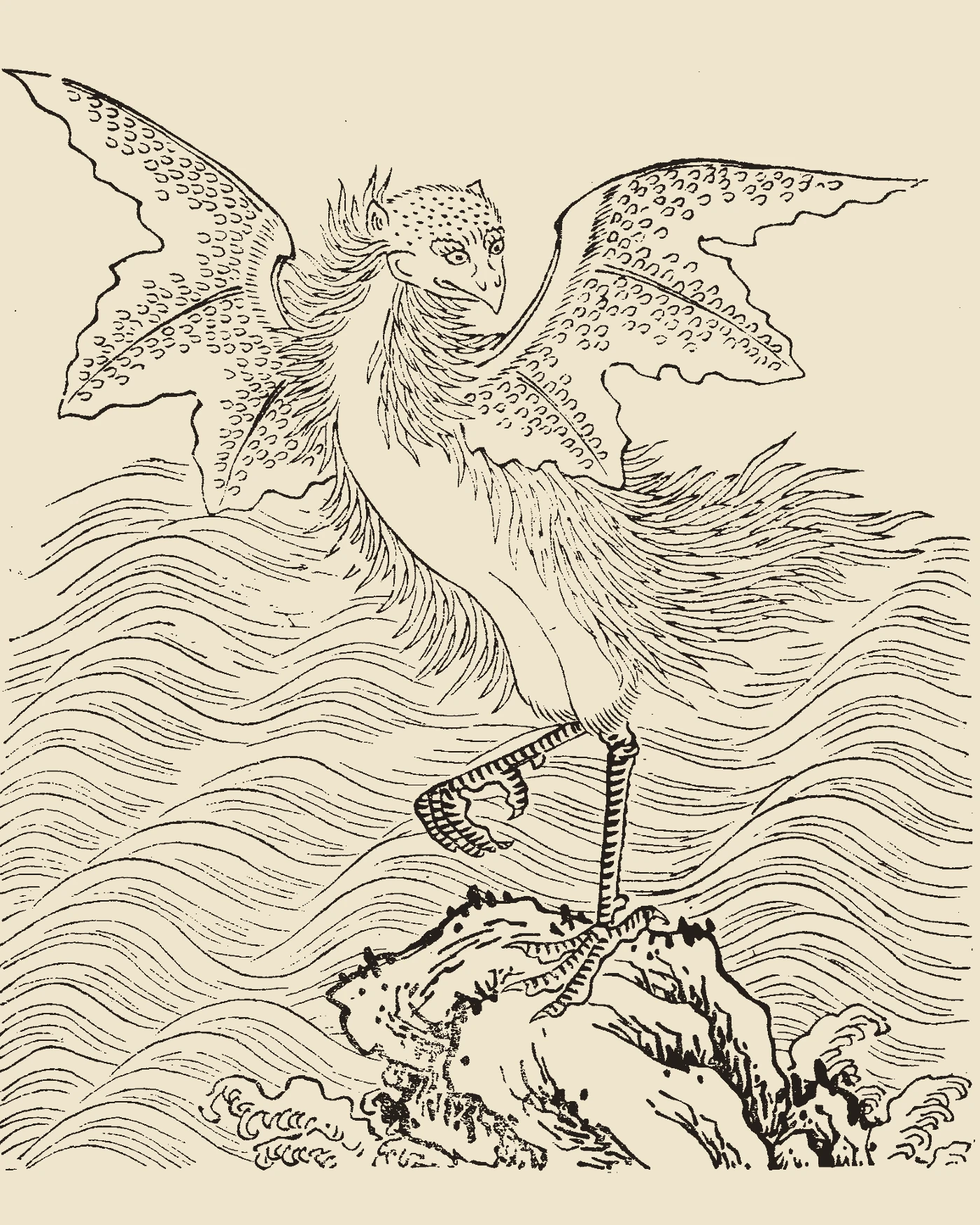
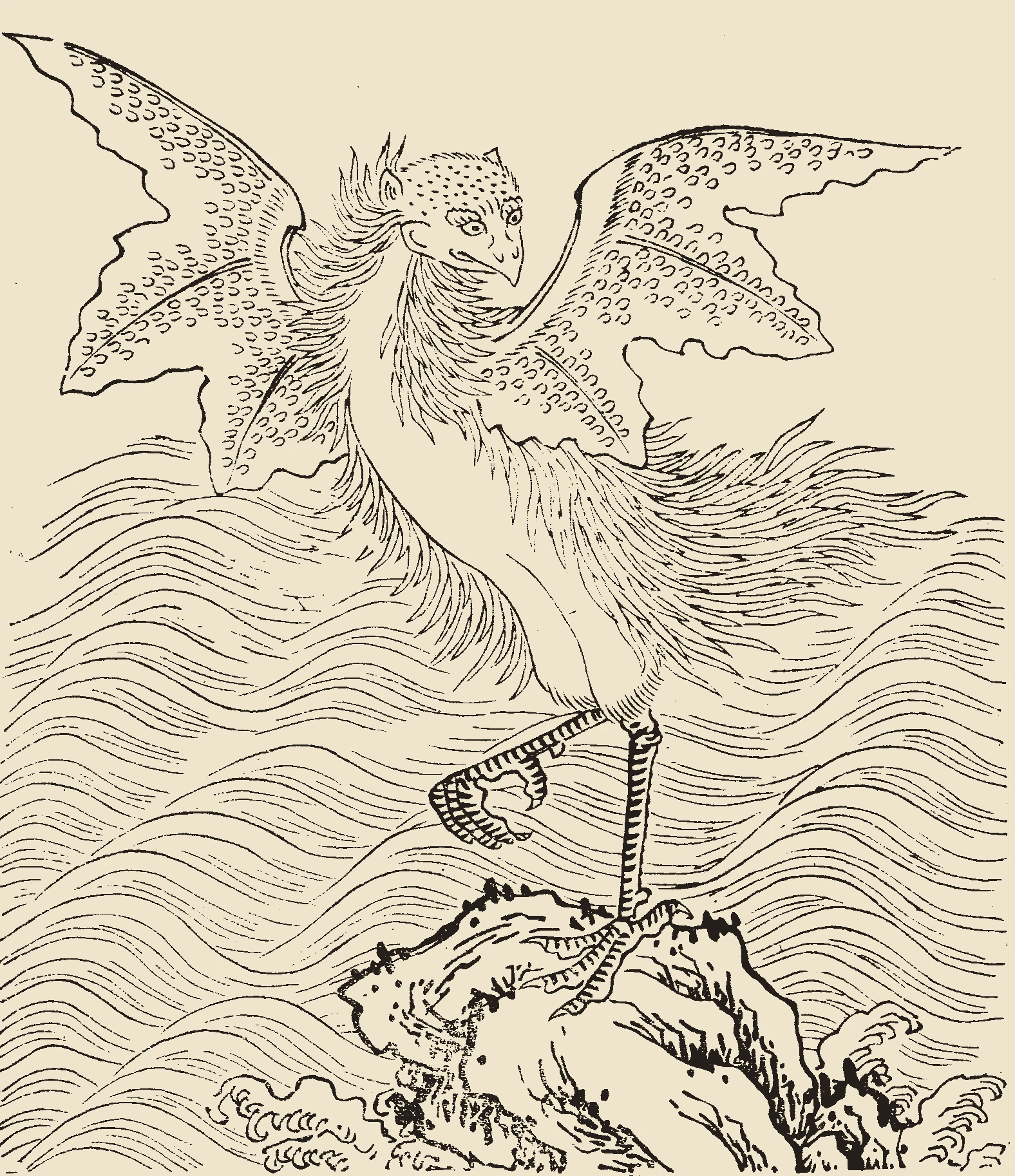
The titan bird of Daoist philosophy: a primeval creature of staggering dimensions that transforms from the leviathan Kun in the northern ocean, bearing wings like clouds suspended from heaven that beat three thousand li of ocean waves to soar ninety thousand li into the infinite azure.
The Leviathan and the Cosmic Bird北冥巨鱼与垂天之鹏
Transforming from the fathomless fish Kun, the colossal Peng spreads wings that veil the entire horizon.化生自极北北冥深渊中的鲲鱼,大鹏振翅,双翼若垂天之云遮蔽万里苍穹。
In the opening passage of the Xiaoyaoyou (Free and Easy Wandering), the first chapter of the Daoist masterpiece Zhuangzi, the author introduces a creature of unimaginable scale: 'In the Northern Darkness there is a fish, named the Kun. The size of the Kun is so vast, none know how many thousands of li it extends. It transforms into a bird, named the Peng.' In Chinese cosmology, this miraculous metamorphosis from the abyssal marine leviathan to the sovereign avian titan represents the ultimate dissolution of physical boundaries, uniting the depths of the primordial sea with the boundless heights of heaven.
The physical presence of the Peng defies earthly comprehension. Zhuangzi describes its spine and feathers as spanning thousands of li across the horizon: when the bird rouses its immense strength and beats its wings to ascend, its outstretched plumage appears like vast clouds hanging from the dome of heaven. Far from being a mere aerial beast, Peng serves as a cosmic monument to scale, contrasting the petty constraints of finite perception with the infinite grandeur of the Dao.
Ninety Thousand Li into the Azure Sky水击三千与扶摇九万
Striking the sea for three thousand li, Peng spirals upon cyclones to journey toward the celestial Southern Lake.击水三千、乘扶摇之风腾跃九万里,以六月大风为息迁徙于南方天池。
The migration of the Peng from the Northern Darkness to the Southern Darkness (the Heavenly Lake) is depicted as a planetary event that shifts the celestial currents. Zhuangzi writes: 'When the Peng migrates to the Southern Darkness, it strikes the waters for three thousand li, spirals upward upon a whirlwind to a height of ninety thousand li, and journeys on the breath of the sixth month.' Only after ascending far beyond the turbulence of earth, where the sky is of an unbroken pure azure and no dust can cloud its vision, does the great bird set its course toward the south.
This monumental flight provoked the mockery of the cicada and the turtledove, who boasted that flitting from elm to sandalwood branch was the summit of flying, ridiculing Peng's ninety-thousand-li ascent. Through this immortal fable, Zhuangzi established the eternal philosophical distinction between small understanding and great understanding, and between short-lived perception and eternal vision.