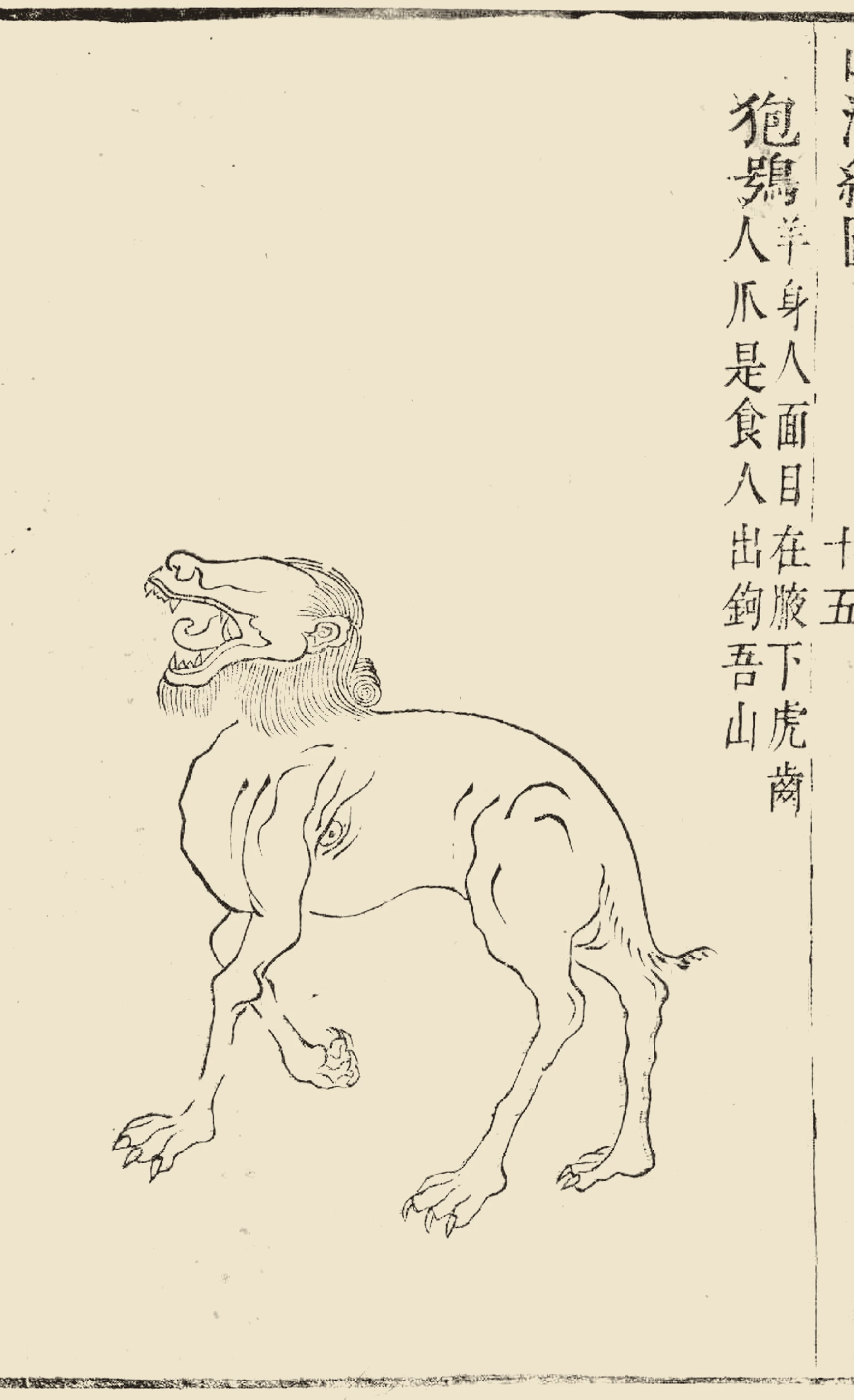
A man-eating beast with a sheep’s body, a human face, tiger teeth and eyes under its armpits.羊身人面、虎齿人爪、眼睛长在腋下的食人兽。
Body身形
Sheep’s body, human face羊的身子,人的脸
其狀如羊身人面
Eyes目
Under the armpits长在腋下
其目在腋下
Teeth齿爪
Tiger teeth, human hands老虎的牙,人的手
虎齒人爪
Nature性情
Insatiable greed, devourer贪暴无厌,食人未咽
貪於飲食,冒於貨賄
饕餮
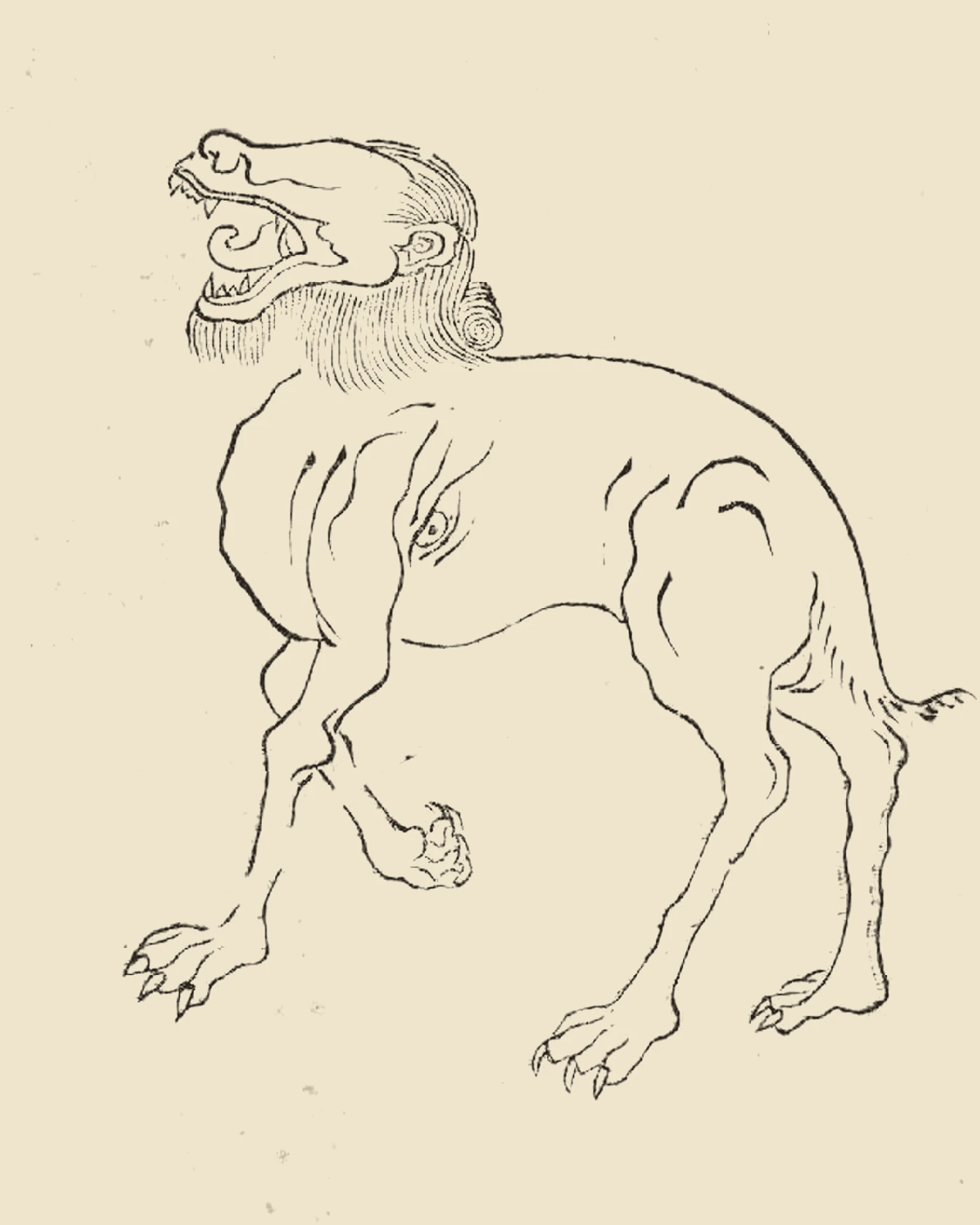
Wu Renchen’s Kangxi-era print of Páoxiāo 狍鴞, the beast Guo Pu’s commentary identifies as the taotie, drawn part by part from the Northern Mountains text.吴任臣康熙刊本中的狍鸮(郭璞注认为即饕餮),逐一画出《北山经》所说的各个部位。
其音如嬰兒,名曰狍鴞,是食人
Its cry is like an infant’s; it is called the Paoxiao, and it eats people.
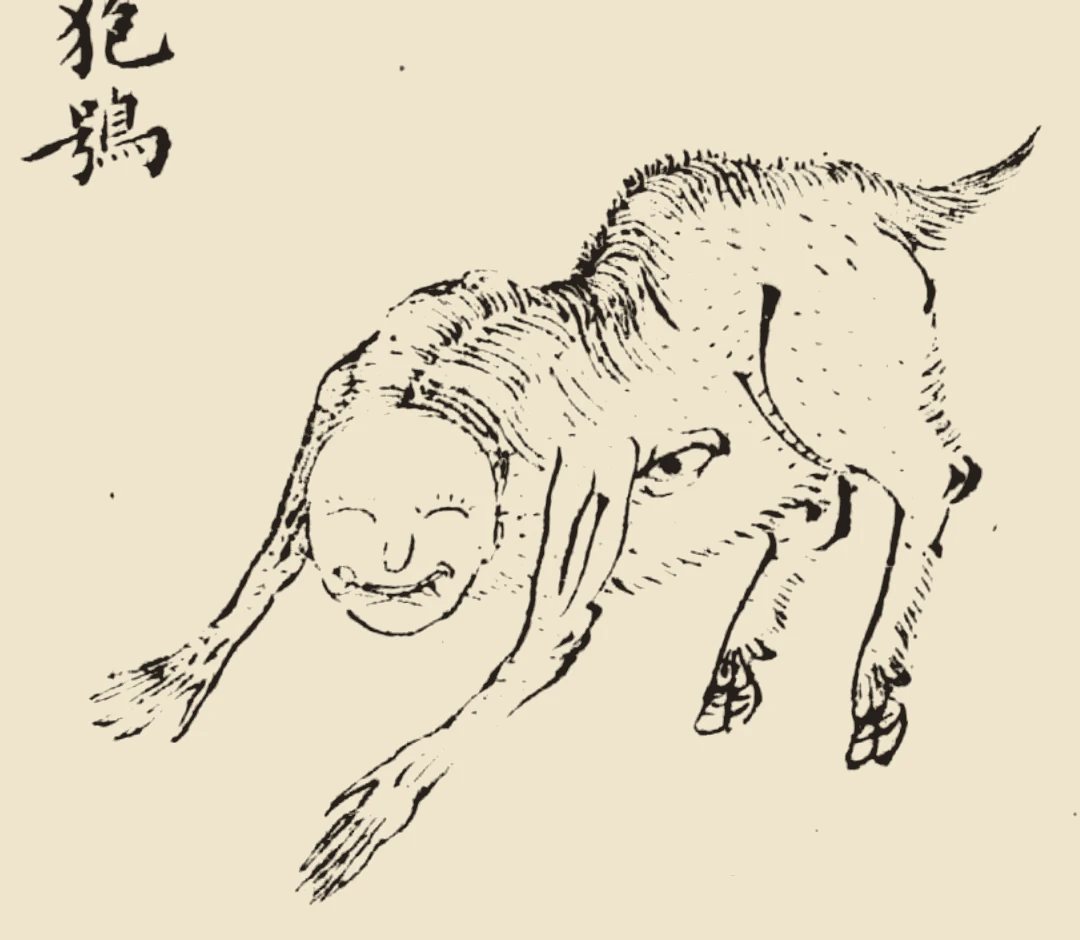
Crawling beast with a grinning moon face爬行的兽,长着笑嘻嘻的圆脸 — A round smiling face, no tiger teeth; long arm-like forelegs; no clear armpit eye圆圆的笑脸,没有虎齿;前肢像长臂;腋下看不出眼睛
Páoxiāo 狍鴞, the beast Guo Pu’s commentary identifies as the taotie. Wu Renchen 吳任臣, Shanhaijing guangzhu 山海經廣注, illustrated juan 3, Kangxi era (1662–1722), National Library of China copy狍鴞,郭璞注认为即饕餮。清·吴任臣《山海经广注》图卷三,康熙年间刊本,中国国家图书馆藏 · Public domain公有领域Same design also in: 同一图样亦见于:Wu Renchen (ed.)吴任臣 编, 17861786年Wang Fu 汪紱, Shanhaijing cun 山海經存, juan 3 (Northern Mountains II plates), lithograph, 1895 (Guangxu 21), National Library of China copy. Páoxiāo 狍鴞清·汪绂《山海经存》卷之三北次二经图,光绪二十一年(1895)石印本,中国国家图书馆藏:狍鸮 · Wang Fu 汪紱 (1692–1759)汪紱(1692–1759), 18951895年
Highlighted words: anatomy part · feature · form type — tap to jump标色词:形态部位 · 特征 · 形态类别,点击可跳转
On Mount Gouwu, there is much jade above and copper below. There is a beast here whose shape is like a sheep's body with a human face; its eyes are under its armpits, it has tiger teeth and human claws, and its voice is like an infant's. Its name is Páoxiāo, and it eats humans.
On Zhou tripods was depicted the Taotie, with a head but no body. It ate humans but had not swallowed them when harm reached its own body—this was used to illustrate the retribution of cause and effect.
The clan of Jinyun had an unworthy son who was gluttonous in eating and drinking, covetous of goods and wealth, endlessly self-indulgent and insatiable... The people of the realm likened him to the other Three Perils, calling him Taotie.
In the southwestern wilderness there was a being with a hairy body and a pig upon its head, greedy as a wolf and vicious, fond of hoarding wealth while those around were destitute, eating people and grasping for office: its name was Taotie.
Comparing the Books典籍对比
The Classic of Mountains and Seas depicts the ravenous beast as the sheep-bodied Páoxiāo with armpit eyes; Jin-dynasty commentator Guo Pu explicitly connected it to the bronze vessel monster. The Zuo Zhuan personified Taotie as an insatiably greedy scion exiled by Emperor Shun as one of the Four Perils, while the Lüshi Chunqiu fixed its iconic visual form on Zhou dynasty ritual bronzes: a voracious head with no body.
The story来历与故事
The ravenous monster of ancient China: in the Shan Hai Jing, Páoxiāo, a sheep-bodied man-eater with a human face and eyes under its armpits, which Guo Pu identified as the taotie; on Shang and Zhou bronzes, a horned mask with no body.
Origins in the Shan Hai Jing《山海经》里的源头
The earliest text calls it Páoxiāo: a sheep-bodied man-eater with eyes under its armpits.最早的文献称其为狍鸮:羊身人面、眼睛长在腋下的食人异兽。
The Shan Hai Jing (Classic of Mountains and Seas) locates the creature on Mount Gouwu, three hundred and fifty leagues to the north. Rich in jade above and copper below, the mountain was home to a terrifying predator named Páoxiāo (狍鴞). It was described as having the body of a sheep and a human face, with sharp tiger fangs and human hands for claws. Stranger still, its eyes were positioned not on its face, but beneath its armpits and its cry was like that of a human infant; it ate people.
When the Jin-dynasty scholar Guo Pu (276–324) annotated the Classic of Mountains and Seas, he linked this Shan Hai Jing beast with the taotie. Guo noted that this ravenous creature, so greedy that it ate people without finishing them until the harm turned back on its own body, had its image on the cauldrons of Xia (像在夏鼎), and was the beast the Zuo Zhuan calls Taotie.
Wang Fu 汪紱, Shanhaijing cun 山海經存, juan 3 (Northern Mountains II plates), lithograph, 1895 (Guangxu 21), National Library of China copy. Páoxiāo 狍鴞清·汪绂《山海经存》卷之三北次二经图,光绪二十一年(1895)石印本,中国国家图书馆藏:狍鸮
The Scion of Jinyun and the Four Perils缙云氏之子与上古四凶
In the Zuo Zhuan, Taotie is an insatiable clan scion exiled by Emperor Shun.《左传》记载饕餮为缙云氏贪财好吃的败家子,被舜帝流放四极。
In historical texts such as the Zuo Zhuan and Sima Qian’s Records of the Grand Historian (Shiji), Taotie appears not merely as a wild beast, but as an allegorical figure of human excess. The Zuo Zhuan records that during the era of the mythical Flame Emperor, the clan of Jinyun had an unworthy son who was enslaved by appetite and avarice. He hoarded mountains of grain and goods without ever distributing them to widows, orphans, or the destitute, prompting the people to brand him Taotie (meaning gluttonous and covetous) and group him among the 'Four Perils' (四凶).
When Emperor Shun took stewardship of the realm under Emperor Yao, he exiled the Four Perils to the four distant borders of the civilized world. Rather than purely punishing them, the ancient rulers turned their terrifying ferocity to a purpose: stationed at the frontiers, these ravenous beings stood guard against evil spirits and malevolent demons, preventing malignant forces from encroaching upon the Central Plains.
周鼎著饕餮,有首無身,食人未咽,害及其身,以言報更也。
On Zhou tripods was depicted the Taotie, with a head but no body. It ate humans but had not swallowed them when harm reached its own body—this was used to illustrate the retribution of cause and effect.
— 呂氏春秋·先識覽 · Lvshi Chunqiu
The Head Without a Body on Bronze Cauldrons青铜鼎上有首无身的诫训
Cast on ritual vessels with a head but no body, it warned against greed consuming itself.铸于宗庙鼎彝之上、有头无身,警示世人贪婪终将自食其果。
During the Shang (c. 1600–1046 BCE) and Zhou dynasties, bronze cauldrons (ding) served as supreme ceremonial vessels representing royal legitimacy and sacrificial communication with gods and ancestors. The dominant motif adorning these ritual bronzes was a front-facing, highly stylized animal mask characterized by symmetrical coiled horns, staring bulging eyes, and a wide mouth gaping over fangs—yet notably lacking a lower jaw or body.
The third-century BCE philosophical compendium Lüshi Chunqiu provided the classic interpretation of this visual paradox: 'On Zhou tripods was cast the Taotie, with a head but no body. It ate humans but had not swallowed them when harm reached its own body.' Cast upon the very vessels used in state feasts, the disembodied mask served as a stern aristocratic memento mori: power and appetite, unchecked by restraint, will inevitably consume the ruler himself.
From Ancient Warning to Modern Gourmet从宗庙警鉴到今天的美食代名词
The terrifying glutton evolved into a symbol of feasts, culinary love, and fantasy beasts.上古凶兽演变为今天形容美食盛宴的代名词,并在奇幻世界中延续生机。
Across thousands of years, the terrifying glutton of ancient bronzes underwent a remarkable cultural metamorphosis. By the Song dynasty (960–1279), the great poet and epicure Su Shi playfully referred to an extravagant dinner as a 'feast for a Taotie.' Over the centuries, the negative stigma of predatory greed softened into an appreciation for lavish culinary indulgence, crystallizing into the modern Chinese idiom 'taotie sheng yan' (饕餮盛宴)—a sumptuous banquet or a rich feast for the senses.
In contemporary fantasy literature, video games, and film, Taotie is frequently reimagined as an ancient titan of voracity. Modern creators draw upon its dual legacy—blending the fierce, symmetrical bronze mask with the bizarre sheep-bodied, armpit-eyed predator of the Shan Hai Jing—ensuring that China's oldest symbol of unbridled appetite remains an indelible part of global mythological lore.
Record档案
Record Card档案卡
Type
Beast (sheep-bodied man-eater)
Also known as
Páoxiāo 狍鴞 (in the Shan Hai Jing); one of the Four Perils 四凶
Earliest source
Shan Hai Jing (Northern Mountains) & Zuo Zhuan (Duke Wen, Year 18)
Nature
Insatiable greed and gluttony; devours people without swallowing before harm reaches its own body
Symbolism
Cast on Shang and Zhou ritual bronze vessels (ding) to warn against excess, greed, and arrogance
Taotie is both a mythical creature in ancient texts and the iconic animal mask (taotie-wen) cast on Shang and Zhou bronze vessels. In the Shan Hai Jing, it is described as the sheep-bodied, man-eating Páoxiāo with eyes under its armpits; in historical lore, it was an insatiable son of the Jinyun clan exiled as one of the Four Perils.
Why does the Taotie motif have a head but no body on ancient bronzes?
According to the third-century BCE text Lüshi Chunqiu, Taotie was cast with a head and no body because it was so voracious that it ate humans without swallowing before harm rebounded onto its own body. Placed on ceremonial cauldrons, this disembodied mask served as a warning against unchecked greed and excess.
Is Taotie one of the Four Perils of ancient China?
Yes. Classical sources like the Zuo Zhuan identify Taotie alongside Hundun, Qiongqi, and Taowu as the Four Perils (四凶)—four corrupt clans or monsters banished by Emperor Shun to the borders of the realm, where they were tasked with defending against malicious spirits.
Why is the word 'Taotie' associated with delicious feasts today?
Over the centuries, the terrifying gluttony of the ancient beast softened through literary use—notably by Song-dynasty poet Su Shi in his humorous essay Ode to the Old Glutton (Lao Tao Fu). Today, 'taotie' is used affectionately for an epicure or foodie, and 'taotie sheng yan' describes a lavish banquet.