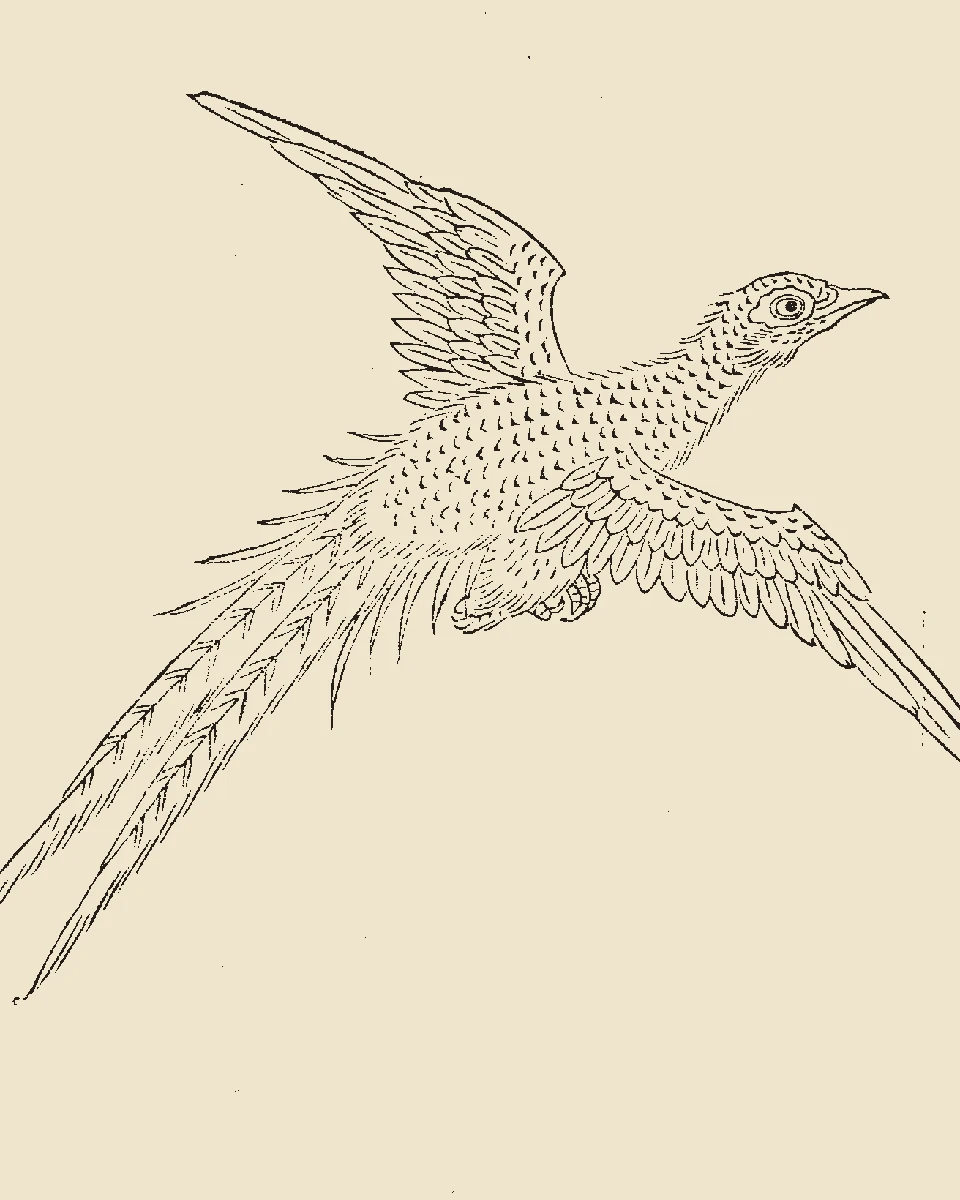
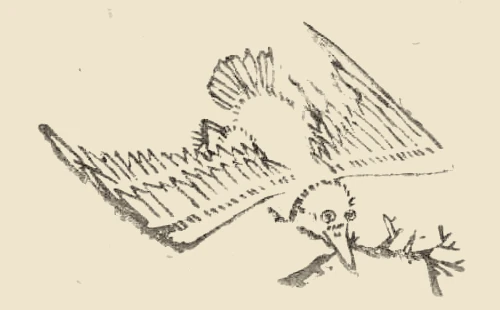
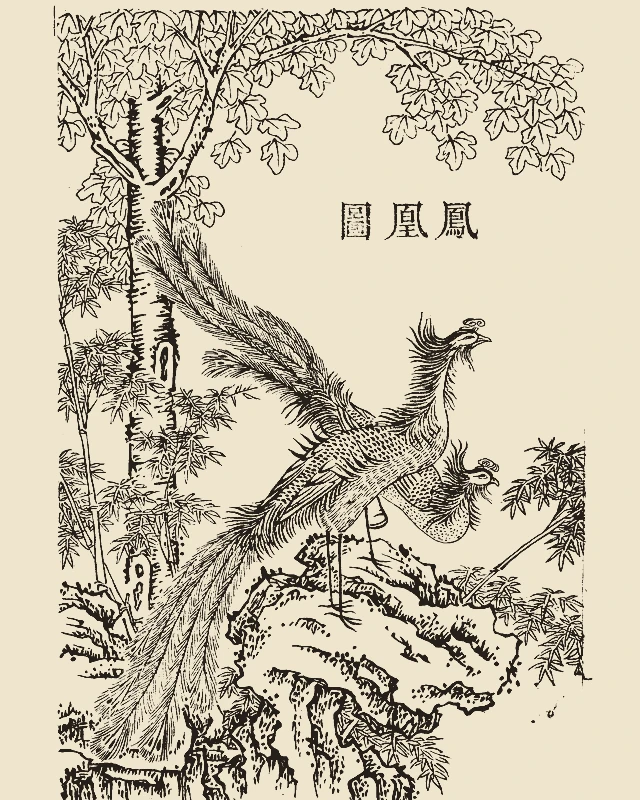
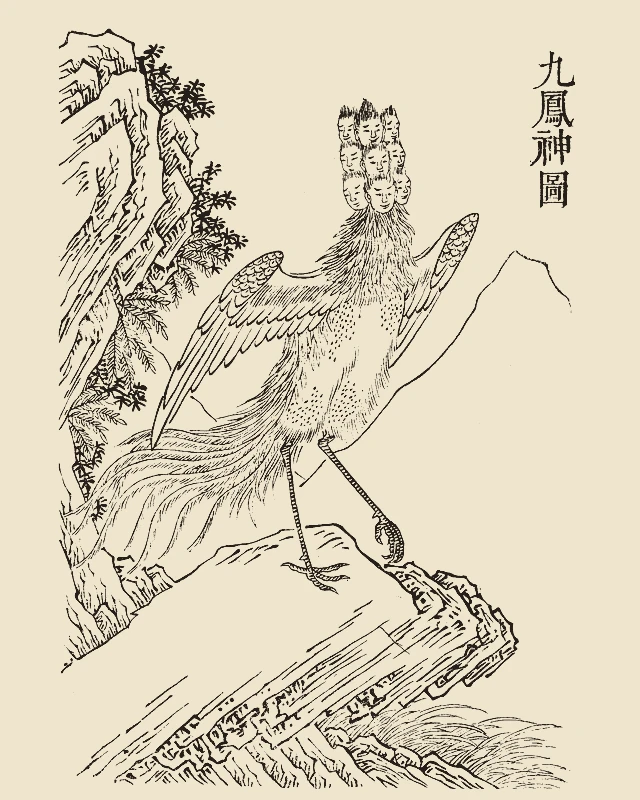
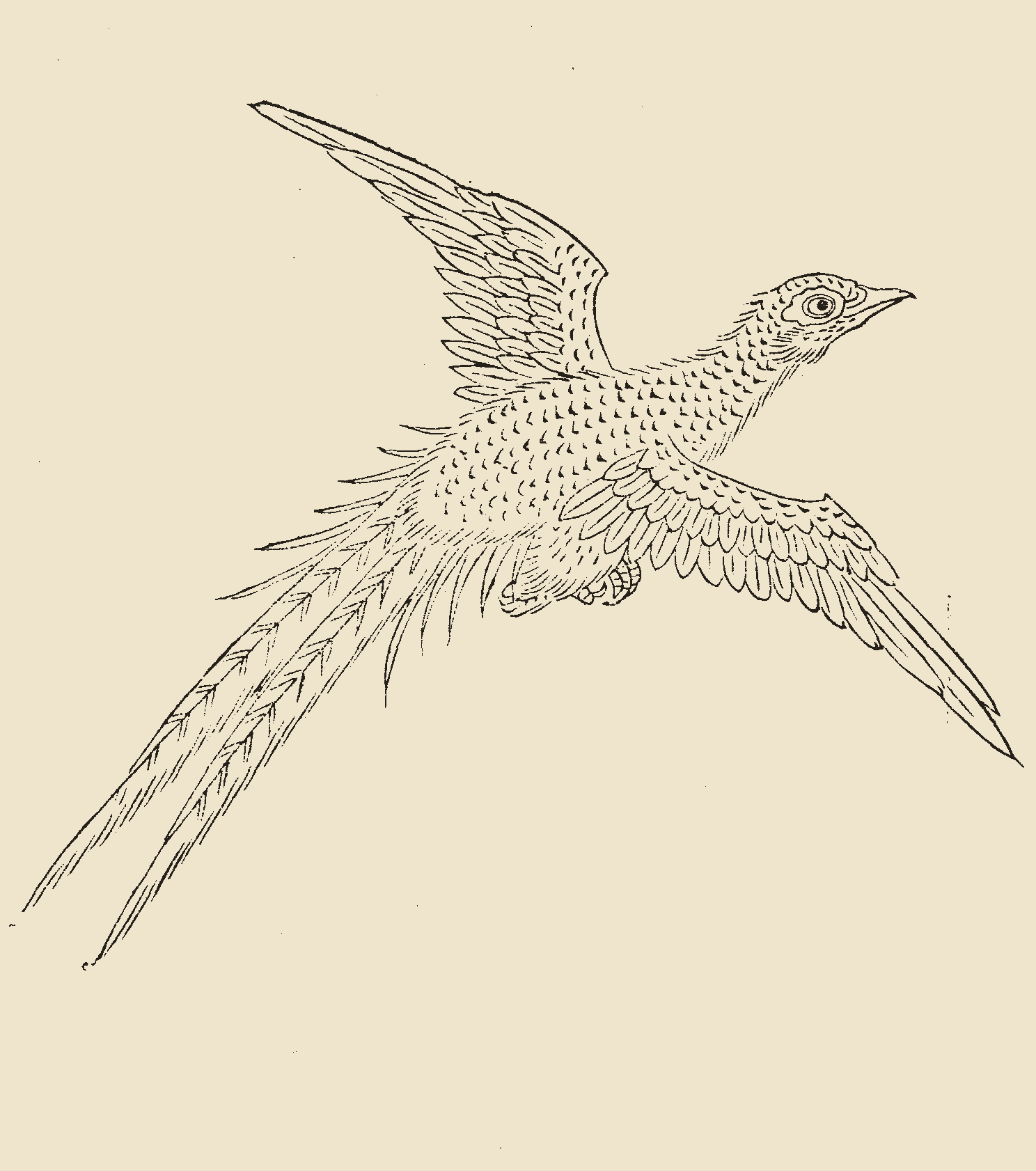
Small bird carrying a twig, by Jiang Yinghao衔着树枝的小鸟:蒋应镐绘 — A small crow-like bird (其狀如烏) with a twig in its beak; no long tail一只像乌鸦的小鸟,嘴里衔着树枝;主图则是一只长尾鸟、嘴里没有东西
Two hundred li further north is Mount Fajiu, covered in mulberry-thorn trees. There is a bird here shaped like a crow, with a patterned head, white beak and red feet. It is called Jingwei, and it cries its own name. She was the youngest daughter of the Flame Emperor, named Nüwa. Nüwa went swimming in the Eastern Sea, drowned and never returned, and so became the Jingwei. She forever carries wood and stones from the Western Mountains in her beak to fill up the Eastern Sea.
述異記·卷上 · Shuyi Ji (Records of Strange Things), vol. 1 · Wikisource
Long ago the Flame Emperor's daughter drowned in the Eastern Sea and changed into the Jingwei, which calls its own name and keeps carrying wood and stones from the western mountains to fill the Eastern Sea. It mated with a petrel and had young: the females look like Jingwei, the males like petrels. Where it once drowned, it vowed never to drink the water of that river. It is also called the Vow Bird, the Wronged Bird and the Resolute Bird; common people call it the Emperor's Daughter Sparrow.
Show all sources (3)展开全部出处(3)
陶淵明·讀《山海經》其十 · Tao Yuanming, Reading the Shan Hai Jing, no. 10 · Wikisource
精衛銜微木,將以填滄海;刑天舞干戚,猛志故常在。
Jingwei carries tiny twigs in its beak, meaning to fill the vast sea; Xingtian dances with shield and axe: a fierce will that endures forever.
Comparing the Books典籍对比
Only one public-domain classical source has been verified for this creature so far.
The story来历与故事
Jingwei is a small bird with a big task. A daughter of the Flame Emperor drowned in the Eastern Sea and came back as a bird that carries twigs and pebbles from the western mountains, one beakful at a time, to fill the sea that killed her.
The story of Jingwei精卫的故事
A drowned princess becomes a bird that carries stones to fill the Eastern Sea.溺水的公主化身为鸟,衔石想要填平东海。
The tale is told in a single paragraph of the Classic of the Northern Mountains, in the Shan Hai Jing. On Mount Fajiu, among the mulberry-like zhe trees, there is a bird shaped like a crow with a patterned head, a white beak and red feet. Its name is Jingwei, and its cry is its own name. It was once Nüwa (Nü Wa, ‘Lady Wa’), the youngest daughter of the Flame Emperor, who went out on the Eastern Sea, drowned and never returned.
So she became Jingwei, the text says, and she keeps carrying wood and stones from the western hills to dam up the Eastern Sea. Note that her name is written 女娃, not the creator goddess Nüwa (女媧); the two are often confused in English.
Jingwei's father, the Flame Emperor (Yandi), is one of the legendary rulers of high antiquity, often linked with agriculture and medicine and sometimes identified with Shennong. The Shan Hai Jing gives him several descendants, and Jingwei is the most famous of his daughters. Her story is unusual in Chinese myth because it centres on a young woman's death and its consequences rather than on a hero's victory.
Some modern readers see in Jingwei a story about grief: a child lost to the sea, and a family that cannot stop trying to undo the loss. Others read it as a myth about nature, the sea as an indifferent force and the bird as human effort against it. The text supports both readings because it gives no moral at all, only the image of a small bird carrying stones.
Jingwei, detail of plate 24 of the Northern Mountains (北山經 第二十四圖) in the Shan Hai Jing illustrated by Jiang Yinghao, Ming dynasty, Wanli period (1573–1620)明万历年间(1573–1620)蒋应镐绘图本《山海经》北山经第二十四图局部(精卫)
What the myth means神话的寓意
Tao Yuanming paired her with Xingtian, praising and pitying their unbroken will.陶渊明把她与刑天并列,既赞美又哀叹他们不屈的意志。
Readers have argued about Jingwei for two thousand years, and the arguments are the point. Is she a model of heroic persistence, or an example of hopeless effort? The phrase 精衛填海, ‘Jingwei fills the sea’, can mean both: dogged determination against impossible odds, and a grudge that will not let go.
Tao Yuanming, the great poet of the Eastern Jin, settled the question for most later readers. In the tenth of his thirteen poems on Reading the Shan Hai Jing he pairs Jingwei with Xingtian, the headless giant who keeps fighting with shield and axe, and calls their fierce will something that endures forever. From then on Jingwei was usually read as a figure of courage.
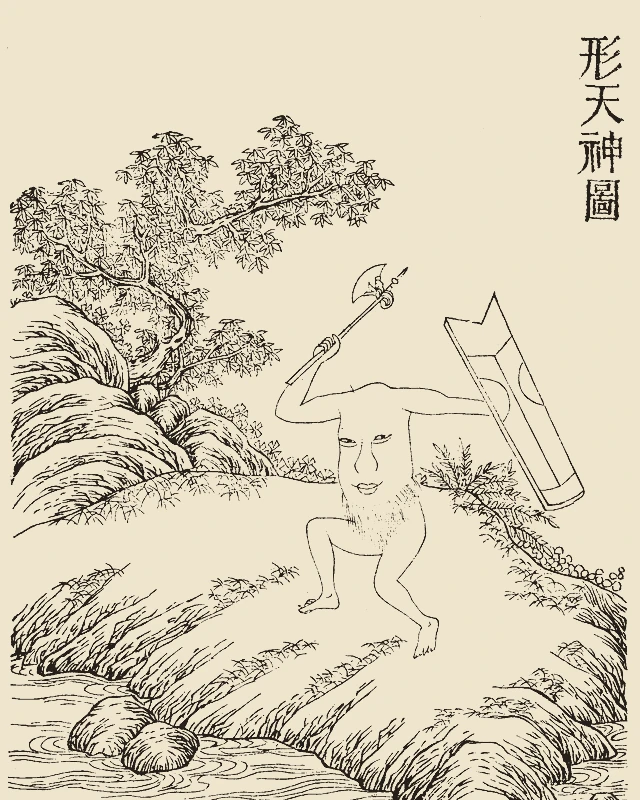
Tao Yuanming's pairing is worth a closer look. Xingtian, ‘the one who was punished’, appears in the Classic of Regions Beyond the Western Seas: after fighting a god for supremacy he was beheaded, yet he kept fighting, using his nipples as eyes and his navel as a mouth, brandishing shield and axe. He and Jingwei are both figures defeated by a far greater power who refuse to accept the defeat.
The poem's second half is often overlooked. Tao writes that both of them, having become other things, have nothing to worry about and nothing to regret, but the heart they once had is in vain, and the good day they wait for will never come. The poem praises their will and mourns their situation in the same breath, which is why Jingwei can carry both meanings in Chinese to this day.
精衛銜微木,將以填滄海;刑天舞干戚,猛志故常在。
Jingwei carries tiny twigs in its beak, meaning to fill the vast sea; Xingtian dances with shield and axe: a fierce will that endures forever.
— 陶淵明·讀《山海經》其十 · Tao Yuanming, Reading the Shan Hai Jing, no. 10
Later versions of the legend传说的后来版本
Later legends gave her a family, turning a single tragic figure into a multi-generational symbol.后来的传说给了她后代,把一个孤单的悲剧形象变成了代代相传的坚持象征。
The Shuyi Ji, a collection of marvels attributed to Ren Fang of the Liang dynasty, adds new details. Jingwei mates with a petrel; the daughters look like Jingwei and the sons like petrels. Where she drowned she vowed never to drink the water, and she earns a string of names: the Vow Bird, the Wronged Bird, the Resolute Bird, and in popular speech the Emperor's Daughter Sparrow.
These additions turn a single tragic image into a lineage. Jingwei is no longer alone; her work can be continued by her descendants. It is a small change, but it fits the later reading of the myth as a story about perseverance across generations.
Because the text gives a precise description, illustrators were fairly consistent: a crow-like bird, often shown in flight over waves with a twig in its beak. The Hu Wenhuan picture book of 1593 draws it with long sweeping wings above a rock; the Gujin Tushu Jicheng shows a smaller, plainer bird. Later prints often add the sea itself, which the classical illustrations usually leave out.
Jingwei today今天的精卫
Today she is a textbook classic in Chinese schools, embodying unyielding resolve.如今她是收录在语文课本中的经典神话,象征着百折不挠的坚毅意志。
Jingwei filling the sea is one of the best-known Chinese myths, widely retold in children's books and commonly taught in Chinese schools alongside Kuafu chasing the sun and Nüwa mending the sky. For English readers it is a useful entry point into the Shan Hai Jing: a complete, human story told in a few lines.
In film, TV & games影视与游戏中的形象
Listed by how familiar each work is to English-speaking audiences; each note says what it keeps from the Shan Hai Jing and what it changes.按在英语世界的知名度排列;每条说明它沿用了《山海经》的什么、又有哪些再创作。
A playable Hunter goddess in Hi-Rez Studios' third-person MOBA; wielding a repeater crossbow, she flies upon death and summons coastal gusts, keeping her vow to fill the sea.Hi-Rez Studios开发的第三人称MOBA中的射手神明;手持连弩,阵亡后可振翅飞回战场并能召唤狂风,忠实延续了衔石填海的誓愿。
Source: Wikipedia来源:Wikipedia
Text only: no posters or screenshots. Facts checked against official pages and Wikipedia.仅文字介绍,不使用海报或截图;信息已对照官方页面与维基百科核实。
Record档案
Record Card档案卡
Type
Bird (transformed human)
Also known as
Nüwa (女娃); Emperor's Daughter Sparrow (帝女雀); The Vow Bird (誓鳥); The Resolute Bird (志鳥)
Habitat
Mount Fajiu (Fajiu Mountain), Northern Mountains
Power
Endless labour — carries twigs and stones to fill the Eastern Sea
Use
Symbol of unyielding resolve; transformed human (daughter of the Flame Emperor)
The Flame Emperor's youngest daughter drowned in the Eastern Sea and was reborn as a bird called Jingwei. Ever since, she has carried twigs and stones from the western mountains to fill the sea. The story comes from the Classic of the Northern Mountains in the Shan Hai Jing.
What does Jingwei symbolize?
Mostly perseverance and an unbreakable will, especially since Tao Yuanming's poem praised her fierce determination. The idiom 精衛填海 can also suggest a hopeless task or a long-held grudge.
Is Jingwei the same as Nüwa?
No. Jingwei's human name is 女娃 (Nüwa, ‘girl Wa’), the Flame Emperor's daughter. The creator goddess who mended the sky is 女媧, a different figure with a similar romanisation.
Which games feature Jingwei?
A major global appearance is Jing Wei, the Oathkeeper in the third-person MOBA SMITE (2016), where she appears as a playable Hunter goddess wielding a repeater crossbow and taking flight to honor her vow.