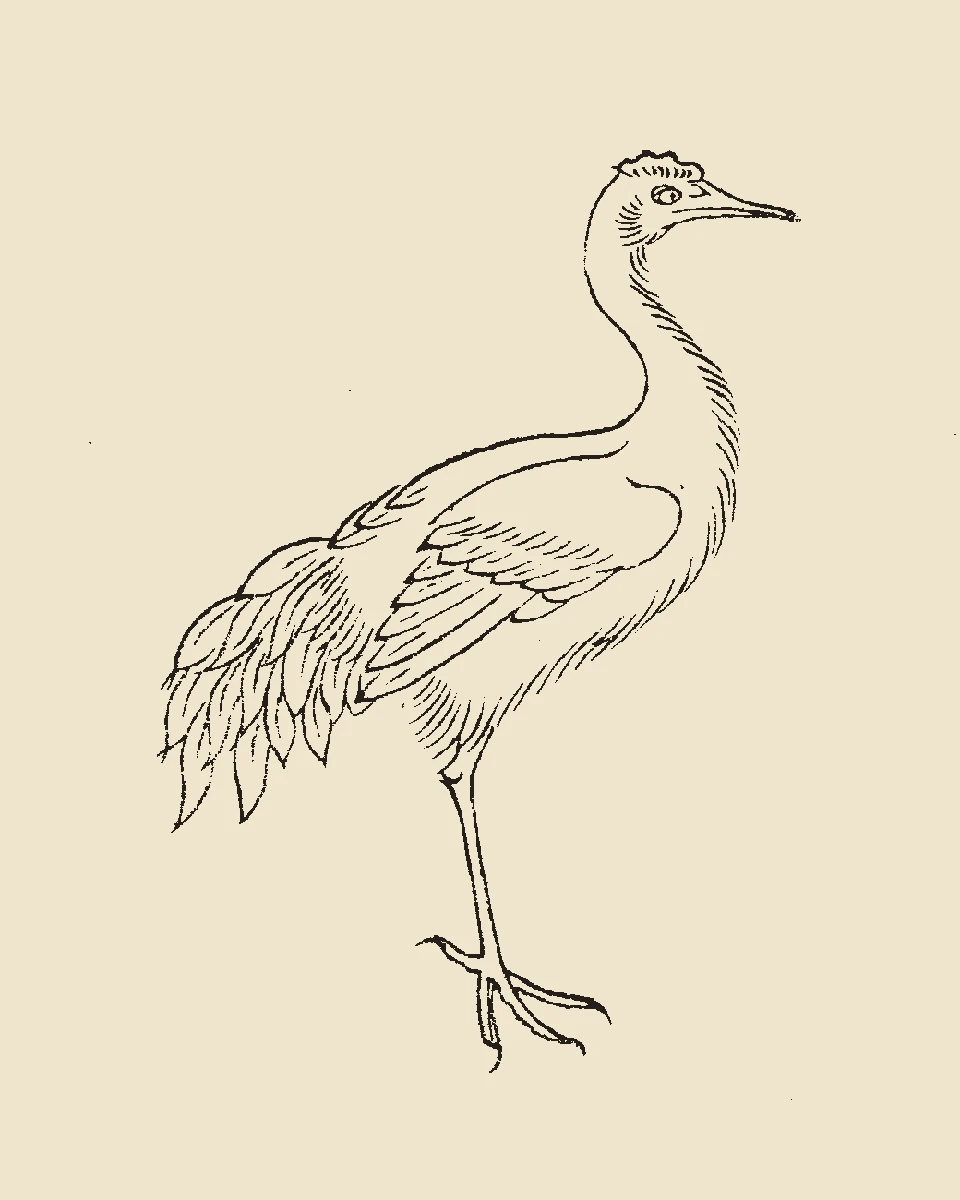
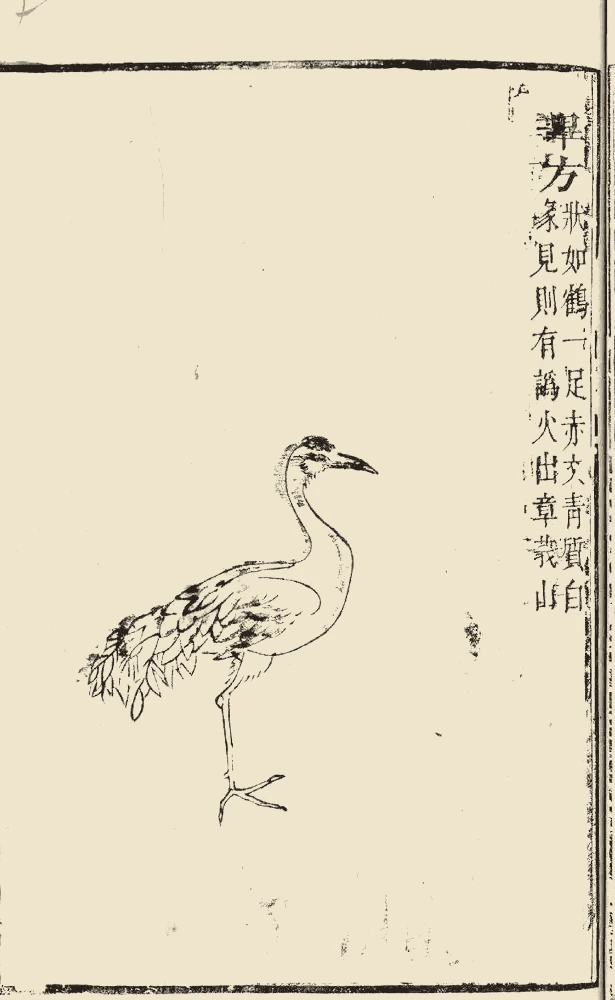
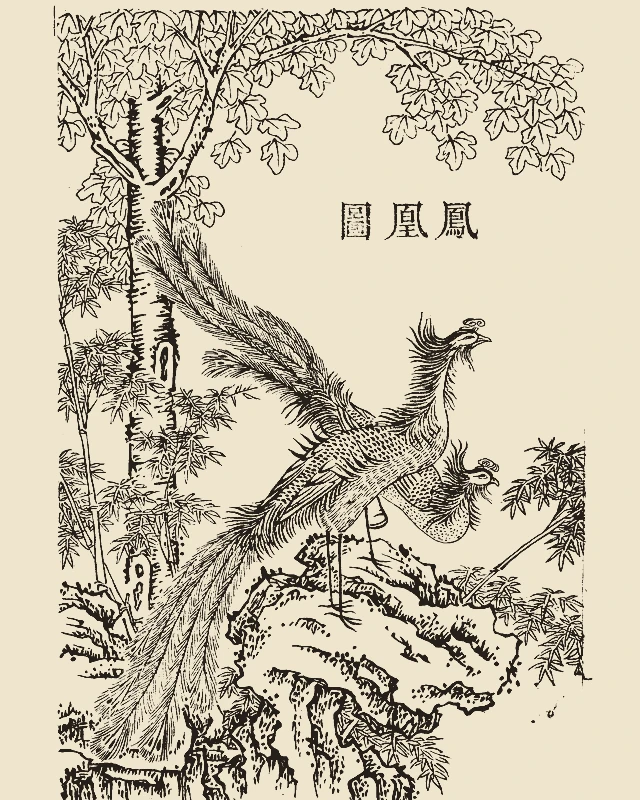
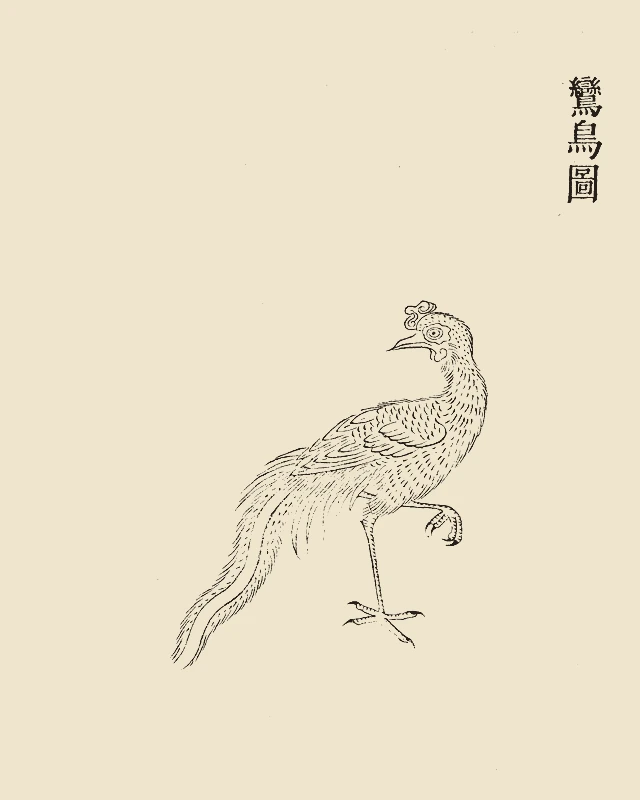
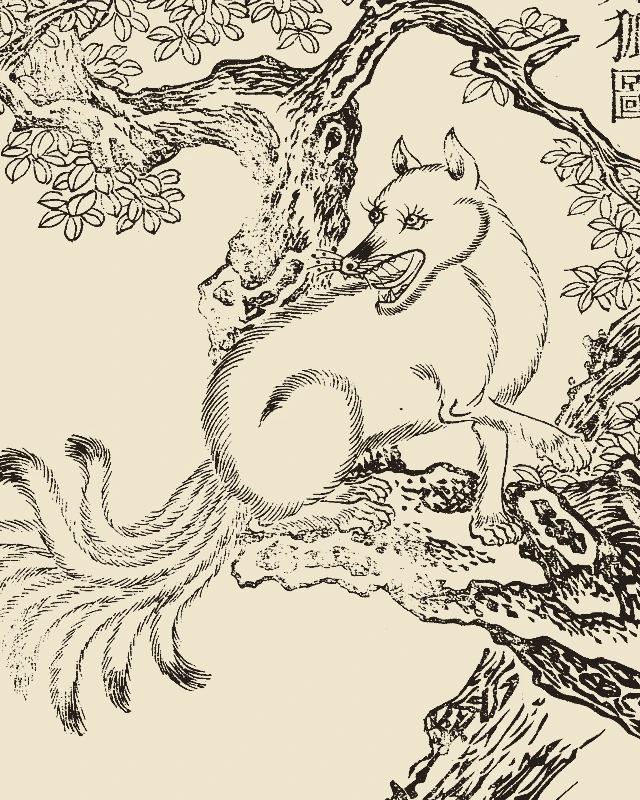
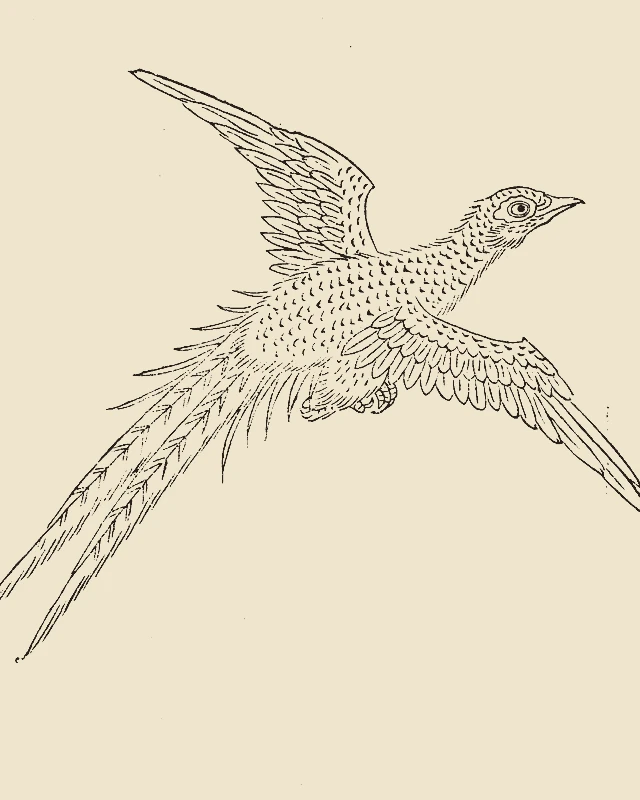
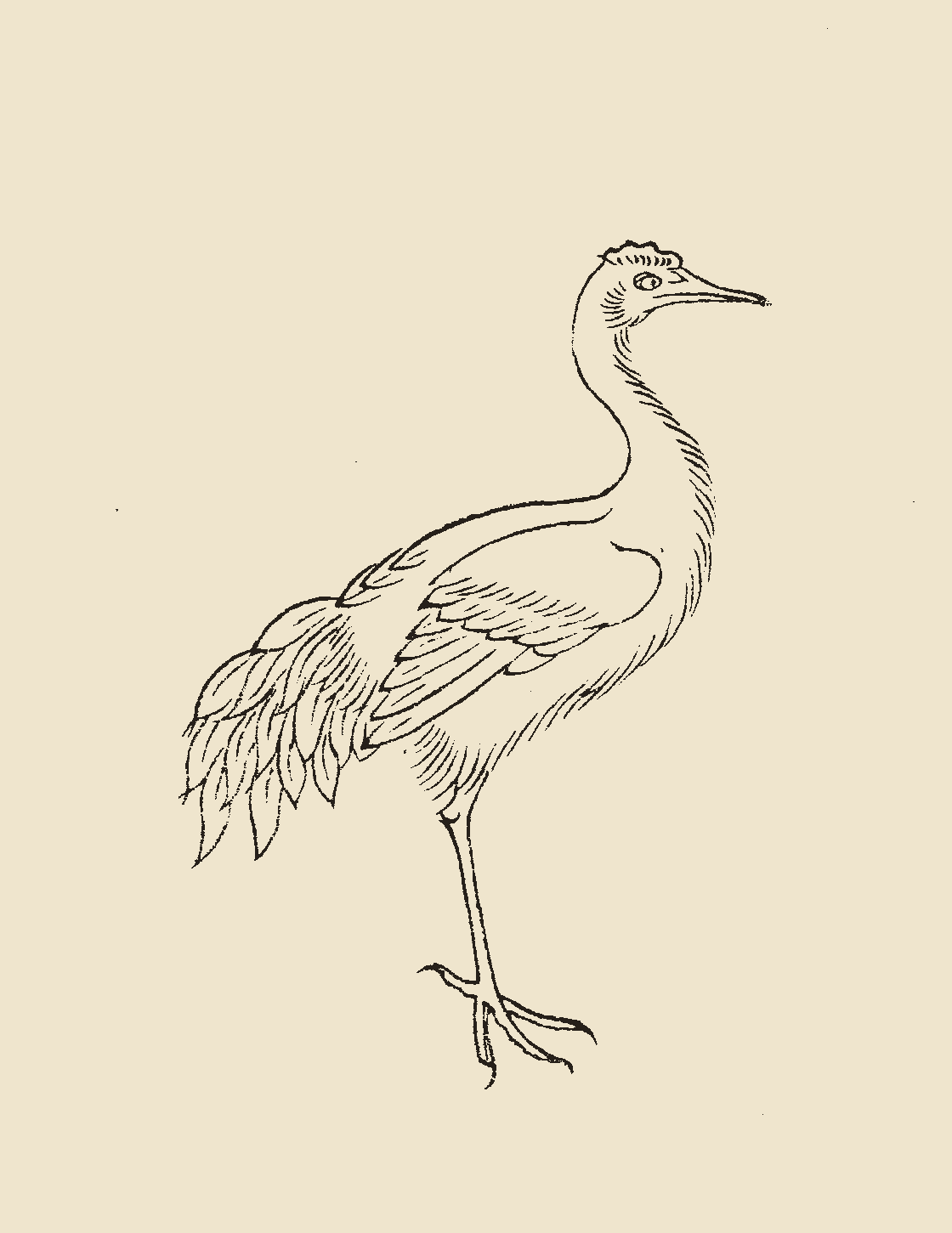
Patterned bird on a rock: the encyclopaedia’s second design立于山石上的花纹鸟:《古今图书集成》的另一种画法 — A patterned, pheasant-like bird (赤文青質) on a rock, not a plain crane羽纹繁密、像雉鸡的鸟站在山石上;主图则是一只素净的鹤
Two hundred and eighty li further west is Mount Zhang'e. No plants grow there, but it abounds in precious jade. Very strange things happen there. … There is a bird here shaped like a crane, with one leg, red patterns on a blue-green ground and a white beak. It is called the Bifang, and it cries out its own name. Wherever it is seen, the town will have weird fires.
山海經·海外南經 · Shan Hai Jing · Classic of the Regions Beyond the Southern Sea · Wikisource
畢方鳥在其東,青水西,其為鳥一腳。一曰在二八神東。
The Bifang bird lives to its east, west of the Green River. It is a bird with one foot. Another account says it lives east of the Sixteen Gods.
Variant reading: 「其為鳥人面一腳」 — 'a bird with a human face and one foot'.
Long ago the Yellow Emperor gathered the ghosts and spirits on top of Mount Tai. He rode an ivory chariot drawn by six scaly dragons, with Bifang riding alongside at the linchpin; Chiyou went in front, the Wind Lord swept the way, the Rain Master sprinkled the road, tigers and wolves went before, ghosts and spirits came behind, soaring serpents lay on the ground and phoenixes covered the sky above. At this great gathering of spirits he composed the Clear Jue music.
Mountains produce the xiaoyang, water produces the wangxiang, wood produces the bifang, wells produce the fenyang, and people find these strange.
Comparing the Books典籍对比
The mountain chapter gives full colouring and the fire omen; the outer-region chapter only locates it and, in some editions, gives it a human face.
The story来历与故事
Bifang is a one-legged crane with crimson patterns on blue-green feathers. It cries its own name, and wherever it appears, strange fires break out. It is one of the oldest fire spirits in Chinese literature.
Bifang in the Shan Hai Jing《山海经》中的毕方
A one-legged crane whose appearance warns of a mysterious fire.一只奇异的神鸟,它在哪里出现,哪里就会发生怪火。
The fullest description comes from the Classic of the Western Mountains. On Mount Zhang'e, a bare mountain full of jade where ‘much that happens is very strange’, lives a bird shaped like a crane with one leg, red patterns on a blue-green body and a white beak. It is called Bifang and cries its own name. Wherever it is seen, the town will have strange fires.
A second, shorter entry in the Classic of Regions Beyond the Southern Seas places a Bifang bird east of the Green River and says it has one leg; some editions add that it has a human face. So even within the Shan Hai Jing there are two versions: a crane-like omen bird and a stranger, human-faced creature.
Illustrators almost always draw a crane, usually standing on one leg, which real cranes do anyway. The Hu Wenhuan picture book of 1593 shows a tall, elegant bird with a fanned tail. The Gujin Tushu Jicheng includes two different Bifang pictures, one a plain crane and one a more ornamental bird among branches, a sign that even Qing editors were not sure what it looked like.
Wu Renchen, Shanhaijing Guangzhu (Extended Commentary on the Shan Hai Jing), illustrated volumes, Kangxi-era printing. National Library of China copy清·吴任臣《山海经广注》图卷,康熙年间刊本,中国国家图书馆藏本
A bird of fire omens火灾之兆
Han thinkers linked it to wood and fire, and later commentators made it a fire spirit.汉代人把它和木、火联系起来,后来的注家更把它视作引火之灵。
Why fire? The Huainanzi, a Han-dynasty compendium, lists Bifang among the strange beings produced by the elements: mountains produce the xiaoyang, water the wangxiang, wood the bifang and wells the fenyang. A creature born from wood that brings fire fits neatly into five-phase thinking, in which wood feeds fire.
Later commentators went further and called Bifang a ‘wood spirit’ or ‘fire spirit’ that carries flames in its beak. Those details are not in the Shan Hai Jing, but they show how the omen bird was gradually turned into an agent of fire.
To understand why a single bird could frighten a town, it helps to remember how dangerous fire was. Chinese towns were built largely of wood and thatch, and a fire could destroy a whole district. The Shan Hai Jing is full of creatures whose appearance predicts drought, flood, war or epidemic, and Bifang is its fire specialist: its sighting is less a cause than a warning.
The word the text uses is 譌火, ‘strange’ or ‘uncanny’ fire, a fire with no obvious cause. The Jin commentator Guo Pu notes simply that 譌 is the same as 妖, uncanny. That fits the bird's character: Bifang is not a dragon breathing flame across a battlefield but the bird that announces the fire nobody can explain.
山出梟陽,水生罔象,木生畢方,井生墳羊,人怪之,
Mountains produce the xiaoyang, water produces the wangxiang, wood produces the bifang, wells produce the fenyang, and people find these strange.
— 淮南子·氾論訓 · Huainanzi, Boundless Discourses
In the Yellow Emperor's procession黄帝的仪仗
In Han Feizi, Bifang rides beside the Yellow Emperor's chariot.在《韩非子》里,毕方随侍在黄帝的车旁。
The Han Feizi passage is worth reading closely, because it shows how Warring States writers imagined the spirit world as an orderly court. The Yellow Emperor rides in an ivory chariot pulled by six scaly dragons; Bifang rides beside the linchpin; Chiyou, later his great enemy, walks in front; the Wind Lord sweeps and the Rain Master sprinkles the road; tigers and wolves lead, ghosts and spirits follow, flying serpents lie on the ground and phoenixes cover the sky.
The story is told by the music master Shi Kuang, who uses it to explain why the solemn Clear Jue music is too powerful for an ordinary ruler to hear. His duke insists, and disaster follows. Bifang's presence in this scene shows that by the third century BCE the fire bird was already a recognised member of the Yellow Emperor's mythology, not just a local omen.
Bifang today今天的毕方
A popular creature in modern art and games, but originally a warning, not a fire-breather.它在现代插画和游戏中很受欢迎,但它原本是一种警示,而不是喷火怪兽。
Bifang has become one of the more popular Shan Hai Jing creatures in modern illustration and fantasy games, partly because its design is so clear: one leg, a crane's body and fire. Its older meaning is worth remembering too. In the classical texts it is less a fire-breathing monster than a warning sign, the bird you hope not to see over your town.
If you want to read Bifang in the original, start with the Classic of the Western Mountains, which gives the full description quoted on this page, then compare the one-line entry in the Classic of Regions Beyond the Southern Seas. The difference between the two, a detailed omen bird and a terse note that may or may not give it a human face, is a good introduction to how layered and inconsistent the Shan Hai Jing really is.
Record档案
Record Card档案卡
Type
Bird
Also known as
The Fire Crane; Fire Bird; Wood Spirit (木精); Fire Spirit (火精)
Habitat
Mount Zhang'e, Western Mountains; also east of the Green River beyond the southern sea
Power
Heralds fire
Use
Ill omen — where it appears, the town suffers mysterious fire
A one-legged mythical bird from the Shan Hai Jing with crimson patterns on blue-green feathers. Its appearance foretells strange fires.
Why does Bifang have one leg?
The Shan Hai Jing does not explain it. Many Chinese mythical creatures are one-legged, including Kui, and real cranes often stand on one leg, which may have shaped the image.
Is Bifang a phoenix?
No. The phoenix (fenghuang) is an auspicious bird, while Bifang is an omen of fire. In the Han Feizi both appear at the Yellow Emperor's gathering on Mount Tai, but as different beings.