jiāngshī

殭屍Jiangshi

A stiff corpse that rises at night and seizes the living.一具在夜里起身、扑抓活人的僵硬尸体。

Body身体

Stiff and hard as wood僵硬如木石

如中木石

Hair毛发

White hair all over全身长满白毛

白毛遍體

Eyes眼睛

Red as cinnabar红如丹砂

目赤如丹砂

Movement行动

Leaps (the hop is a film image)纵跃(蹦跳出自电影)

且躍且鳴

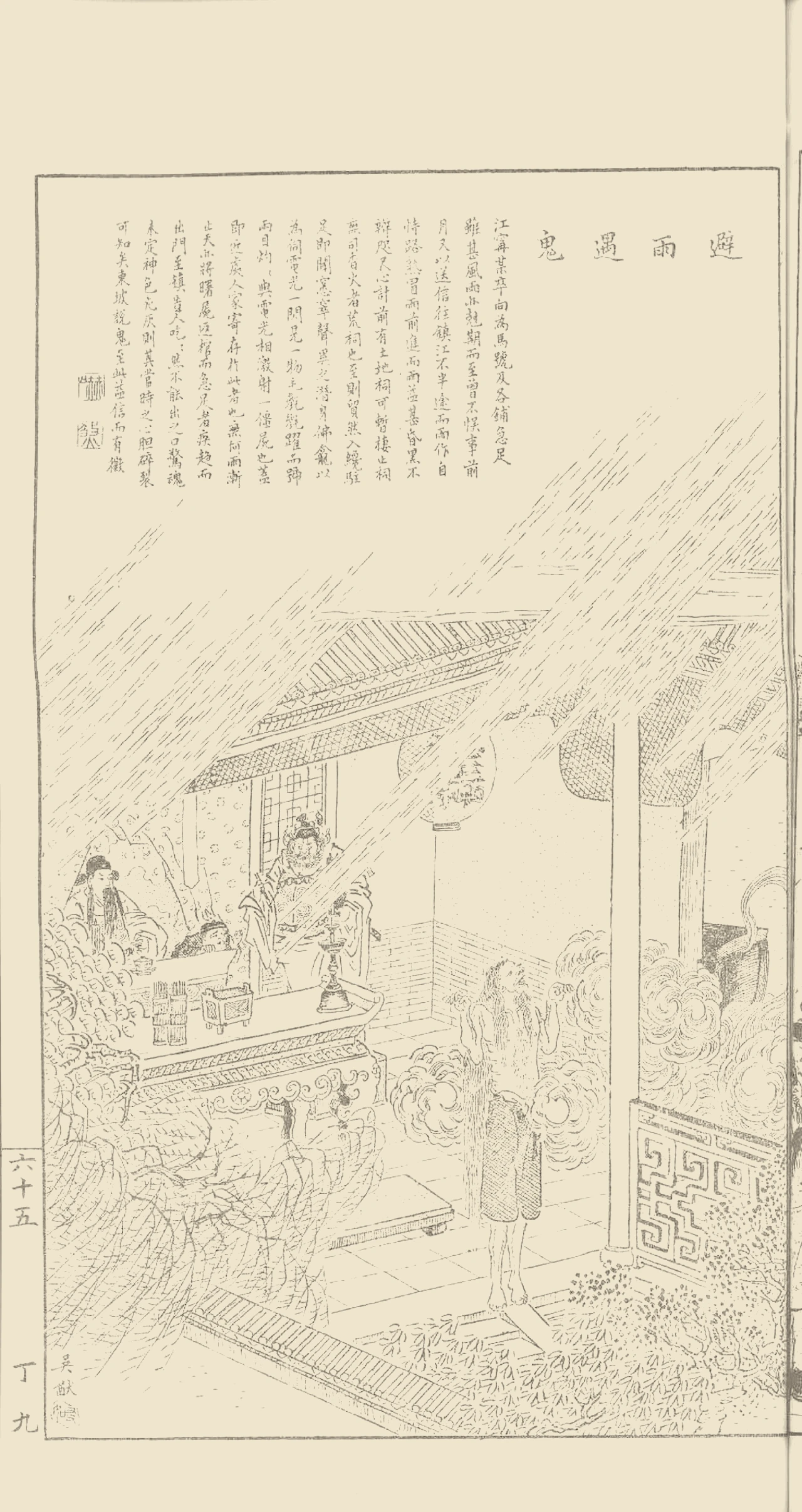
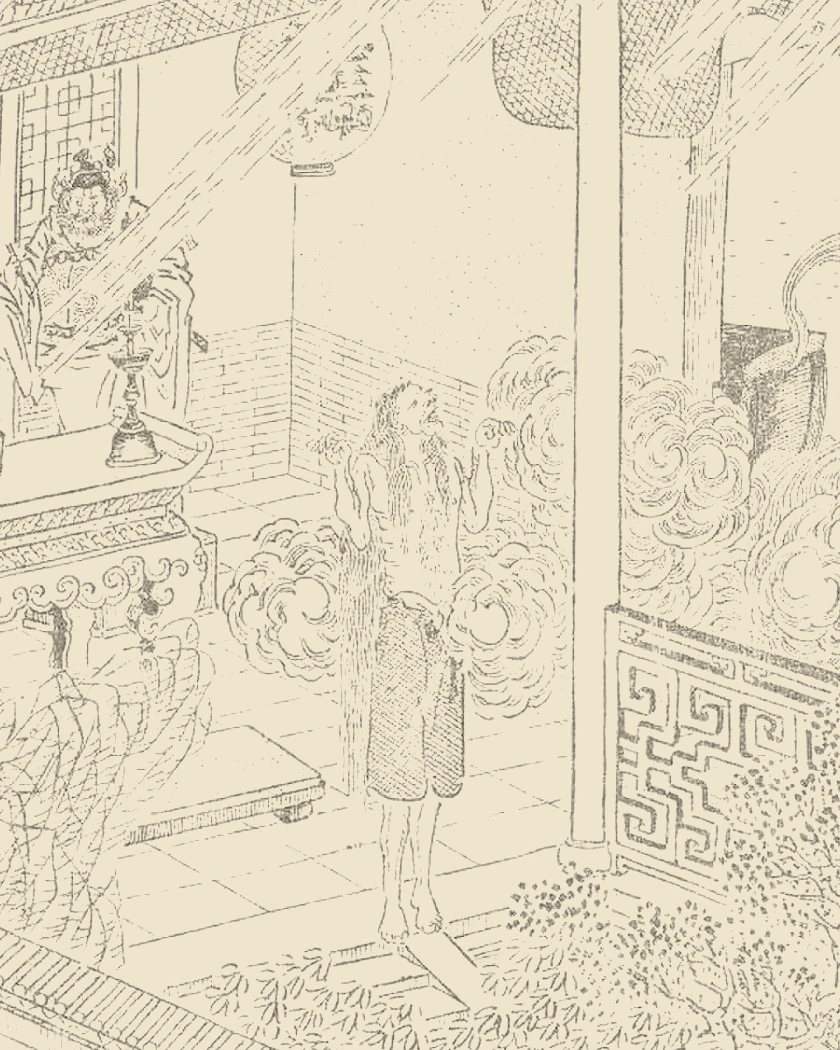
Lithograph of a hairy, long-haired corpse standing in a ruined temple in the rain, by Wu Youru, Dianshizhai Pictorial, about 1885

The Qing-official robe and hat of the films are a 20th-century addition.电影里僵尸的清代官服和官帽是20世纪才加上的。

兩目灼灼,與電光相激射,一僵屍也

Its two eyes blazed, flashing back at the lightning: it was a jiangshi.

點石齋畫報·避雨遇鬼

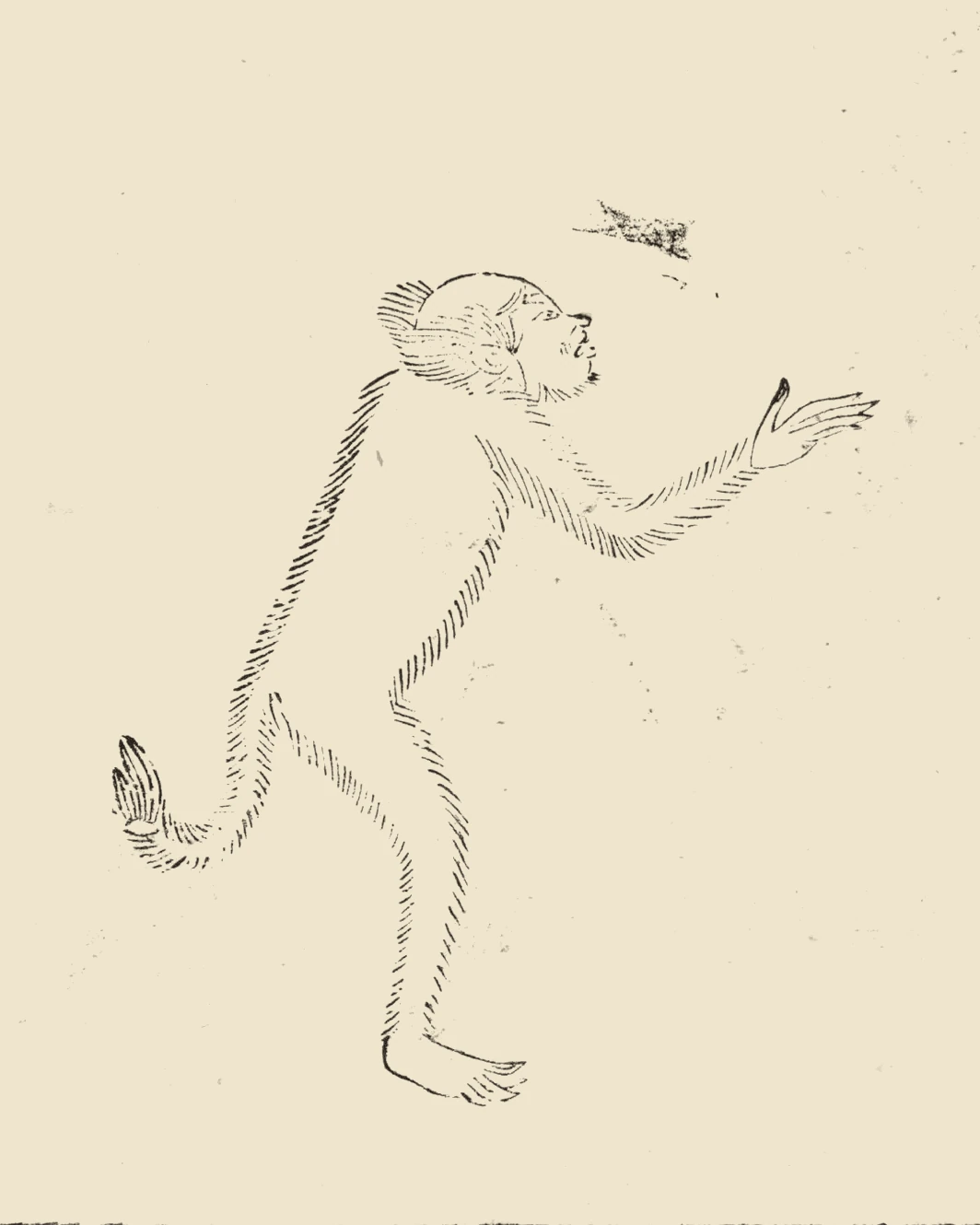
The drought demon (魃) as a hairy figure: Sancai Tuhui形如毛人的旱魃:《三才图会》 — An ape-like figure (魃) alone on a blank page, long arms reaching; no temple scene像猿的人形(旱魃)独自立在空白页上,伸出长臂;没有古庙场景

Wu Youru, “Meeting a Ghost While Sheltering from Rain” (避雨遇鬼), Dianshizhai Pictorial, c. 1885. A messenger hiding in a ruined temple sees a hairy corpse leap out of a coffin left there吴友如《避雨遇鬼》,《点石斋画报》,约1885年。送信人躲进荒废的土地祠避雨,看见寄存在祠里的灵柩中跳出一个浑身是毛的僵尸 · Public domain公有领域The drought demon (魃) in the Sancai Tuhui encyclopaedia, 1607. Ji Yun wrote that the drought demons of his day were all jiangshi《三才图会》中的旱魃,1607年。纪昀说当时所谓的旱魃都是僵尸 · Wang Qi and Wang Siyi (eds.)王圻、王思义 编, 16071607年Same design also in: 同一图样亦见于:Terajima Ryōan寺岛良安, 17121712年

Highlighted words: anatomy part · feature · form type — tap to jump标色词:形态部位 · 特征 · 形态类别,点击可跳转

The texts原文

Original Text & Translation原文与译文

閱微草堂筆記·卷十 · Ji Yun, Notes of the Thatched Abode of Close Scrutiny, vol. 10 · Wikisource

然此類皆不為祟,其為祟者曰僵屍。僵屍有二,其一新屍未斂者,忽躍起搏人﹔其一久葬不腐者,變形如魑魅,夜或出遊,逢人即攫。或曰旱魃即此,莫能詳也。
Yet bodies of this kind do no harm. The ones that do harm are called jiangshi. There are two kinds. One is a fresh corpse not yet laid in its coffin, which suddenly leaps up and seizes people. The other has been buried a long time without decaying; it changes shape until it resembles a mountain demon, sometimes roams at night, and snatches anyone it meets. Some say the drought demon is this very thing, but no one can be sure.

閱微草堂筆記·卷七 · Ji Yun, vol. 7 — the physician Hu Gongshan’s encounter · Wikisource

說少年嘗遇一僵屍,揮拳擊之,如中木石,幾為所搏,幸躍上高樹之頂,屍繞樹踴距,至曉乃抱木不動。……白毛遍體,目赤如丹砂,指如曲鉤,齒露唇外如利刃,怖幾失魂。
He said that as a young man he once met a jiangshi. He punched it, and it was like striking wood or stone; it nearly caught him. Luckily he leapt to the top of a tall tree. The corpse circled the tree, jumping and stamping, until dawn, when it clung to the trunk and stopped moving. … It was covered all over in white hair, its eyes were red as cinnabar, its fingers like hooks, its teeth stuck out past its lips like blades. He was nearly frightened out of his wits.
Note the corpse “jumping” (踴) around the tree, one of several leaping corpses in these texts. Ellipsis marks omitted lines.
Show all sources (6)展开全部出处(6)

閱微草堂筆記·卷七 · Ji Yun, vol. 7 — on the drought demon · Wikisource

近世所云旱魃則皆僵屍,掘而焚之,亦往往致雨。
The drought demons spoken of in recent times are all jiangshi; when they are dug up and burned, rain often follows.

子不語·卷十二·飛僵 · Yuan Mei, What Confucius Did Not Speak Of, vol. 12, “The Flying Jiangshi” · Wikisource

山中出一僵屍,能飛行空中,食人小兒。……法師曰:「凡僵屍最怕鈴鐺聲,爾到夜間伺其飛出,即入穴中持兩大鈴搖之,手不可住。……
A jiangshi came out of the mountains. It could fly through the air and ate the village’s small children. … The Taoist master said: “All jiangshi fear the sound of bells above everything. At night, wait until it flies out, then go into its lair with two large bells and shake them — and don’t let your hands stop.”

子不語·卷十二·兩僵屍野合 · Yuan Mei, vol. 12, “Two Jiangshi Meet in Secret” · Wikisource

素聞僵屍失棺上蓋便不能作祟……再尾之,至樓下且躍且鳴,唶唶有聲;樓上婦亦相對唶唶,以手搖拒,似訝其不應再至者。雞忽鳴,屍倒於路側。
He had always heard that a jiangshi that loses the lid of its coffin can do no more harm. … He followed it again. Beneath the window it leapt and cried out, chattering; the woman upstairs chattered back, waving it away with her hand, as if surprised it had come again. Suddenly a rooster crowed, and the corpse fell down by the roadside.
The corpse “leapt and cried out” (且躍且鳴): another Qing image of a leaping corpse, decades before the films.

子不語·卷二十二·僵屍抱韋馱 · Yuan Mei, vol. 22, “The Jiangshi That Hugged Weituo” · Wikisource

見床後厝棺砉然有聲,走出一屍,遍身白毛,如反穿銀鼠套者,面上皆滿,兩眼深黑,中有綠眼,光閃閃然,直來撲李。……僵屍伸兩臂抱韋馱神而口咬之,嗒嗒有聲。
Behind the bed, a coffin awaiting burial burst open with a crack and a corpse walked out. It was covered in white hair, as if wearing an ermine coat inside out, its face covered too; its two eyes were deep black with green pupils that glittered, and it lunged straight at Li. … The jiangshi stretched out both arms, hugged the statue of the god Weituo and bit it — clack, clack.

Comparing the Books典籍对比

Ji Yun sorts jiangshi into types and records what witnesses told him; Yuan Mei tells complete stories with a plot and a cure. In the passages quoted here, both describe a hairy, violent corpse that leaps rather than hops, and neither mentions an official’s robe or a forehead talisman.
The story来历与故事

A jiangshi is a reanimated corpse from Chinese folklore: stiff, cold, and dangerous to the living. Pop culture turned it into a hopping figure in Qing-dynasty robes with a yellow paper charm stuck to its forehead. The older ghost stories are stranger, and in some ways scarier.

What the Word Means名字的意思

A jiangshi is a “stiff corpse” that gets up and attacks the living.僵尸就是“僵硬的尸体”:它会起身袭击活人。

The word is two characters. 殭 / 僵 (jiāng) means stiff or rigid, the way a body stiffens after death. 屍 (shī) means corpse. So jiangshi is literally a “stiff corpse.” English speakers sometimes meet the word in its Cantonese form, geung si, because the best-known jiangshi films came out of Hong Kong.

The name says nothing about blood, bats or capes. It only describes a body that should be lying still and isn’t. That plainness is part of the creature’s appeal.

Put simply, a jiangshi is a dead body that gets up and moves around, usually at night, and attacks people. In classical Chinese thought a person has a higher soul (hun 魂) and a lower, more physical soul (po 魄). Writers of the Qing dynasty (1644–1912) argued about what made a corpse move. Was it the lingering po? Was it some outside evil that had taken over the body?

The scholar-official Ji Yun (紀昀, also known as Ji Xiaolan) gave one of the clearest descriptions. He said there were two kinds: a fresh corpse that had not yet been put in its coffin and suddenly leapt up to grab people, and a body buried for a long time that never decayed and turned into something like a mountain demon, coming out at night to snatch anyone it met. He then admitted he couldn’t explain how either could happen. The full passage is quoted below.

The drought demon (魃) in the Sancai Tuhui encyclopaedia, 1607. Ji Yun wrote that the drought demons of his day were all jiangshi
The drought demon (魃) in the Sancai Tuhui encyclopaedia, 1607. Ji Yun wrote that the drought demons of his day were all jiangshi《三才图会》中的旱魃,1607年。纪昀说当时所谓的旱魃都是僵尸

The Jiangshi in Qing Ghost Stories清代志怪里的僵尸

Two 18th-century story collections give us almost everything we know.我们对僵尸的了解,几乎都来自两部18世纪的志怪集。

Most of what we can read today about the jiangshi comes from two famous 18th-century collections of strange tales (zhiguai 志怪). Ji Yun’s Notes of the Thatched Abode of Close Scrutiny (閱微草堂筆記) and Yuan Mei’s What Confucius Did Not Speak Of (子不語) both have several corpse stories. Both books are long out of copyright, and full texts are on Chinese Wikisource.

Their jiangshi are surprisingly varied. One flies through the air and carries off village children. Another chases a young man up a tree and circles it, leaping and stamping, until dawn. A third is covered in white fur like a coat turned inside out, with green light in its eyes. One pair of jiangshi even meets for a secret love affair. Several of these corpses leap or jump, but none moves with the neat two-footed hop of the films. That image belongs to later folklore and, above all, to cinema.

近世所云旱魃則皆僵屍,掘而焚之,亦往往致雨。

The drought demons spoken of in recent times are all jiangshi; when they are dug up and burned, rain often follows.

— 閱微草堂筆記·卷七 · Ji Yun, vol. 7 — on the drought demon

Jiangshi vs. Vampire僵尸与吸血鬼

Both rise at night, but the jiangshi seizes with brute force and fears bells, not garlic.两者都在夜里出没,但僵尸靠蛮力扑抓,怕的是铃声而不是大蒜。

The label “Chinese vampire” stuck because the Western vampire was the nearest thing English audiences already knew. Both are corpses that come back and prey on the living, and both rise at night and retreat at dawn.

The differences are bigger, though. The classical jiangshi has no aristocratic charm and doesn’t seduce anyone. In the stories we checked, drinking blood is not its defining habit either. It grabs, crushes and bites with brute strength. In one story by Yuan Mei, a jiangshi bit a temple statue hard enough to snap the god’s weapon into three pieces. Its weaknesses also differ. There’s no garlic or crucifix. Instead the sources mention bells, the stolen coffin lid, the rooster’s crow and fire. “Hopping vampire” is a handy shorthand, but the jiangshi is really its own kind of monster.

Talismans, Bells and the Coffin Lid符、铃与棺盖

Old stories stop a jiangshi with bells, dawn and fire; the forehead talisman is a film device.古代故事用铃声、天亮和火来制服僵尸;额头贴符是电影的设计。

In films a Taoist priest stops a jiangshi by slapping a strip of yellow paper, inked with red characters, onto its forehead. While the charm stays put, the corpse freezes. These talismans (fu 符) are a real part of Taoist ritual practice, where written charms are used for protection and exorcism.

The classical tales we quote use other methods. In Yuan Mei’s “Flying Jiangshi” a Taoist tells villagers that “jiangshi fear the sound of bells above all,” and a brave man shakes two bells all night at the mouth of the creature’s lair. Another story notes the belief that a jiangshi that has lost its coffin lid can no longer do harm. So the forehead talisman is best read as the modern, cinematic form of a much older idea: a corpse can be controlled by ritual.

Why Does a Jiangshi Hop?僵尸为什么蹦跳?

The hop is mostly modern; one theory points to corpse driving in western Hunan.蹦跳大多是现代形象;有一种说法把它与湘西赶尸联系起来。

The hop is a mostly modern image, and nobody can say for sure where it started. One popular explanation points to the folk tradition of “corpse driving” (gan shi 趕屍), associated with western Hunan. In these tales, specialists were said to guide the bodies of people who had died far from home back to their native villages, moving them by night. Stiff bodies, a line of figures moving in rhythm, and a ringing bell make a natural seed for the hopping jiangshi. Treat this as a theory, though, not established history.

The Jiangshi Today今天的僵尸

The robe, talisman and hop all come from 1980s Hong Kong cinema.官服、符纸和蹦跳,全都来自20世纪80年代的香港电影。

The classic jiangshi outfit is a long dark robe with a square embroidered badge on the chest, a round hat topped with a bead and trailing a peacock-style plume, and the yellow forehead talisman. It’s essentially the court dress of a Qing-dynasty official. That fits the films, which are set in the late Qing, when the dead would have been buried in exactly these clothes.

For a convincing costume: dark robe or long changshan, a round official’s hat, pale face makeup with grey or green shading around the eyes, long fingernails, and a paper talisman. Hold your arms straight out and you have the pose. Weng Pu’s 1751 portrait of a living official shows the real Qing court dress that the costume imitates.

In film, TV & games影视与游戏中的形象

Listed by how familiar each work is to English-speaking audiences; each note says what it keeps from the Qing stories and what comes from the films.按在英语世界的知名度排列;每条说明它沿用了清代故事的什么、又有哪些来自电影。

  1. Genshin Impact — Qiqi《原神》七七 2020 · Video game电子游戏

    A playable undead herb gatherer based on the jiangshi; like most modern versions, she draws on the film-era image rather than the white-haired corpse of the Qing tales.一位可操作的不死采药少女,以僵尸为原型;和大多数现代版本一样,她借用的是电影时代的形象,而不是清代故事里浑身白毛的尸体。

    Source: Wikipedia来源:Wikipedia

  2. Darkstalkers — Hsien-Ko《恶魔战士》Hsien-Ko 1995 · Video game电子游戏

    Introduced in Night Warriors: Darkstalkers’ Revenge; Capcom based her on the jiangshi, a girl turned undead when merged with her twin sister to free their mother’s spirit.首次登场于1995年的 Night Warriors: Darkstalkers’ Revenge;卡普空以僵尸为原型,她与双胞胎姐妹合为一体、化为僵尸,为的是解救母亲的灵魂。

    Source: Wikipedia来源:Wikipedia

  3. Mr. Vampire《僵尸先生》 1985 · Hong Kong film香港电影

    The film that fixed the modern image, directed by Ricky Lau and produced by Sammo Hung, with Lam Ching-ying as the Taoist priest; its hopping, robed corpses come from cinema, not the Qing texts.确立现代僵尸形象的电影,刘观伟导演、洪金宝监制,林正英饰演道士;片中穿官服、蹦跳的僵尸来自电影,而非清代文献。

    Source: Wikipedia来源:Wikipedia

  4. Rigor Mortis《僵尸》 2013 · Hong Kong film香港电影

    Juno Mak’s darker tribute to the Mr. Vampire series, produced by Takashi Shimizu and reuniting several of its original cast.麦浚龙执导、清水崇监制,向《僵尸先生》系列致敬的黑暗风格作品,召回了多位原班演员。

    Source: Wikipedia来源:Wikipedia

  5. Encounters of the Spooky Kind《鬼打鬼》 1980 · Hong Kong film香港电影

    Sammo Hung’s earlier mix of kung fu, comedy and Taoist sorcery, named alongside Mr. Vampire as a model of the jiangshi film formula.洪金宝更早的作品,把功夫、喜剧和道术结合在一起,与《僵尸先生》并称僵尸片模式的代表。

    Source: Wikipedia来源:Wikipedia

Text only: no posters or screenshots. Facts checked against official pages and Wikipedia.仅文字介绍,不使用海报或截图;信息已对照官方页面与维基百科核实。

Record档案

Record Card档案卡

TypeUndead (reanimated corpse)
Also known asHopping vampire; Chinese vampire; geung si (Cantonese)
Also written僵屍 / 僵尸; Cantonese geung si
Appearance (classical)Covered in white hair, red or green glowing eyes, hooked fingers, teeth jutting from the lips
Appearance (modern)Qing-dynasty official’s robe and hat, arms held out, a yellow talisman on the forehead
Weaknesses (as told in the sources)The sound of bells; losing its coffin lid; dawn and the crow of the rooster; fire
Key sources閱微草堂筆記 (Ji Yun, 1789–98); 子不語 (Yuan Mei, 18th c.)
Source books閱微草堂筆記·卷十
閱微草堂筆記·卷七
閱微草堂筆記·卷七
子不語·卷十二·飛僵
子不語·卷十二·兩僵屍野合
子不語·卷二十二·僵屍抱韋馱
Image sourceWu Youru · Wikimedia Commons
LicensePublic domain

Frequently Asked Questions

Why do jiangshi hop?

Hopping is mostly a modern image made famous by 1980s Hong Kong films. Qing ghost stories do have corpses that leap and jump, and a popular theory links the hop to tales of “corpse driving” (趕屍) in western Hunan, but neither fully explains the neat two-footed hop of the films.

Is a jiangshi a vampire?

It’s often called the “Chinese hopping vampire,” but it’s a different creature. Classical jiangshi grab and bite with brute strength rather than seducing victims and drinking blood. Their weaknesses in old stories include bells, dawn and fire, not garlic or crosses.

How do you defeat a jiangshi?

In the Qing ghost stories quoted on this page, the sound of bells keeps a jiangshi at bay, a rooster’s crow at dawn makes it fall, stealing its coffin lid leaves it harmless, and in the end it is usually burned. The yellow forehead talisman that freezes it comes from 1980s Hong Kong films.

What are the best-known jiangshi movies and games?

The genre classic is Mr. Vampire (1985), directed by Ricky Lau and starring Lam Ching-ying; Rigor Mortis (2013) is a modern homage. In games, Qiqi in Genshin Impact and Hsien-Ko in Darkstalkers are both based on the jiangshi.