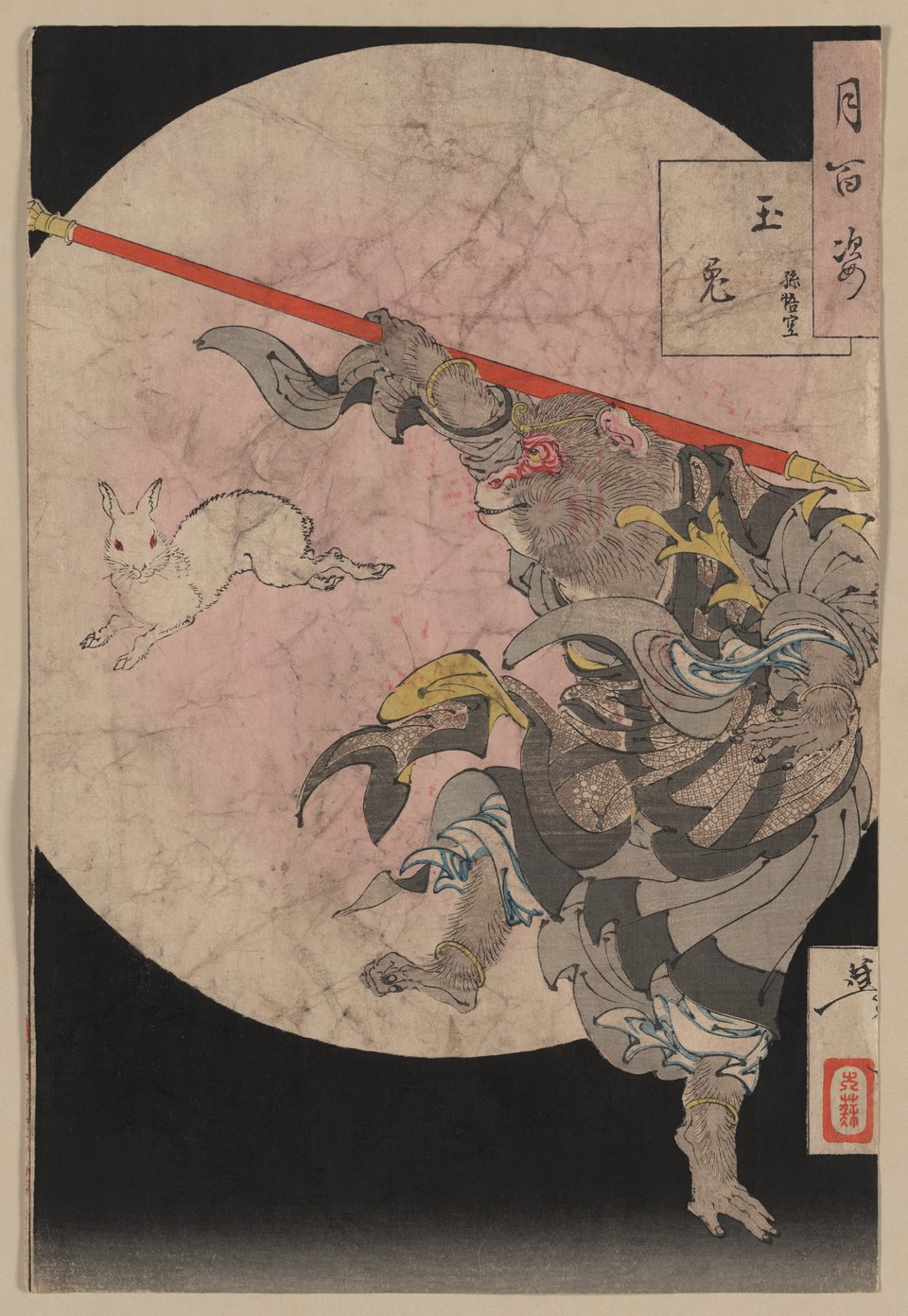
A stone-born monkey who mastered 72 transformations, rebelled against Heaven, and wields a 13,500-jin iron staff.由仙石孕育而生、精通七十二变、大闹天宫并手持一万三千五百斤如意金箍棒的齐天大圣。
Eyes眼睛
Golden eyes forged in a furnace炉中熏成的神眼
火眼金睛
Body身躯
A monkey hatched from stone仙石孕育的石猴
產一石卵……化作一個石猴
Weapon兵刃
Gold-banded staff, 13,500 jin能大能小的神铁棒
如意金箍棒,重一萬三千五百斤
Movement遁术
Somersault cloud, 108,000 li一个筋斗十万八千里
一觔斗就有十萬八千里路
大聖
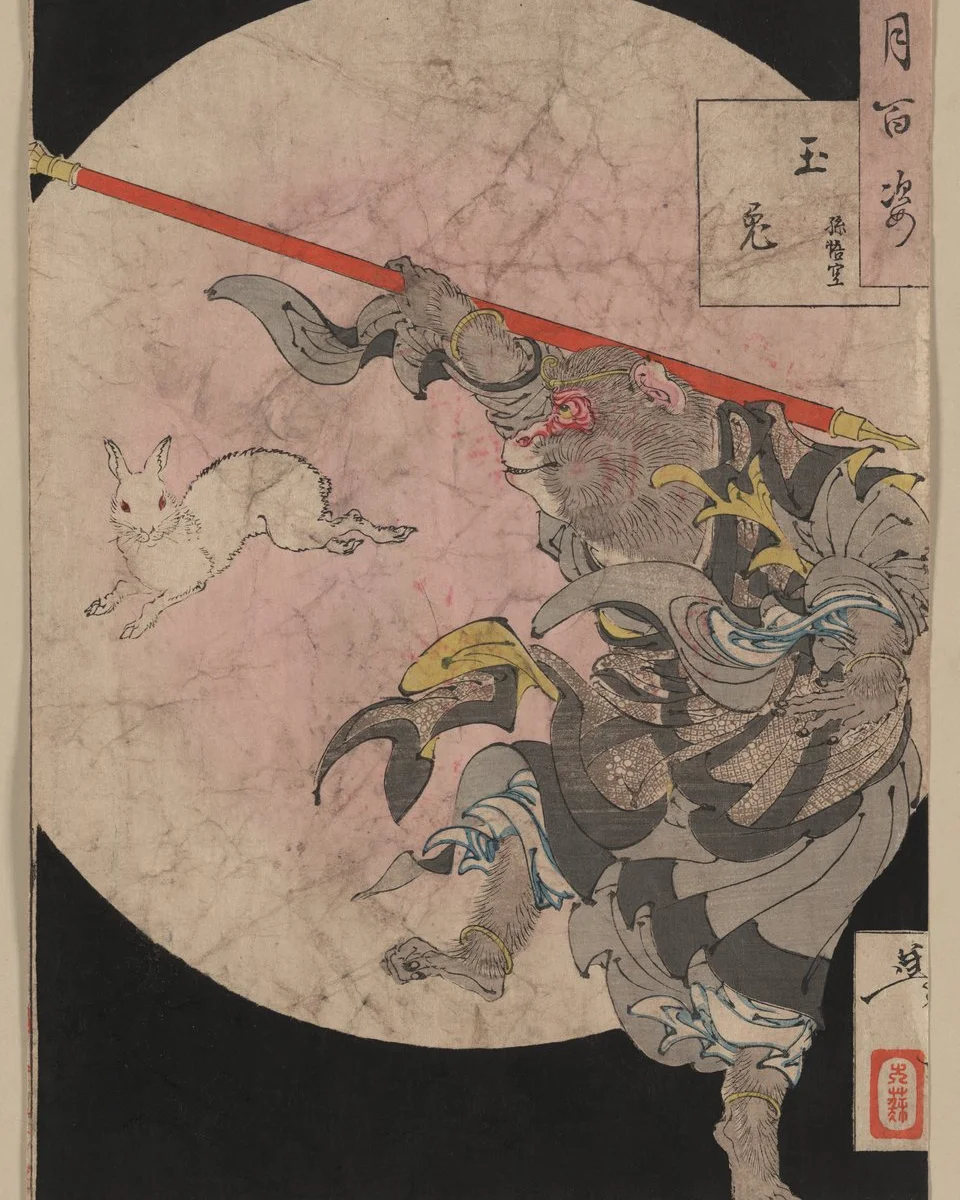
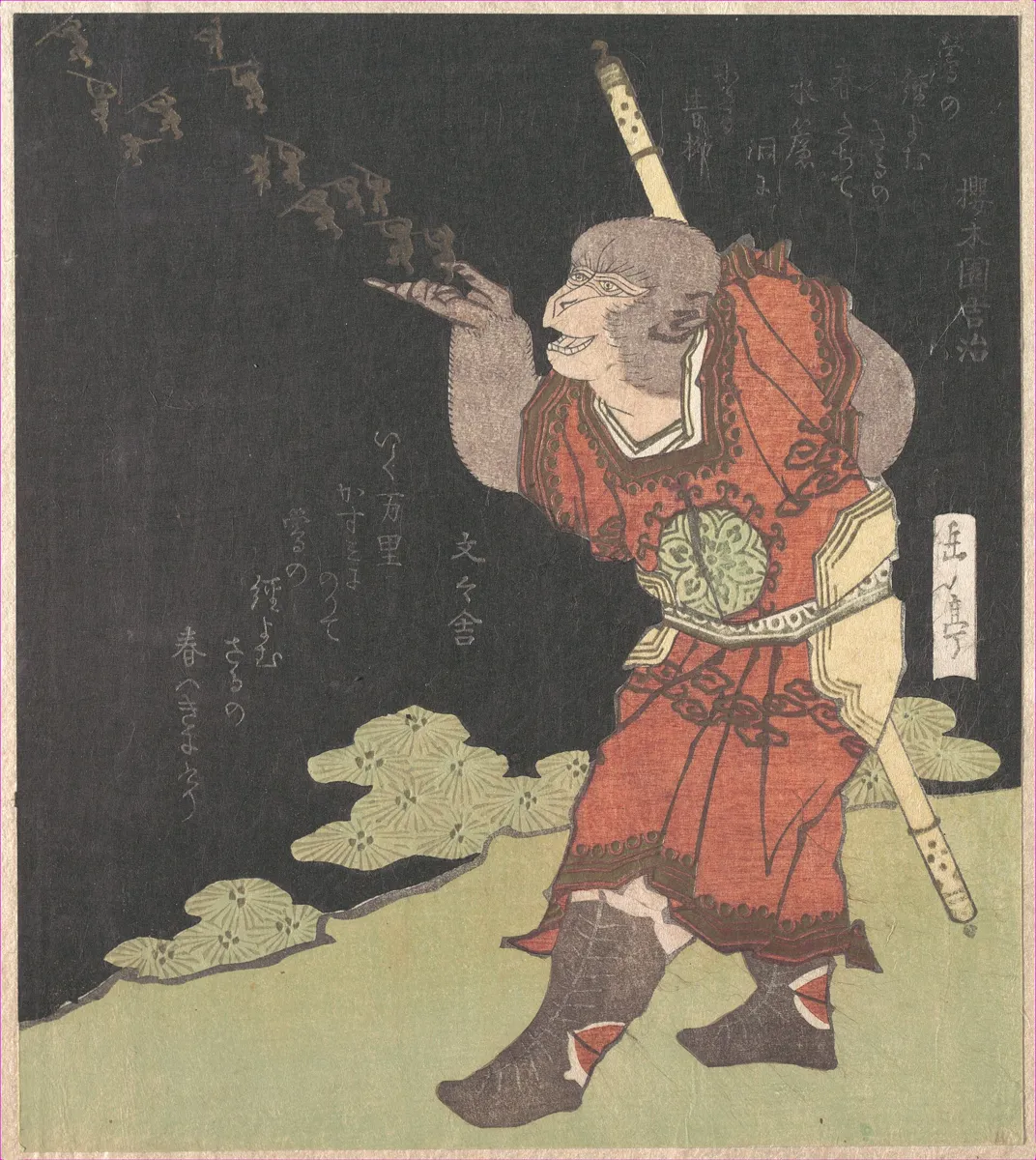
Not drawn in this image:此图未画:身外身Hair clones拔毫毛嚼碎变小猴 · 步雲履Cloud-walking boots东海龙王所献步云履In Yoshitoshi’s print above, the Monkey King leaps before the full moon; his staff and golden headband are drawn. The hair clones and cloud-walking boots are not in this print; Gakutei’s 1824 surimono (thumbnails above the image) shows the hair clones.上方月冈芳年的版画中,美猴王跃于满月之前,画出了金箍棒和金箍;身外身和步云履不在这幅画里,八岛岳亭1824年的版画(见主图上方的小图)画出了身外身。
目運兩道金光,射沖斗府
From its eyes shot two beams of golden light that pierced the palace of the Pole Star.
Hokusai: Wukong wielding his staff北斋:挥舞金箍棒的悟空 — A pale figure alone on a black ground, swinging the staff; no moon or rabbit黑底上独自一个浅色人物,双手挥舞金箍棒;没有明月和玉兔
Gakutei: the Monkey King in a red robe岳亭:身着红袍的美猴王 — In a red robe, staff on his back, blowing hairs that become clones (身外身)身穿红袍,金箍棒斜背身后,吹毫毛化作身外身;没有明月和玉兔
Shunman: surimono of Son Gokū春满:悟空摺物 — Riding a cloud with the staff (如意金箍棒) held behind him驾着云,金箍棒横在身后
Book illustration: led to the Jade Emperor读本插图:被引见玉帝 — A small figure in a full court scene; staff and headband (金箍) are barely visible在完整的宫廷场景里只是一个小人物,金箍棒和金箍几乎看不清
Book illustration: drilling his monkey army读本插图:操练猴兵 — A small figure among his monkey army; the costume details are not the focus在猴兵中只是一个小人物,服饰细节不是重点
Taito II: blowing away his hairs二代戴斗:吹毫毛变化 — Hair clones (身外身) shown as tiny figures flying from his breath, inside a round frame身外身画成从他口中吹出、飞散的小身影,画面是圆形构图
Kuniyoshi: an army of monkeys from his fur国芳:拔毛变出猴群 — Hair clones (身外身) shown springing out as a separate little monkey; green costume身外身画成一只单独跳出的小猴;身穿绿衣
Roshū: surimono of the Monkey King卢洲:美猴王摺物 — No staff: he dances on a fence with a fan, wearing a hat没有金箍棒:他戴着帽子、拿着扇子在栏杆上起舞
Tsukioka Yoshitoshi, “Jade Rabbit – Sun Wukong,” from One Hundred Aspects of the Moon (c. 1885–90). The Monkey King leaps before the moon with his staff月冈芳年《月百姿·玉兔·孙悟空》(约1885–90年):美猴王手持如意金箍棒,与玉兔一同跃于明月之前 · Public domain公有领域Katsushika Hokusai, Sun Wukong wielding his staff, 19th century葛饰北斋《孙悟空挥棒图》,19世纪 · Katsushika Hokusai葛饰北斋, 19th century19世纪Yashima Gakutei, The Monkey King Songokū, probably 1824. Metropolitan Museum of Art八岛岳亭《孙悟空》,约1824年,大都会艺术博物馆藏 · Yashima Gakutei八岛岳亭, c. 1824约1824年Kubo Shunman, Son Gokū, 1812. Library of Congress窪俊满《孙悟空》,1812年,美国国会图书馆藏 · Kubo Shunman洼俊满, 18121812年Ōhara Tōya, Taibai Jinxing leads Wukong to the Jade Emperor, from Ehon Saiyūki, 1828大原东野《太白率悟空谒玉帝》,出自《绘本西游记》,1828年 · Ōhara Tōya大原东野, 18281828年Ōhara Tōya, Wukong returns to the Water Curtain Cave and drills his army, from Ehon Saiyūki, 1828大原东野《悟空归帘洞为军防》,出自《绘本西游记》,1828年 · Ōhara Tōya大原东野, 18281828年Katsushika Taito II, The Monkey King blows away his hairs, 1836. Rijksmuseum二代葛饰戴斗《猴王吹毛》,1836年,荷兰国家博物馆藏 · Katsushika Taito II二代葛饰戴斗, 18361836年Utagawa Kuniyoshi, Monkey: Sun Wukong conjures an army of monkeys from his fur, c. 1840. British Museum歌川国芳《申》:孙悟空拔毛变出猴兵,约1840年,大英博物馆藏 · Utagawa Kuniyoshi歌川国芳, c. 1840约1840年Kinoshita Roshū, Monkey Songokū, surimono, 19th century. LACMA木下芦洲《猴子悟空》,摺物版画,19世纪,洛杉矶郡艺术博物馆藏 · Kinoshita Roshū木下芦洲, 19th century19世纪
Highlighted words: anatomy part · feature · form type — tap to jump标色词:形态部位 · 特征 · 形态类别,点击可跳转
The texts原文
Original Text & Translation原文与译文
西遊記·第一回 · Chapter 1 — the stone monkey is born · Wikisource
Inside it an immortal embryo was nurtured. One day it burst open and produced a stone egg about the size of a ball. Exposed to the wind, it turned into a stone monkey, complete with all five senses and four limbs. At once it learned to crawl and walk and bowed to the four directions. From its eyes shot two beams of golden light that pierced the palace of the Pole Star.
西遊記·第一回 · Chapter 1 — the Handsome Monkey King · Wikisource
自此,石猿高登王位,將「石」字兒隱了,遂稱「美猴王」。
From then on the stone monkey ascended the throne. He dropped the word “stone” and called himself the “Handsome Monkey King.”
Show all sources (8)展开全部出处(8)
西遊記·第二回 · Chapter 2 — the 72 transformations · Wikisource
The Patriarch said: “Very well, which do you want to learn? There is the Heavenly Ladle set, with thirty-six transformations, and the Earthly Multitude set, with seventy-two.” Wukong said: “Your disciple would rather grab the bigger share — let me learn the Earthly Multitude transformations.”
西遊記·第二回 · Chapter 2 — the somersault cloud · Wikisource
這朵雲,捻著訣,念動真言,攢緊了拳,將身一抖,跳將起來,一觔斗就有十萬八千里路哩。
For this cloud you make the hand-sign, recite the true words, clench your fists, give your body a shake and leap — and a single somersault carries you a hundred and eight thousand li.
It turned out there was a golden band at each end, with a length of black iron between. Right beside the bands a line of characters was engraved: “As-You-Will Gold-Banded Staff, weight 13,500 jin.”
西遊記·第四回 · Chapter 4 — Great Sage Equal to Heaven · Wikisource
He ordered his four generals: “Quickly make me a banner with the four big characters ‘Great Sage Equal to Heaven’ and hoist it on a pole. From now on call me only the Great Sage Equal to Heaven — no more ‘Great King.’”
西遊記·第七回 · Chapter 7 — the Buddha’s palm · Wikisource
The Great Sage opened wide his fiery golden eyes and looked down: there on the middle finger of the Buddha’s right hand was written “The Great Sage Equal to Heaven was here.” … The Buddha flipped his palm over and pushed the Monkey King out through the West Gate of Heaven, turning his five fingers into five linked mountains of metal, wood, water, fire and earth, named the Five Elements Mountain, and pinned him gently beneath it.
When Sanzang saw him put on the cap, he stopped eating his dry rations and silently recited the Tight-Fillet Spell once. The Pilgrim cried, “My head hurts! My head hurts!” … He reached up and felt his head: something like a golden thread was clamped tight around it. He couldn’t pull it off or snap it — it had already taken root.
Comparing the Books典籍对比
Chapters 1–7 chronicle Sun Wukong’s rise and defiance as an indomitable trickster hero battling celestial hierarchy, while Chapter 14 marks his transition into a Buddhist disciple disciplined by the curbing circlet. Across the novel, his journey moves from the pursuit of personal immortality to spiritual enlightenment and the protection of others.
The story来历与故事
Sun Wukong is the stone-born Monkey King at the heart of Journey to the West, one of the four great classical novels of Chinese literature. After mastering Taoist arts and crowning himself “Great Sage Equal to Heaven,” he fights the celestial army to a standstill, is imprisoned under a mountain by the Buddha, and five centuries later earns redemption by escorting the monk Tang Sanzang on a sacred pilgrimage to India.
Origins: Born from Stone石猴出世
Born from a magic stone, Wukong mastered Taoist arts to escape mortality.仙石孕育而生,为求长生跨海学道,得名悟空。
The novel opens with Sun Wukong’s miraculous birth. Atop the Mountain of Flowers and Fruit, a magic stone nurtured by the pure energies of heaven, earth, sun and moon bursts open, producing a stone egg that transforms into a monkey. The moment he opens his eyes, two beams of golden light shoot upward and pierce the palace of the Jade Emperor.
He wins the loyalty of the island’s primates by bravely leaping through a roaring waterfall to discover the Water Curtain Cave. Fearing that death will eventually end his carefree paradise, the monkey departs on a wooden raft across the oceans to seek the secret of eternal life. A Taoist patriarch takes him as a disciple and grants him his formal name: Wukong (悟空), meaning “awakened to emptiness.”
The title “Monkey King” translates the classical Chinese Měihóuwáng (美猴王), literally the “Handsome Monkey King.” After finding the Water Curtain Cave, the young stone monkey takes the throne, drops the word “stone” from his title, and adopts the royal moniker. In English editions, Arthur Waley’s landmark 1942 translation popularized the shortened name Monkey.
Yashima Gakutei, The Monkey King Songokū, probably 1824. Metropolitan Museum of Art八岛岳亭《孙悟空》,约1824年,大都会艺术博物馆藏
Powers, Staff & Headband神通、神兵与金箍
72 transformations, the 13,500-jin staff, and the golden headband that controls him.身兼七十二变、手持万三千斤神铁,唯有金箍能约束其心。
Patriarch Subodhi offers Wukong a choice between two magical curricula: the 36 Heavenly Ladle transformations or the 72 Earthly Multitude transformations. Wukong eagerly chooses the larger number, mastering all 72 transformations. When his teacher notices his clumsy flying, he instructs him in the somersault cloud (觔斗雲), allowing a single somersault to span 108,000 li across the sky.
Wukong multiplies his powers through heavenly exploits. Gorging on Queen Mother’s peaches of immortality, stealing Laozi’s divine elixir pills, and drinking imperial wine make his body invulnerable to blade and thunderbolt. When Laozi attempts to smelt him in the Eight Trigrams Furnace, the smoke refines his eyes into the fiery golden eyes (火眼金睛), granting him the vision to pierce any demonic illusion.
Wukong’s primary weapon is the Ruyi Jingu Bang (如意金箍棒), the “As-You-Will Gold-Banded Staff.” Searching for a weapon worthy of his might, he storms the crystal palace of the Dragon King of the Eastern Sea. Finding standard swords and halberds far too light, he is guided to an ancient iron pillar used by Yu the Great to measure ocean depths.
The iron pillar shrinks at Wukong’s command. Engraved beside its golden bands are the words: “As-You-Will Gold-Banded Staff, weight 13,500 jin.” In battle, it expands to crush entire armies or shrinks to an embroidery needle tucked discreetly behind his ear, ready to be summoned in an instant.
The golden headband (緊箍, the “tight fillet”) is placed on Wukong in Chapter 14. To discipline his fiery, violent temper, the bodhisattva Guanyin presents Tang Sanzang with a brocade cap concealing a golden band, alongside the secret Tight-Fillet Spell. When Wukong dons the cap, the band binds to his skull, and the monk’s recitation causes unbearable cranial agony.
The band cannot be pried off or cut; it yields only to spiritual obedience. Classical commentators read the headband as an explicit Buddhist metaphor: the untamed “monkey of the mind” (心猿) bound by ethical discipline. Only when the pilgrimage concludes and Wukong achieves Buddhahood does the band naturally dissolve.
自此,石猿高登王位,將「石」字兒隱了,遂稱「美猴王」。
From then on the stone monkey ascended the throne. He dropped the word “stone” and called himself the “Handsome Monkey King.”
— 西遊記·第一回 · Chapter 1 — the Handsome Monkey King
Havoc in Heaven & The Mountain大闹天宫与五行山
He fought Heaven to a draw until trapped by the Buddha beneath the Five Elements Mountain.自号齐天大圣勇战诸神,终被如来佛祖镇压于五行山下五百年。
Readers often ask whether Sun Wukong is a god, a demon, or a mortal animal. In the novel’s cosmology, he traverses every category. He begins as a mortal stone monkey who attains Taoist immortality. Heaven first attempts to placate him with an imperial posting as the Protector of the Horses (弼馬溫), but insulted by the lowly station, Wukong proclaims himself the Great Sage Equal to Heaven (齊天大聖).
At the climax of the pilgrimage, the Buddha bestows upon Wukong the rank of the Victorious Fighting Buddha (鬥戰勝佛). In southern Chinese and Southeast Asian folk religion, he transcended fiction to become a revered protective deity, worshipped in folk temples as the Great Sage.
During his rebellion, Wukong matches the greatest warriors in Heaven. The celestial marshal Erlang Shen fights him to a standstill in an epic duel of transformations, capturing him only after Laozi drops a diamond snare from the clouds and Erlang’s celestial hound bites his leg.
When Wukong escapes Laozi’s furnace and wrecks the celestial palaces, the Buddha wagers that Wukong cannot leap from his right hand. Wukong somersaults to five pink pillars at the edge of the cosmos, scrawls “The Great Sage Equal to Heaven was here,” and urinates on one. The pillars turn out to be the Buddha’s fingers; the Buddha turns his hand into the Five Elements Mountain, pinning the monkey for five hundred years.
The Pilgrimage to the West西天取经之路
Freed by Tang Sanzang, he led the disciples through 81 trials to achieve Buddhahood.受唐僧救拔护持西行,历经八十一难终成斗战胜佛。
Chapters 8 through 12 lay the spiritual foundation of the pilgrimage: Tang Sanzang is dispatched by Emperor Taizong of Tang to retrieve authentic Mahayana scriptures from the Western Heaven. In Chapter 14, Sanzang removes the divine seal atop the mountain, liberating Wukong to become his eldest disciple and principal protector.
Joined by the gluttonous Zhu Bajie (Pigsy), the loyal sand-monk Sha Wujing (Sandy), and the Dragon Prince transformed into a white steed, the four pilgrims face 81 tribulations. Throughout the road, Wukong relies on wit and transformation as much as brute force, enlisting Guanyin and heavenly deities to conquer demons bearing stolen celestial treasures.
The Monkey King Today今天的孙悟空
From Dragon Ball’s Goku to Black Myth: Wukong, he remains a global cultural icon.从《七龙珠》的孙悟空到《黑神话:悟空》,他始终是影响世界的中国神话代表。
Today, Sun Wukong stands among the most instantly recognized mythological figures worldwide. While countless film, television and gaming adaptations have popularized his image, the original Journey to the West remains richer, funnier, and more philosophically profound than any spin-off.
Whether seen as a rebel against rigid authority, a symbol of self-mastery, or an immortal folk hero, Sun Wukong continues to inspire readers and creators across continents.
In film, TV & games影视与游戏中的形象
Listed by how familiar each work is to English-speaking audiences; each note says what it keeps from Journey to the West and what it changes.按在英语世界的知名度排列;每条说明它沿用了《西游记》原著的什么、又有哪些再创作。
Akira Toriyama borrowed Wukong’s name (the Japanese reading Son Gokū), monkey tail, flying cloud and extending staff, reimagining him as a kind-hearted Saiyan martial artist defending Earth.鸟山明借用了孙悟空的日语读音、猴尾巴、飞云与如意棒,但将他重新设定为保卫地球、心地善良的赛亚人武道家。
Game Science’s hit action RPG; players control “the Destined One,” a monkey warrior retracing the fallen Monkey King’s footsteps, weaving novel lore into a darker, soulslike setting.游戏科学开发的现象级动作角色扮演游戏;玩家扮演“天命人”重走西游故地,将原著典故与暗黑神话题材融为一体。
Broadcast in the West by the BBC with English dubbing, this cult classic introduced millions of English-speaking viewers to the Monkey King through comedy and martial arts.经英国BBC配音播出后风靡英联邦国家,以诙谐奇幻与武打场面让数以百万计的西方观众第一次认识了“Monkey”(美猴王)。
Directed by Yang Jie with Liu Xiao Ling Tong as Wukong; the definitive screen portrayal for generations of Chinese viewers, softening the book’s satire into a heroic adventure.杨洁导演、六小龄童主演的经典电视剧;几代中国观众心目中最权威的齐天大圣荧屏形象,将原著的讽刺寓意转化为充满人情味的正义传奇。
Directed by Wan Laiming at Shanghai Animation Film Studio; adapts chapters 1–7 with Peking opera face paint and music, omitting Wukong’s defeat to end in triumph.上海美术电影制片厂万籁鸣导演的传世名作;融合京剧脸谱与锣鼓器乐改编前七回,略去了被压五行山的结局,定格在胜利凯旋花果山。
Source: Wikipedia来源:Wikipedia
Text only: no posters or screenshots. Facts checked against official pages and Wikipedia.仅文字介绍,不使用海报或截图;信息已对照官方页面与维基百科核实。
Record档案
Record Card档案卡
Type
Hero / Deity (immortal stone monkey)
Also known as
The Monkey King (美猴王); Great Sage Equal to Heaven (齊天大聖); Pilgrim Sun (孫行者)
Origin
Born from a magic stone on the Mountain of Flowers and Fruit (花果山)
Weapon
如意金箍棒, the As-You-Will Gold-Banded Staff, 13,500 jin
Sun Wukong is the Monkey King, the stone-born mythological hero and trickster of the 16th-century Chinese epic novel Journey to the West. After mastering Taoist arts and rebelling against Heaven, he is trapped beneath a mountain by the Buddha and later freed to escort the monk Tang Sanzang on a sacred pilgrimage to India.
What are Sun Wukong’s powers?
His core skills include 72 transformations, leaping 108,000 li across the sky in a single leap, refined golden vision that detects demons through any disguise, hair clones created by chewing and blowing his fur, and invulnerability after eating heavenly peaches and Laozi’s elixir.
What is Sun Wukong’s staff called?
His weapon is the miraculous iron staff, famously known as the “As-You-Will Gold-Hooped Rod.” Originally an ancient measuring rod used by Yu the Great to calm ocean waters, it weighs 13,500 jin (about 8 tonnes) and can shrink to the size of a needle or grow to pierce the heavens.
Which games and shows feature Sun Wukong?
Well-known examples include Goku in Dragon Ball (whose cloud and extending staff directly adapt Wukong), Game Science’s Black Myth: Wukong (2024), the BBC-dubbed cult TV classic Monkey (1978), the beloved 1986 Chinese TV series, and the animated masterpiece Havoc in Heaven (1964).